Space Shuttle
Overview
The space shuttle was the world's first reusable spacecraft. From 1981 to 2011, NASA launched five orbiters—Atlantis, Challenger, Columbia, Discovery, and Endeavor—across 135 missions, after years of testing with the Enterprise prototype shuttle. These missions included deploying and servicing the Hubble Space Telescope and delivering major payloads for the International Space Station's assembly.
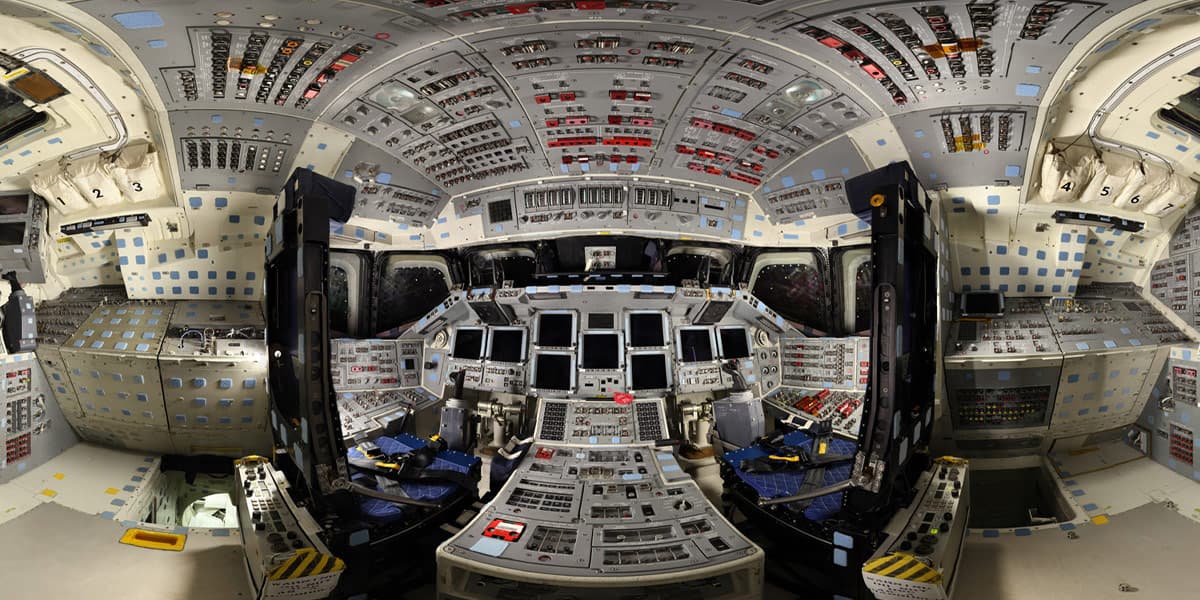
The Space Shuttle program—officially known as the Space Transportation System—received presidential approval in 1972. The entire vehicle consisted of the orbiter, two reusable solid rocket boosters that provided lift alongside the shuttle's three main engines, and the external tank, which supplied fuel for the engines and burned up in the atmosphere after launch. Each orbiter included a flight deck, the crew's living quarters, and a payload bay supported by Canadarm, a mechanical arm that could move cargo.
Throughout its rocket launch, orbital flight, and unpowered glide back to Earth's surface, the space shuttle relied on cutting-edge communication, navigation, and thermal protection systems, enabling it to carry payloads of up to 27,500 kilograms (60,600 pounds) at speeds of up to 28,000 kilometers (17,400 miles) per hour. However, high maintenance costs and safety concerns following the Challenger and Columbia disasters led to the fleet's retirement after the ISS was built.
1440 Findings
Hours of research by our editors, distilled into minutes of clarity.



Explore Science & Technology
Dive into the dynamic world of science and technology, where curiosity has brought about extraordinary understandings of the universe and creativity has led to the breakthroughs and innovations that have transformed our world. Explore a wide range of topics, from the natural and physical sciences to cutting-edge technologies and the people who shaped them, each of which is accompanied by carefully curated resources meant to inform, engage, and inspire those eager to uncover the nature of reality.
Featured Topics
- 3D Printing
- Algae
- Algorithms
- Asteroids
- Atoms
- Auroras
- Batteries
- Big Bang
- Bill Nye
- Biofluorescence
- Biological Cells
- Bioluminescence
- Bioremediation
- Biosphere 2
- Black Holes
- Calculators
- Chaos Theory
- Climatology
- Comets
- Computer Viruses
- Coral Reefs
- Critical Minerals
- Crude Oil
- Cryptography
- Dark Energy
- Dark Matter
- Dark Web
- Data Centers
- David Attenborough
- Deep-Sea Mining
- Deepfakes
- Dinosaurs
- DNA
- Earth
- Earth's Atmosphere
- Earthquakes
- Eclipses
- El Niño-Southern Oscillation
- Electric Grids
- Electric Vehicles
- Electricity
- Environmental Protection Agency
- Evolution
- Extremophiles
- Fireworks
- Fracking
- General Relativity
- Generative AI
- Geothermal Power
- Grace Hopper
- Graphics Processing Unit
- Greenhouse Gases
- Helium
- Hubble Space Telescope
- Hurricanes
- International Space Station
- Internet
- Invasive Species
- James Webb Space Telescope
- Jane Goodall
- Jupiter
- Keystone Species
- Large Hadron Collider
- Large Language Models
- Lasers
- Light
- Lightning
- LIGO
- Marie Curie
- Mars
- Memory
- Microchips
- Microplastics
- Mixed Reality
- Molecular Gastronomy
- Nancy Roman
- NASA
- National Science Foundation
- Neptune
- Neutron Stars
- Nikola Tesla
- Nobel Prize
- Nuclear Power
- Oceans
- Particle Accelerators
- Photosynthesis
- Plate Tectonics
- Pollinators
- Pontifical Academy of Sciences
- Quantum Computing
- Quantum Field Theory
- Quantum Mechanics
- Radioactivity
- Rosalind Franklin
- Scientific Theory
- Self-Driving Cars
- Smart Cities
- Solar Power
- Sound
- Space Shuttle
- Space Tourism
- Space Trash
- Special Relativity
- Standard Model
- Stephen Hawking
- Sun
- Tardigrades
- Tesla
- Time
- Tornadoes
- Tsunamis
- Turbulence
- Viking Project
- Volcanoes
- Voyager Mission
- Water
- White Dwarfs
- Wikipedia
- Wind Power