Batteries
Overview
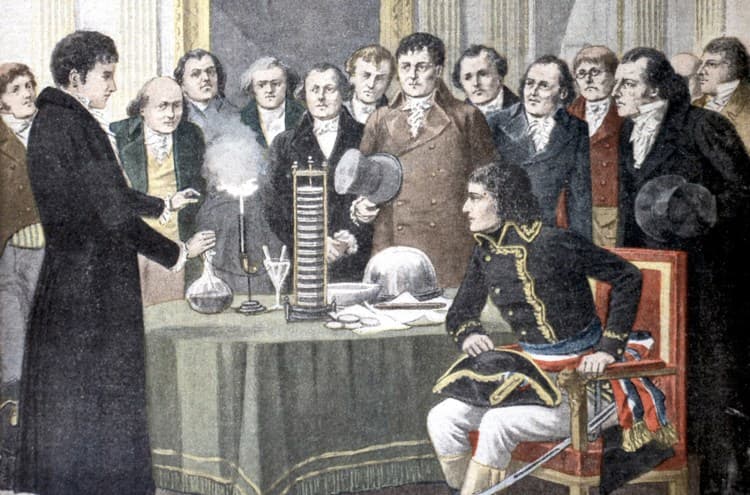
Batteries are devices that provide electrical energy stored as chemical energy. The first electrochemical cell was invented in 1799 by Alessandro Volta, who generated electricity after stacking plates of copper and zinc separated by saltwater-soaked cloth. In his honor, electrical potential is measured in volts, the units seen on the billions of batteries sold each year.
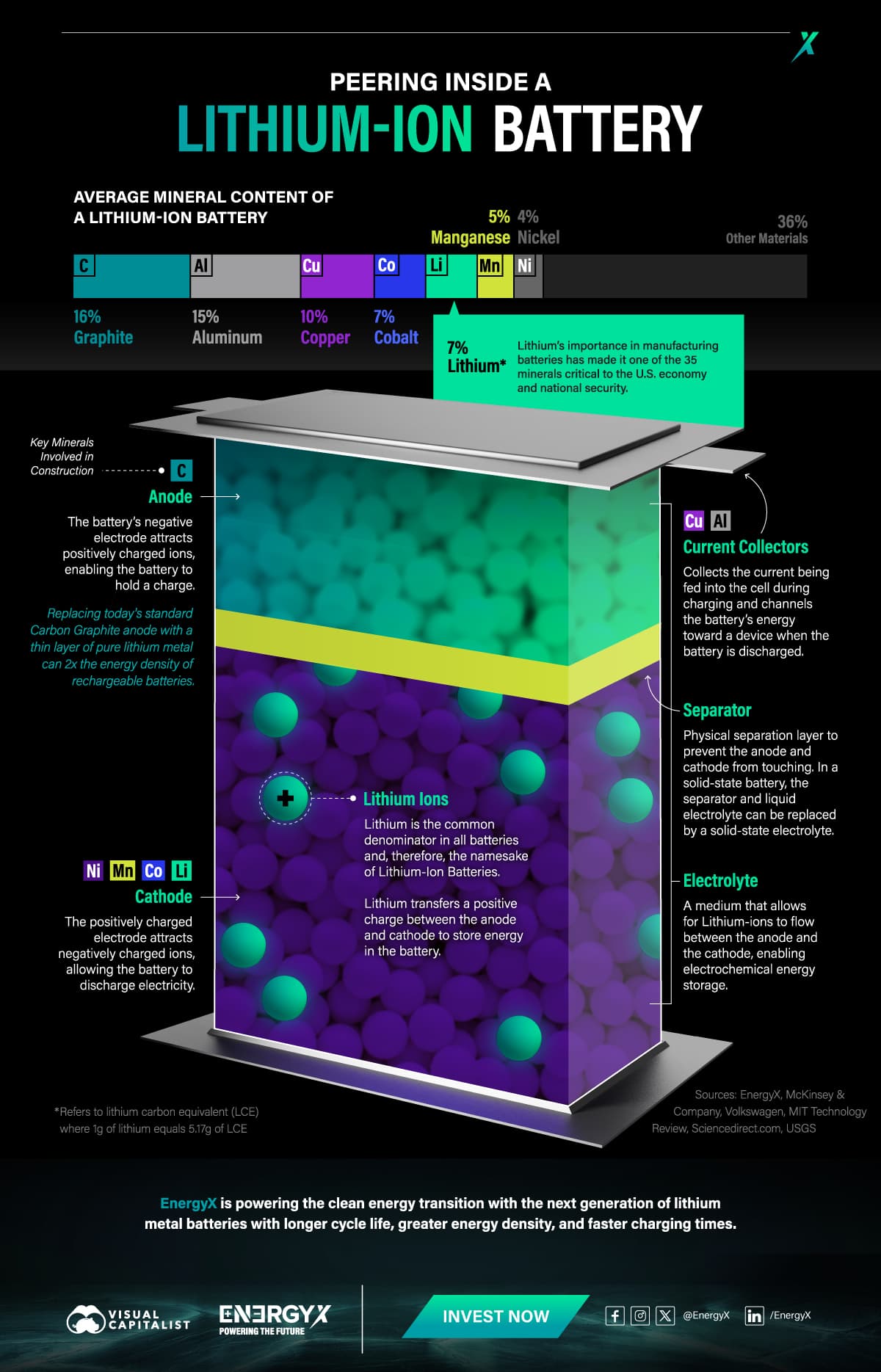
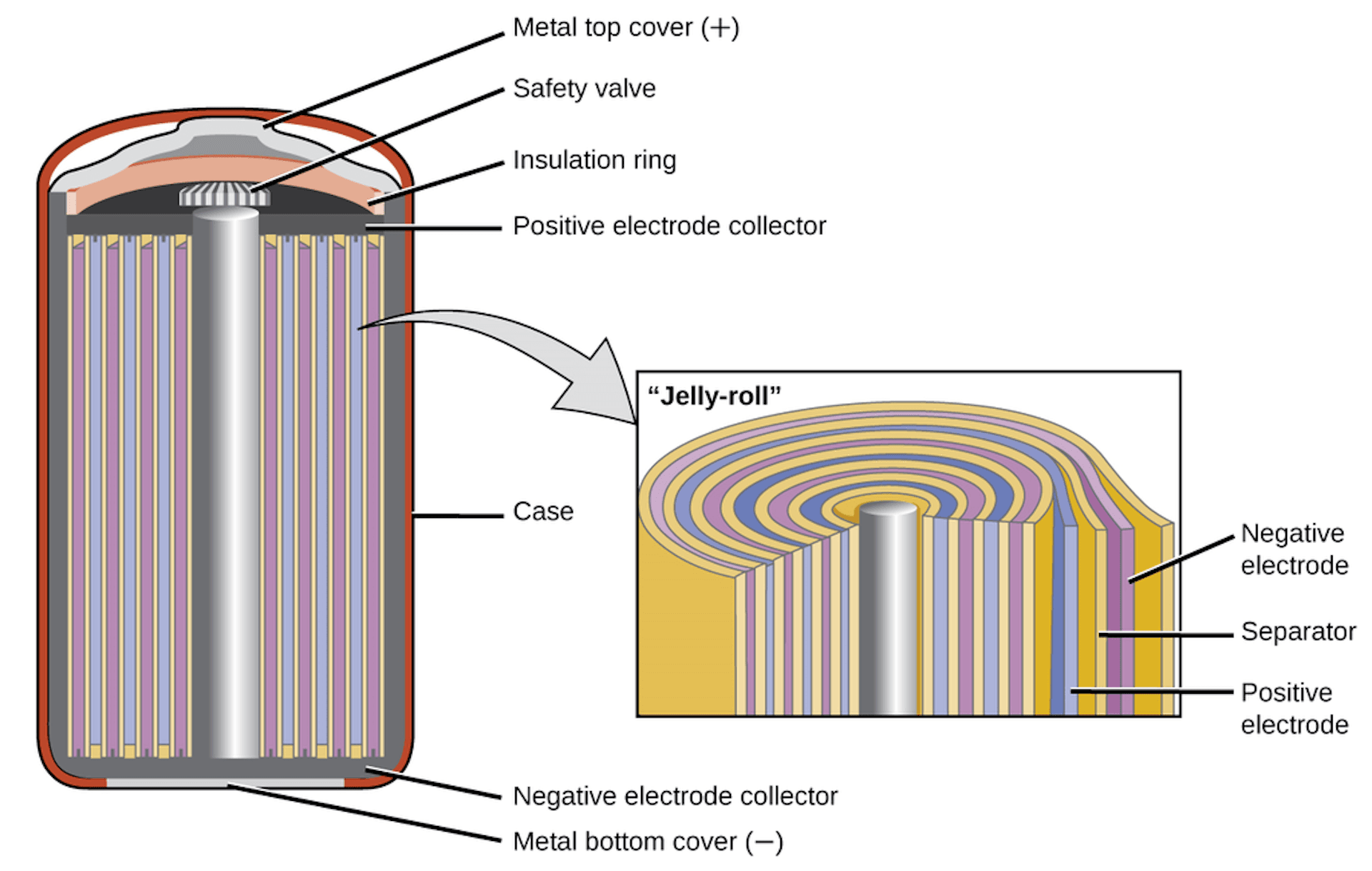
Every battery consists of three components: an anode, a cathode, and an electrolyte barrier separating them. When the cathode and anode are connected in a circuit, chemical reactions produce energetic electrons that flow from the anode (negative end of the battery) to the cathode (positive end). This flow is the electricity that powers devices connected to the circuit.
To offset the buildup of charge from the displaced electrons, ions produced in the reactions move between the anode and cathode through the electrolyte. The electrical current continues until there is insufficient material left in the anode to undergo a chemical reaction. If a battery is rechargeable, an external voltage can reverse the flows and restore the chemical reservoirs.
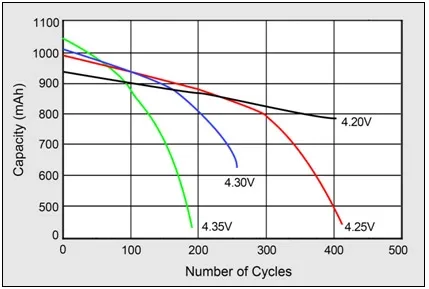
Despite battery management software in many devices, several factors reduce battery capacity with each charge cycle. All batteries eventually discharge too quickly and must be replaced, but the diversity of elements they incorporate and their nonuniform designs have made widespread recycling challenging.
1440 Findings
Hours of research by our editors, distilled into minutes of clarity.








Explore Science & Technology
Dive into the dynamic world of science and technology, where curiosity has brought about extraordinary understandings of the universe and creativity has led to the breakthroughs and innovations that have transformed our world. Explore a wide range of topics, from the natural and physical sciences to cutting-edge technologies and the people who shaped them, each of which is accompanied by carefully curated resources meant to inform, engage, and inspire those eager to uncover the nature of reality.
Featured Topics
- 3D Printing
- Algae
- Algorithms
- Asteroids
- Atoms
- Auroras
- Batteries
- Big Bang
- Bill Nye
- Biofluorescence
- Biological Cells
- Bioluminescence
- Bioremediation
- Biosphere 2
- Black Holes
- Calculators
- Chaos Theory
- Climatology
- Comets
- Computer Viruses
- Coral Reefs
- Critical Minerals
- Crude Oil
- Cryptography
- Dark Energy
- Dark Matter
- Dark Web
- Data Centers
- David Attenborough
- Deep-Sea Mining
- Deepfakes
- Dinosaurs
- DNA
- Earth
- Earth's Atmosphere
- Earthquakes
- Eclipses
- El Niño-Southern Oscillation
- Electric Grids
- Electric Vehicles
- Electricity
- Environmental Protection Agency
- Evolution
- Extremophiles
- Fireworks
- Fracking
- General Relativity
- Generative AI
- Geothermal Power
- Grace Hopper
- Graphics Processing Unit
- Greenhouse Gases
- Helium
- Hubble Space Telescope
- Hurricanes
- International Space Station
- Internet
- Invasive Species
- James Webb Space Telescope
- Jane Goodall
- Jupiter
- Keystone Species
- Large Hadron Collider
- Large Language Models
- Lasers
- Light
- Lightning
- LIGO
- Marie Curie
- Mars
- Memory
- Microchips
- Microplastics
- Mixed Reality
- Molecular Gastronomy
- Nancy Roman
- NASA
- National Science Foundation
- Neptune
- Neutron Stars
- Nikola Tesla
- Nobel Prize
- Nuclear Power
- Oceans
- Particle Accelerators
- Photosynthesis
- Plate Tectonics
- Pollinators
- Pontifical Academy of Sciences
- Quantum Computing
- Quantum Mechanics
- Radioactivity
- Rosalind Franklin
- Scientific Theory
- Self-Driving Cars
- Smart Cities
- Solar Power
- Sound
- Space Shuttle
- Space Tourism
- Space Trash
- Standard Model
- Stephen Hawking
- Sun
- Tardigrades
- Tesla
- Time
- Tornadoes
- Tsunamis
- Turbulence
- Viking Project
- Volcanoes
- Voyager Mission
- Water
- White Dwarfs
- Wikipedia
- Wind Power