DNA
Overview
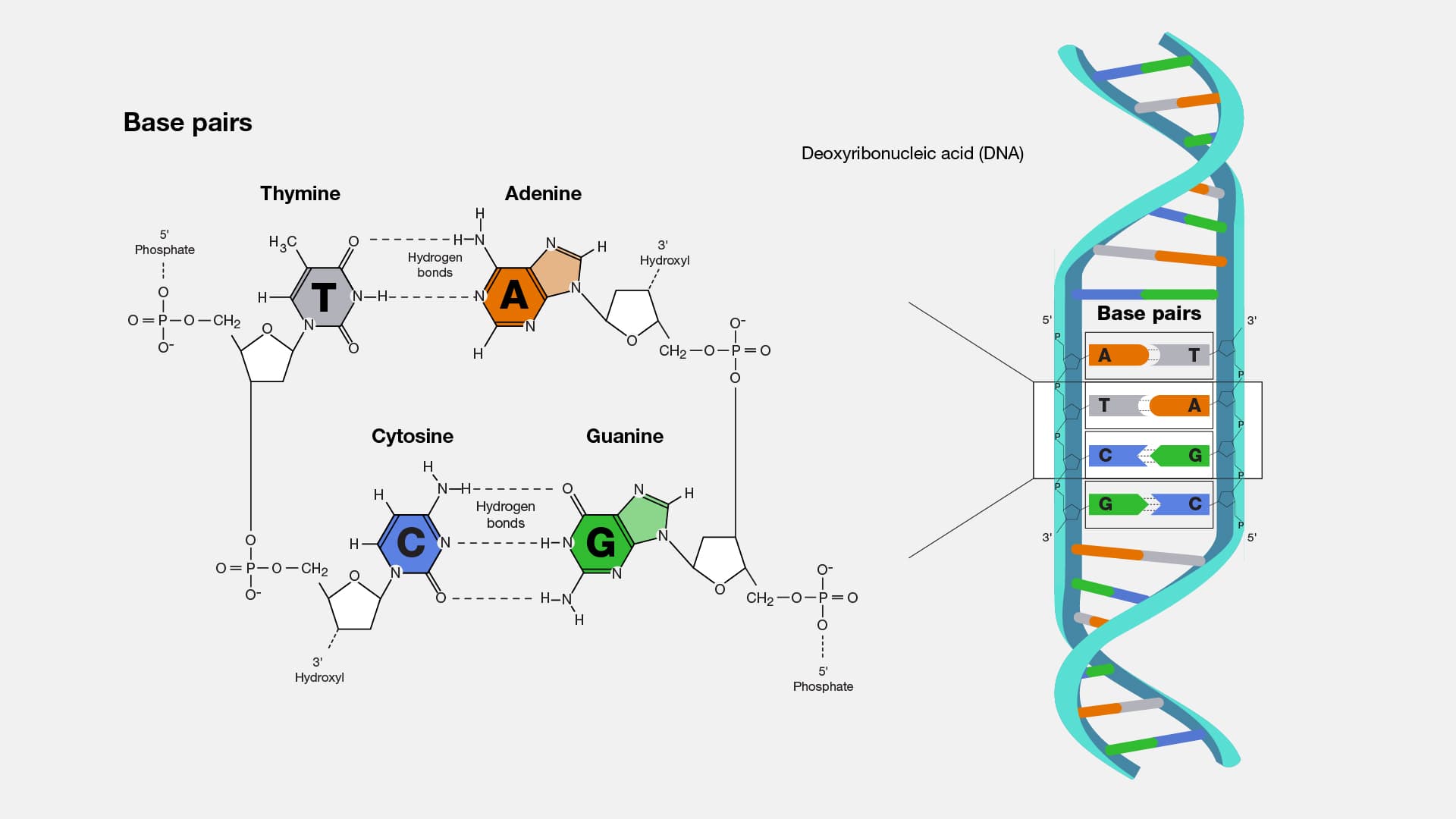
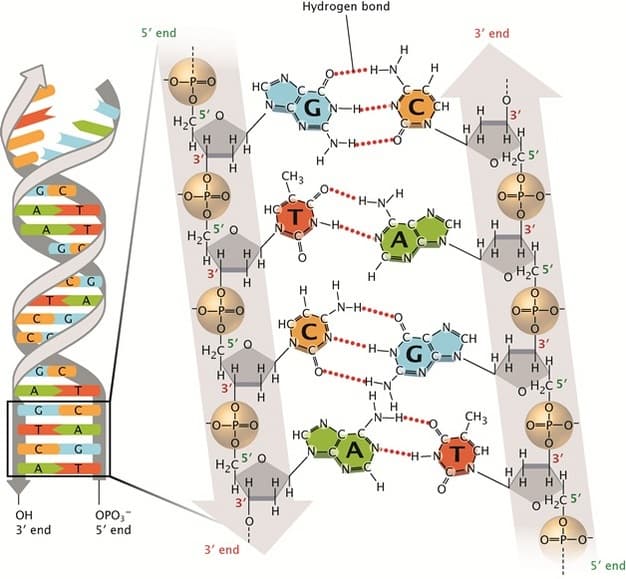
Deoxyribonucleic acid, or DNA, is the molecule that encodes the genetic information of all known living things. Tightly packed into the nucleus of nearly all cells, DNA takes the shape of a double helix—a twisted ladder—with rails made up of stacked sugar-phosphate groups connected by rungs made up of four types of nitrogen-containing bases in pairs. The order of these bases mimics the letters of an alphabet, spelling out genes that carry the instructions for an organism's traits.
DNA was initially called "nuclein" after its discovery in the nuclei of white blood cells in 1869. Although DNA's bases were discovered by the late 1800s, scientists were skeptical that it was a hereditary molecule and viewed proteins, which were made of 20 different building blocks, as more likely to code for the wide variety of observed life.
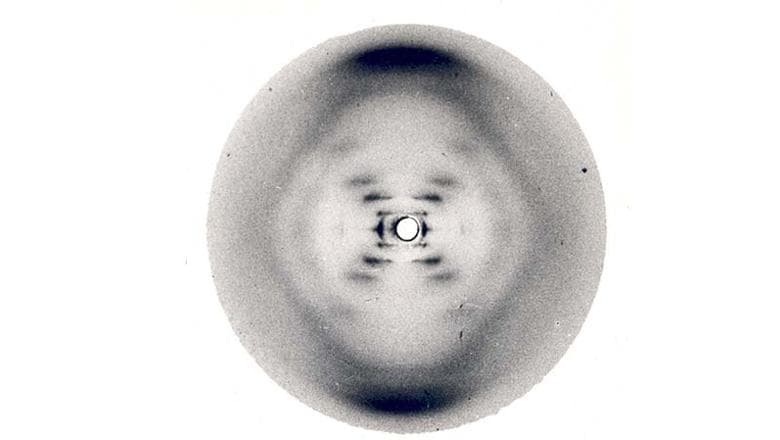
However, by 1952, experiments had shown that bacterial traits changed when they took up DNA rather than proteins, overturning the prevailing wisdom. The following year, DNA's structure was identified, and subsequent observations of how proteins responsible for cellular function are encoded in DNA led to modern genetics.
Advancements in DNA sequencing and editing have enabled breakthrough technologies, including the testing and diagnosis of genetic disorders, disaster victim and forensic identification, genetically engineered crops and microbes for medications like insulin, the detection and tracking of variant pathogens, and various gene therapies.
1440 Findings
Hours of research by our editors, distilled into minutes of clarity.








Explore Science & Technology
Dive into the dynamic world of science and technology, where curiosity has brought about extraordinary understandings of the universe and creativity has led to the breakthroughs and innovations that have transformed our world. Explore a wide range of topics, from the natural and physical sciences to cutting-edge technologies and the people who shaped them, each of which is accompanied by carefully curated resources meant to inform, engage, and inspire those eager to uncover the nature of reality.
Featured Topics
- 3D Printing
- Algae
- Algorithms
- Asteroids
- Atoms
- Auroras
- Batteries
- Big Bang
- Bill Nye
- Biological Cells
- Bioluminescence
- Bioremediation
- Biosphere 2
- Black Holes
- Calculators
- Chaos Theory
- Climatology
- Comets
- Computer Viruses
- Coral Reefs
- Critical Minerals
- Crude Oil
- Cryptography
- Dark Energy
- Dark Matter
- Dark Web
- Data Centers
- David Attenborough
- Deep-Sea Mining
- Deepfakes
- Dinosaurs
- DNA
- Earth
- Earth's Atmosphere
- Earthquakes
- Eclipses
- El Niño-Southern Oscillation
- Electric Grids
- Electric Vehicles
- Electricity
- Environmental Protection Agency
- Extremophiles
- Fireworks
- Fracking
- General Relativity
- Generative AI
- Geothermal Power
- Grace Hopper
- Graphics Processing Unit
- Greenhouse Gases
- Helium
- Hubble Space Telescope
- Hurricanes
- International Space Station
- Internet
- Invasive Species
- James Webb Space Telescope
- Jupiter
- Keystone Species
- Large Hadron Collider
- Large Language Models
- Lasers
- Light
- Lightning
- LIGO
- Marie Curie
- Mars
- Memory
- Microchips
- Microplastics
- Mixed Reality
- Molecular Gastronomy
- Nancy Roman
- NASA
- National Science Foundation
- Neutron Stars
- Nikola Tesla
- Nobel Prize
- Nuclear Power
- Particle Accelerators
- Photosynthesis
- Plate Tectonics
- Pollinators
- Pontifical Academy of Sciences
- Quantum Computing
- Quantum Mechanics
- Radioactivity
- Rosalind Franklin
- Scientific Theory
- Self-Driving Cars
- Smart Cities
- Solar Power
- Sound
- Space Shuttle
- Space Tourism
- Space Trash
- Standard Model
- Stephen Hawking
- Sun
- Tardigrades
- Tesla
- Time
- Tornadoes
- Tsunamis
- Turbulence
- Viking Project
- Volcanoes
- Voyager Mission
- Water
- Wikipedia
- Wind Power