Water
Overview
Water is a compound made of one oxygen atom and two hydrogen atoms (H₂O). It is essential for life because it transports nutrients and waste products, helps regulate temperature, and, as the universal solvent, dissolves many molecules, facilitating their use in biochemical processes.
These characteristics result from water being a polar molecule, with the oxygen end slightly negative and the hydrogen ends slightly positive. Acting as tiny magnets, these charged ends can pull on and break apart oppositely charged regions in other polar molecules. The opposite ends of multiple water molecules can also link together, forming hydrogen bonds.
Hydrogen bonds act as thermal buffers, enabling water to absorb large amounts of energy before warming up and evaporating. This allows Earth's oceans to mitigate climate change by acting as heat sinks. The bonds also contribute to the formation of a less dense, spacious crystal structure when water freezes, allowing ice to float.
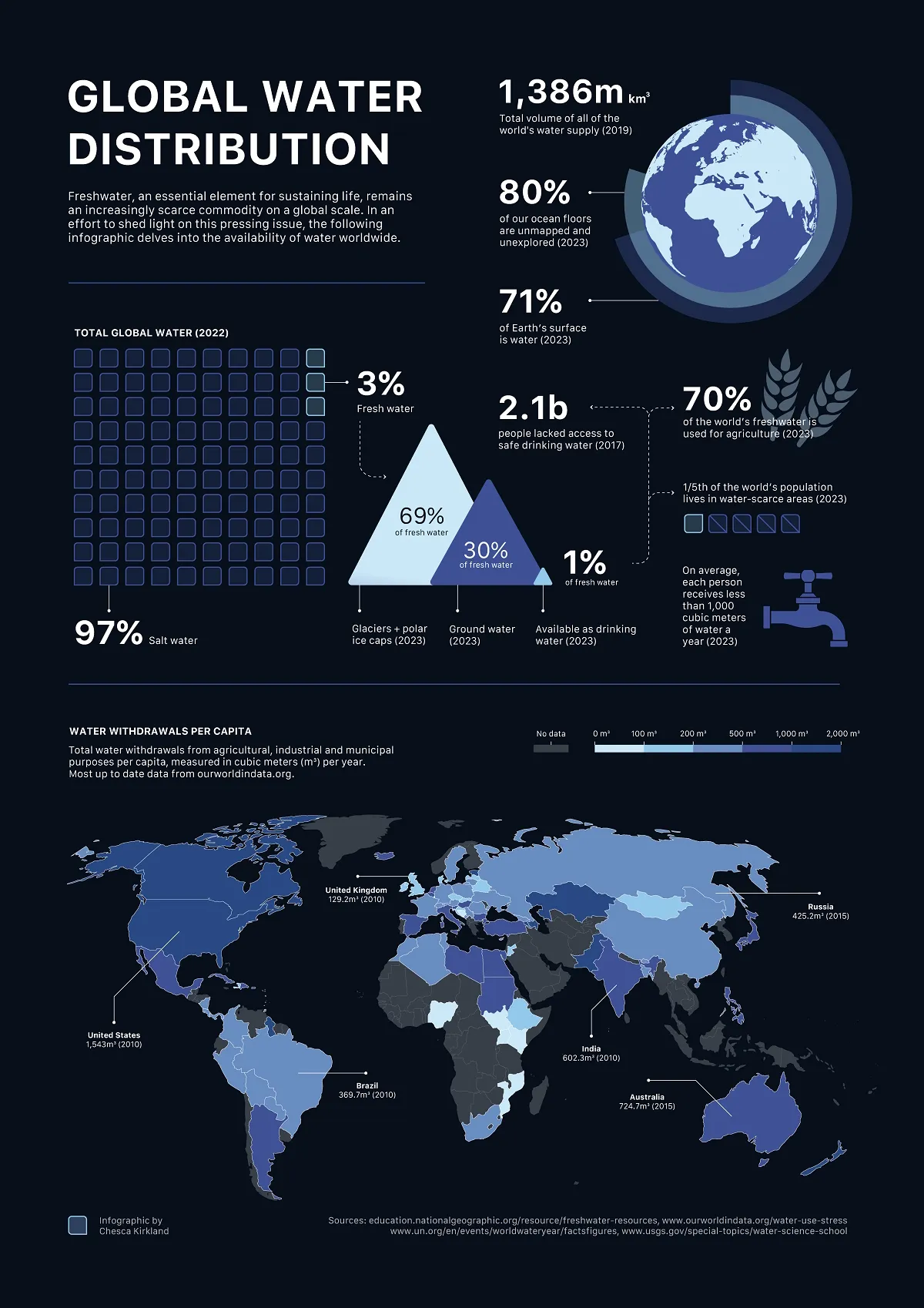
Water covers about 71% of Earth's surface, but only 3% of it is consumable freshwater, about two-thirds of which is trapped in glaciers. Although water is recycled via the hydrologic cycle, reservoirs of this resource are being depleted faster than they can be replenished amid its increasing use for agriculture, industry, energy production, and human consumption.
1440 Findings
Hours of research by our editors, distilled into minutes of clarity.









Explore Science & Technology
Dive into the dynamic world of science and technology, where curiosity has brought about extraordinary understandings of the universe and creativity has led to the breakthroughs and innovations that have transformed our world. Explore a wide range of topics, from the natural and physical sciences to cutting-edge technologies and the people who shaped them, each of which is accompanied by carefully curated resources meant to inform, engage, and inspire those eager to uncover the nature of reality.
Featured Topics
- 3D Printing
- Algae
- Algorithms
- Asteroids
- Atoms
- Auroras
- Batteries
- Big Bang
- Bill Nye
- Biological Cells
- Bioluminescence
- Bioremediation
- Biosphere 2
- Black Holes
- Calculators
- Chaos Theory
- Climatology
- Comets
- Computer Viruses
- Coral Reefs
- Critical Minerals
- Crude Oil
- Cryptography
- Dark Energy
- Dark Matter
- Dark Web
- Data Centers
- David Attenborough
- Deep-Sea Mining
- Deepfakes
- Dinosaurs
- DNA
- Earth
- Earth's Atmosphere
- Earthquakes
- Eclipses
- El Niño-Southern Oscillation
- Electric Grids
- Electric Vehicles
- Electricity
- Environmental Protection Agency
- Extremophiles
- Fireworks
- Fracking
- General Relativity
- Generative AI
- Geothermal Power
- Grace Hopper
- Graphics Processing Unit
- Greenhouse Gases
- Helium
- Hubble Space Telescope
- Hurricanes
- International Space Station
- Internet
- Invasive Species
- James Webb Space Telescope
- Jupiter
- Keystone Species
- Large Hadron Collider
- Large Language Models
- Lasers
- Light
- Lightning
- LIGO
- Marie Curie
- Mars
- Memory
- Microchips
- Microplastics
- Mixed Reality
- Molecular Gastronomy
- Nancy Roman
- NASA
- National Science Foundation
- Neutron Stars
- Nikola Tesla
- Nobel Prize
- Nuclear Power
- Particle Accelerators
- Photosynthesis
- Plate Tectonics
- Pollinators
- Pontifical Academy of Sciences
- Quantum Computing
- Quantum Mechanics
- Radioactivity
- Rosalind Franklin
- Scientific Theory
- Self-Driving Cars
- Smart Cities
- Solar Power
- Sound
- Space Shuttle
- Space Tourism
- Space Trash
- Standard Model
- Stephen Hawking
- Sun
- Tardigrades
- Tesla
- Time
- Tornadoes
- Tsunamis
- Turbulence
- Viking Project
- Volcanoes
- Voyager Mission
- Water
- Wikipedia
- Wind Power