Time
Overview
Time is a dimension in which events can be mapped by when they occur. Just as distance measures how far two locations are from one another on a map, duration measures how far two events are from one another in the time dimension. Without this dimension, we would not be able to contrast events and observe change in the universe.
Historically, time intervals have been quantified by counting the repetition of motion between events, such as the apparent motion of the sun across the sky. Replacements involving consistent motion that repeats more frequently, such as swinging pendulums, vibrating crystals, and oscillating atoms, enabled more precise plotting of events along the time dimension.
While three-dimensional motion through space is possible in any direction, our perception is that time flows only from the past to the future. The second law of thermodynamics states that the entropy, or disorder, of the universe cannot decrease, impeding certain events from succeeding others and imposing an "arrow of time."
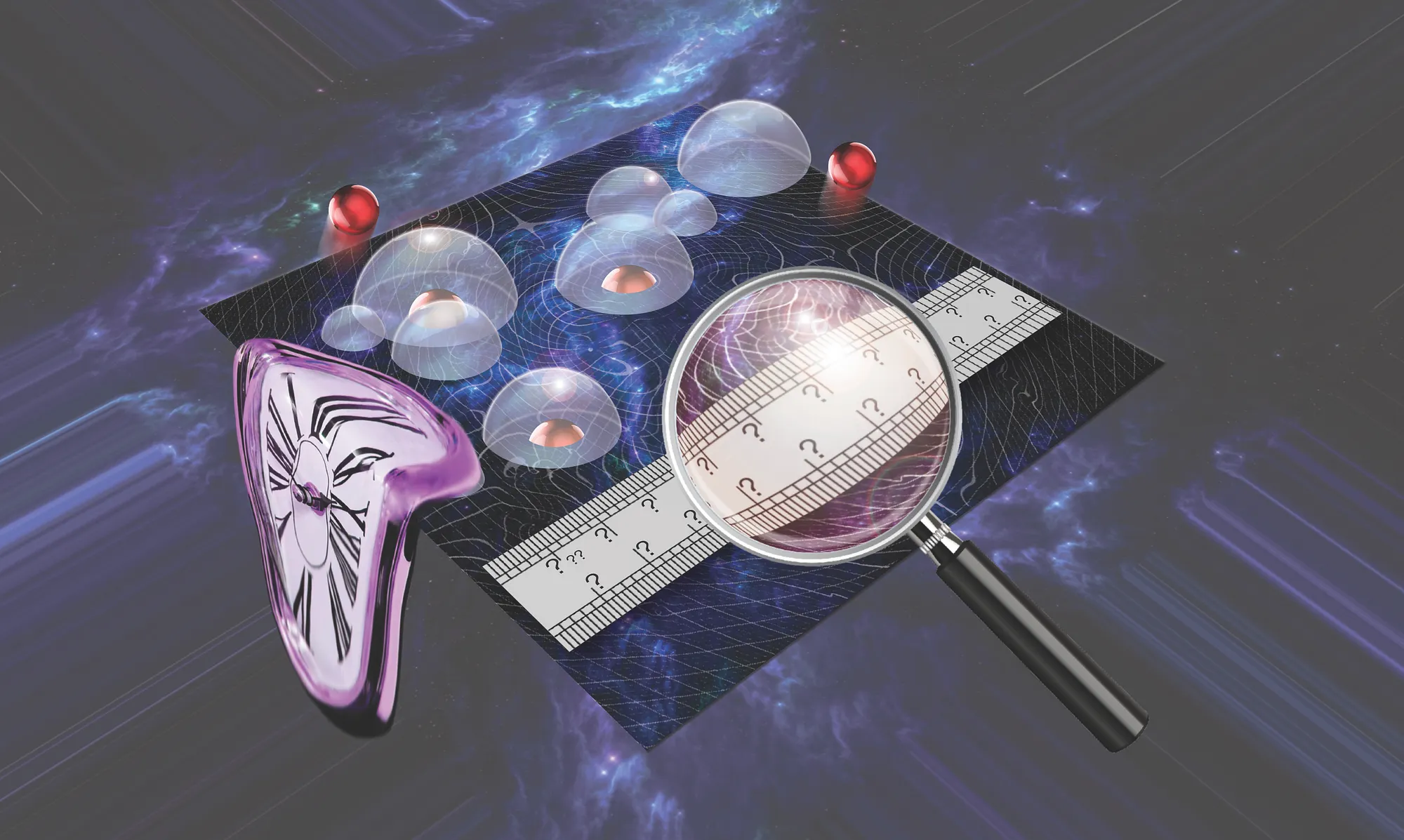
However, relativity combines time and space into a single structure—spacetime—and just as all of space exists, so does all of time, making perceptions of the past, present, and future illusory. The theory also explains why the passage of time slows the more one moves through space and the stronger the gravity one experiences.
By contrast, time is considered a background parameter in quantum physics, independent of one's motion or location, contributing to the incompatibility of quantum mechanics with general relativity.
1440 Findings
Hours of research by our editors, distilled into minutes of clarity.







Explore Science & Technology
Dive into the dynamic world of science and technology, where curiosity has brought about extraordinary understandings of the universe and creativity has led to the breakthroughs and innovations that have transformed our world. Explore a wide range of topics, from the natural and physical sciences to cutting-edge technologies and the people who shaped them, each of which is accompanied by carefully curated resources meant to inform, engage, and inspire those eager to uncover the nature of reality.
Featured Topics
- 3D Printing
- Algae
- Algorithms
- Asteroids
- Atoms
- Auroras
- Batteries
- Big Bang
- Bill Nye
- Biofluorescence
- Biological Cells
- Bioluminescence
- Bioremediation
- Biosphere 2
- Black Holes
- Calculators
- Chaos Theory
- Climatology
- Comets
- Computer Viruses
- Coral Reefs
- Critical Minerals
- Crude Oil
- Cryptography
- Dark Energy
- Dark Matter
- Dark Web
- Data Centers
- David Attenborough
- Deep-Sea Mining
- Deepfakes
- Dinosaurs
- DNA
- Earth
- Earth's Atmosphere
- Earthquakes
- Eclipses
- El Niño-Southern Oscillation
- Electric Grids
- Electric Vehicles
- Electricity
- Environmental Protection Agency
- Evolution
- Extremophiles
- Fireworks
- Fracking
- General Relativity
- Generative AI
- Geothermal Power
- Grace Hopper
- Graphics Processing Unit
- Greenhouse Gases
- Helium
- Hubble Space Telescope
- Hurricanes
- International Space Station
- Internet
- Invasive Species
- James Webb Space Telescope
- Jane Goodall
- Jupiter
- Keystone Species
- Large Hadron Collider
- Large Language Models
- Lasers
- Light
- Lightning
- LIGO
- Marie Curie
- Mars
- Memory
- Microchips
- Microplastics
- Mixed Reality
- Molecular Gastronomy
- Nancy Roman
- NASA
- National Science Foundation
- Neptune
- Neutron Stars
- Nikola Tesla
- Nobel Prize
- Nuclear Power
- Oceans
- Particle Accelerators
- Photosynthesis
- Plate Tectonics
- Pollinators
- Pontifical Academy of Sciences
- Quantum Computing
- Quantum Field Theory
- Quantum Mechanics
- Radioactivity
- Rosalind Franklin
- Scientific Theory
- Self-Driving Cars
- Smart Cities
- Solar Power
- Sound
- Space Shuttle
- Space Tourism
- Space Trash
- Special Relativity
- Standard Model
- Stephen Hawking
- Sun
- Tardigrades
- Tesla
- Time
- Tornadoes
- Tsunamis
- Turbulence
- Viking Project
- Volcanoes
- Voyager Mission
- Water
- White Dwarfs
- Wikipedia
- Wind Power