Scientific Theory
Overview
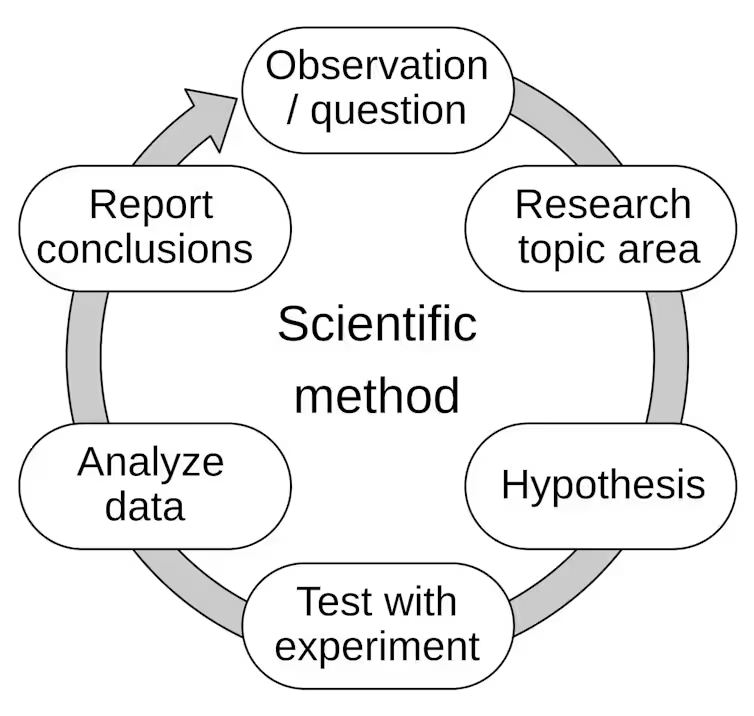
Scientific theories are explanations of natural phenomena supported by extensive evidence and repeated experimental scrutiny. In everyday language, "theory" is often used to mean a guess or a hunch, but these speculations are more closely aligned with the term "hypothesis." Instead, scientific theories are widely accepted frameworks for how the universe works because they account for existing observations and make predictions that have been rigorously tested.
Much of the confusion around scientific theories stems from the existence of scientific laws. These may seem absolute, proven, and something theories can become once sufficiently scrutinized. However, scientific laws describe what happens in nature, often via mathematical relationships, such as acceleration doubling when a force is doubled. On the other hand, scientific theories explain why events occur. Theories can never become laws, no matter how much evidence exists, but both complement one another.
Because they cannot be tested against every possible scenario, scientific theories can never be proven or become factual, though they can be disproved. New data can revise, overturn, or help fill missing gaps within a theory toward a more complete understanding of the universe. This self-correction is a hallmark, not a flaw, of science. However, this openness to revision has sometimes been misinterpreted as incompetence or politicized to erode confidence in science.
1440 Findings
Hours of research by our editors, distilled into minutes of clarity.





Explore Science & Technology
Dive into the dynamic world of science and technology, where curiosity has brought about extraordinary understandings of the universe and creativity has led to the breakthroughs and innovations that have transformed our world. Explore a wide range of topics, from the natural and physical sciences to cutting-edge technologies and the people who shaped them, each of which is accompanied by carefully curated resources meant to inform, engage, and inspire those eager to uncover the nature of reality.
Featured Topics
- 3D Printing
- Algae
- Algorithms
- Asteroids
- Atoms
- Auroras
- Batteries
- Big Bang
- Bill Nye
- Biological Cells
- Bioluminescence
- Bioremediation
- Biosphere 2
- Black Holes
- Calculators
- Chaos Theory
- Climatology
- Comets
- Computer Viruses
- Coral Reefs
- Critical Minerals
- Crude Oil
- Cryptography
- Dark Energy
- Dark Matter
- Dark Web
- Data Centers
- David Attenborough
- Deep-Sea Mining
- Deepfakes
- Dinosaurs
- DNA
- Earth
- Earth's Atmosphere
- Earthquakes
- Eclipses
- El Niño-Southern Oscillation
- Electric Grids
- Electric Vehicles
- Electricity
- Environmental Protection Agency
- Extremophiles
- Fireworks
- Fracking
- General Relativity
- Generative AI
- Geothermal Power
- Grace Hopper
- Graphics Processing Unit
- Greenhouse Gases
- Helium
- Hubble Space Telescope
- Hurricanes
- International Space Station
- Internet
- Invasive Species
- James Webb Space Telescope
- Jupiter
- Keystone Species
- Large Hadron Collider
- Large Language Models
- Lasers
- Light
- Lightning
- LIGO
- Marie Curie
- Mars
- Memory
- Microchips
- Microplastics
- Mixed Reality
- Molecular Gastronomy
- Nancy Roman
- NASA
- National Science Foundation
- Neutron Stars
- Nikola Tesla
- Nobel Prize
- Nuclear Power
- Particle Accelerators
- Photosynthesis
- Plate Tectonics
- Pollinators
- Pontifical Academy of Sciences
- Quantum Computing
- Quantum Mechanics
- Radioactivity
- Rosalind Franklin
- Scientific Theory
- Self-Driving Cars
- Smart Cities
- Solar Power
- Sound
- Space Shuttle
- Space Tourism
- Space Trash
- Standard Model
- Stephen Hawking
- Sun
- Tardigrades
- Tesla
- Time
- Tornadoes
- Tsunamis
- Turbulence
- Viking Project
- Volcanoes
- Voyager Mission
- Water
- Wikipedia
- Wind Power