Electric Grids
Overview
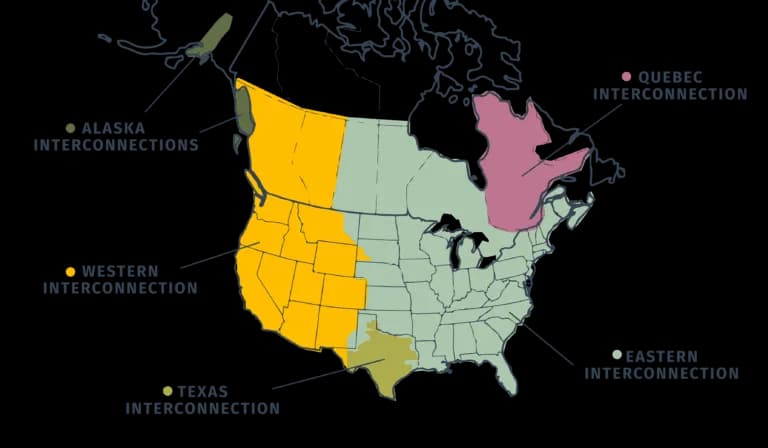
Electric grids are the infrastructure that delivers electricity to consumers. Grids began as isolated systems connecting a single power source to one location, such as a Niagara Falls hydroelectric plant to Buffalo, New York. The need to meet dynamic, growing energy demands more efficiently and to increase reliability led to the interconnection of these systems into today's synchronized networks, with many spanning multiple countries.
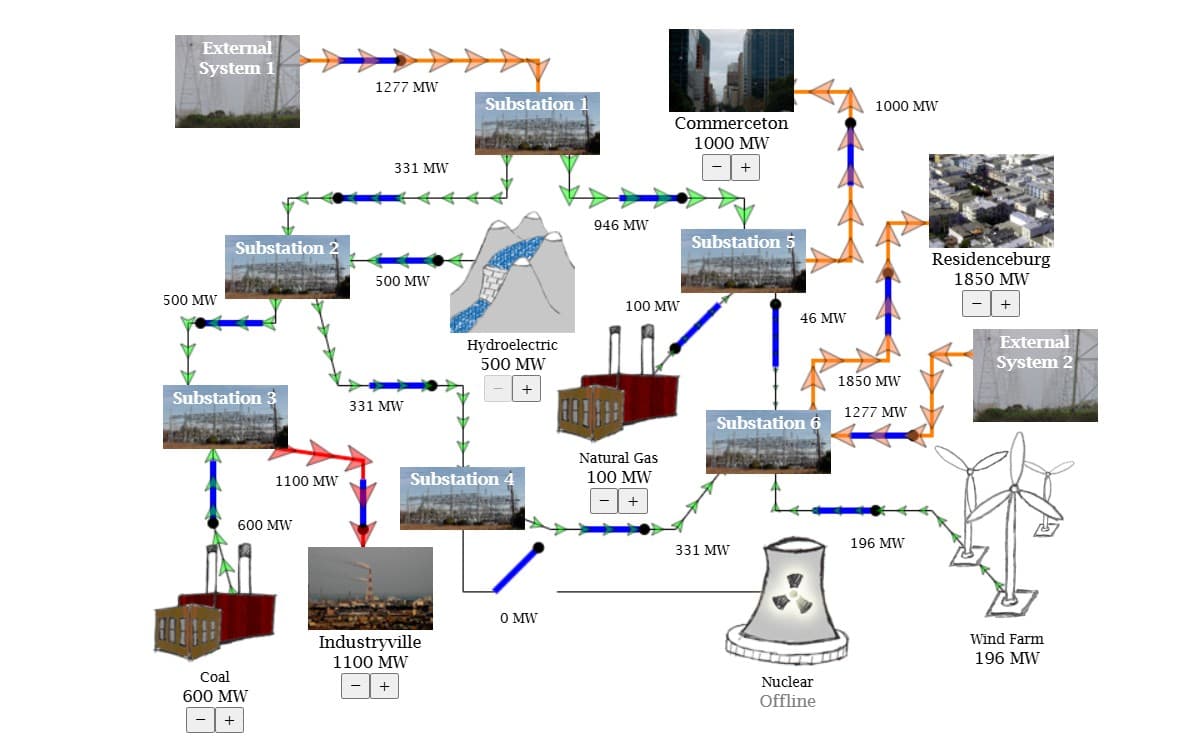
Each grid consists of three main segments: generation, transmission, and distribution. Generation occurs in power plants, solar farms, and other facilities that convert resources into electricity. Transmission carries this energy over long-range power lines to distribution systems, which deliver the electricity to local customers. Between these segments, transformers at substations increase voltage to minimize power losses during transmission or decrease it to make electricity safer for use.
Electric grids have been designed to continuously monitor demand and provide a matching supply of electricity for immediate use. For this reason, integrating intermittent renewable energy sources, such as wind power, has been challenging, particularly when generation sites are far from population centers. Large-scale battery and smart grid technologies may facilitate these integrations and improve grid efficiency, but the latter opens the door to cyberattacks.
1440 Findings
Hours of research by our editors, distilled into minutes of clarity.






Explore Science & Technology
Dive into the dynamic world of science and technology, where curiosity has brought about extraordinary understandings of the universe and creativity has led to the breakthroughs and innovations that have transformed our world. Explore a wide range of topics, from the natural and physical sciences to cutting-edge technologies and the people who shaped them, each of which is accompanied by carefully curated resources meant to inform, engage, and inspire those eager to uncover the nature of reality.
Featured Topics
- 3D Printing
- Algae
- Algorithms
- Asteroids
- Atoms
- Auroras
- Batteries
- Big Bang
- Bill Nye
- Biofluorescence
- Biological Cells
- Bioluminescence
- Bioremediation
- Biosphere 2
- Black Holes
- Calculators
- Chaos Theory
- Climatology
- Comets
- Computer Viruses
- Coral Reefs
- Critical Minerals
- Crude Oil
- Cryptography
- Dark Energy
- Dark Matter
- Dark Web
- Data Centers
- David Attenborough
- Deep-Sea Mining
- Deepfakes
- Dinosaurs
- DNA
- Earth
- Earth's Atmosphere
- Earthquakes
- Eclipses
- El Niño-Southern Oscillation
- Electric Grids
- Electric Vehicles
- Electricity
- Environmental Protection Agency
- Evolution
- Extremophiles
- Fireworks
- Fracking
- General Relativity
- Generative AI
- Geothermal Power
- Grace Hopper
- Graphics Processing Unit
- Greenhouse Gases
- Helium
- Hubble Space Telescope
- Hurricanes
- International Space Station
- Internet
- Invasive Species
- James Webb Space Telescope
- Jane Goodall
- Jupiter
- Keystone Species
- Large Hadron Collider
- Large Language Models
- Lasers
- Light
- Lightning
- LIGO
- Marie Curie
- Mars
- Memory
- Microchips
- Microplastics
- Mixed Reality
- Molecular Gastronomy
- Nancy Roman
- NASA
- National Science Foundation
- Neptune
- Neutron Stars
- Nikola Tesla
- Nobel Prize
- Nuclear Power
- Oceans
- Particle Accelerators
- Photosynthesis
- Plate Tectonics
- Pollinators
- Pontifical Academy of Sciences
- Quantum Computing
- Quantum Mechanics
- Radioactivity
- Rosalind Franklin
- Scientific Theory
- Self-Driving Cars
- Smart Cities
- Solar Power
- Sound
- Space Shuttle
- Space Tourism
- Space Trash
- Standard Model
- Stephen Hawking
- Sun
- Tardigrades
- Tesla
- Time
- Tornadoes
- Tsunamis
- Turbulence
- Viking Project
- Volcanoes
- Voyager Mission
- Water
- White Dwarfs
- Wikipedia
- Wind Power