Algorithms
Overview
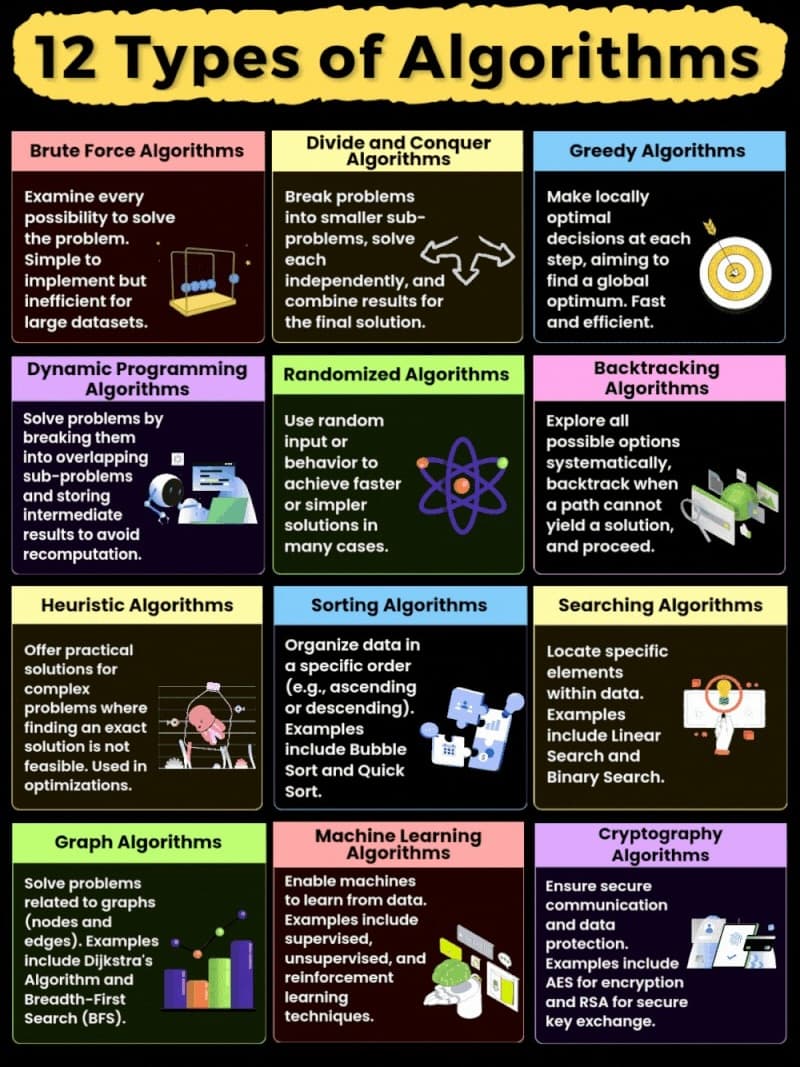
An algorithm is a series of steps for completing a task. Broadly, this includes everything from the instructions in a recipe and the procedures for solving mathematical problems to the software that underlies search engines and the ways AI systems identify patterns in data. Colloquially, algorithms are associated with recommendation systems that provide users with personalized content based on their preferences, as seen in social media feeds.
Although algorithms have existed as long as routines, processes, and mathematics have, the term originated from Algoritmi, the Latin translation of al-Khwārizmī, a 9th-century mathematician whose book "Al-Jabr" gave algebra its name. In 1843, English mathematician Ada Lovelace—considered the first computer programmer—designed the first computer algorithm, which showed how a machine could perform a complex mathematical calculation. By 1936, Alan Turing proved that a machine could be designed to execute any conceivable algorithm, laying the foundation for modern computing.
Since then, algorithms have been developed to process data faster than can be done by hand, with complex systems able to automatically self-improve and become more efficient. Certain algorithms, such as those in hiring and lending, may reinforce existing biases because they rely on human programming or, in the case of machine learning, historical patterns in data.
1440 Findings
Hours of research by our editors, distilled into minutes of clarity.




Explore Science & Technology
Dive into the dynamic world of science and technology, where curiosity has brought about extraordinary understandings of the universe and creativity has led to the breakthroughs and innovations that have transformed our world. Explore a wide range of topics, from the natural and physical sciences to cutting-edge technologies and the people who shaped them, each of which is accompanied by carefully curated resources meant to inform, engage, and inspire those eager to uncover the nature of reality.
Featured Topics
- 3D Printing
- Algae
- Algorithms
- Asteroids
- Atoms
- Auroras
- Batteries
- Big Bang
- Bill Nye
- Biological Cells
- Bioluminescence
- Bioremediation
- Biosphere 2
- Black Holes
- Calculators
- Chaos Theory
- Climatology
- Comets
- Computer Viruses
- Coral Reefs
- Critical Minerals
- Crude Oil
- Cryptography
- Dark Energy
- Dark Matter
- Dark Web
- Data Centers
- David Attenborough
- Deep-Sea Mining
- Deepfakes
- Dinosaurs
- DNA
- Earth
- Earth's Atmosphere
- Earthquakes
- Eclipses
- El Niño-Southern Oscillation
- Electric Grids
- Electric Vehicles
- Electricity
- Environmental Protection Agency
- Extremophiles
- Fireworks
- Fracking
- General Relativity
- Generative AI
- Geothermal Power
- Grace Hopper
- Graphics Processing Unit
- Greenhouse Gases
- Helium
- Hubble Space Telescope
- Hurricanes
- International Space Station
- Internet
- Invasive Species
- James Webb Space Telescope
- Jupiter
- Keystone Species
- Large Hadron Collider
- Large Language Models
- Lasers
- Light
- Lightning
- LIGO
- Marie Curie
- Mars
- Memory
- Microchips
- Microplastics
- Mixed Reality
- Molecular Gastronomy
- Nancy Roman
- NASA
- National Science Foundation
- Neutron Stars
- Nikola Tesla
- Nobel Prize
- Nuclear Power
- Particle Accelerators
- Photosynthesis
- Plate Tectonics
- Pollinators
- Pontifical Academy of Sciences
- Quantum Computing
- Quantum Mechanics
- Radioactivity
- Rosalind Franklin
- Scientific Theory
- Self-Driving Cars
- Smart Cities
- Solar Power
- Sound
- Space Shuttle
- Space Tourism
- Space Trash
- Standard Model
- Stephen Hawking
- Sun
- Tardigrades
- Tesla
- Time
- Tornadoes
- Tsunamis
- Turbulence
- Viking Project
- Volcanoes
- Voyager Mission
- Water
- Wikipedia
- Wind Power