Earth's Atmosphere
Overview
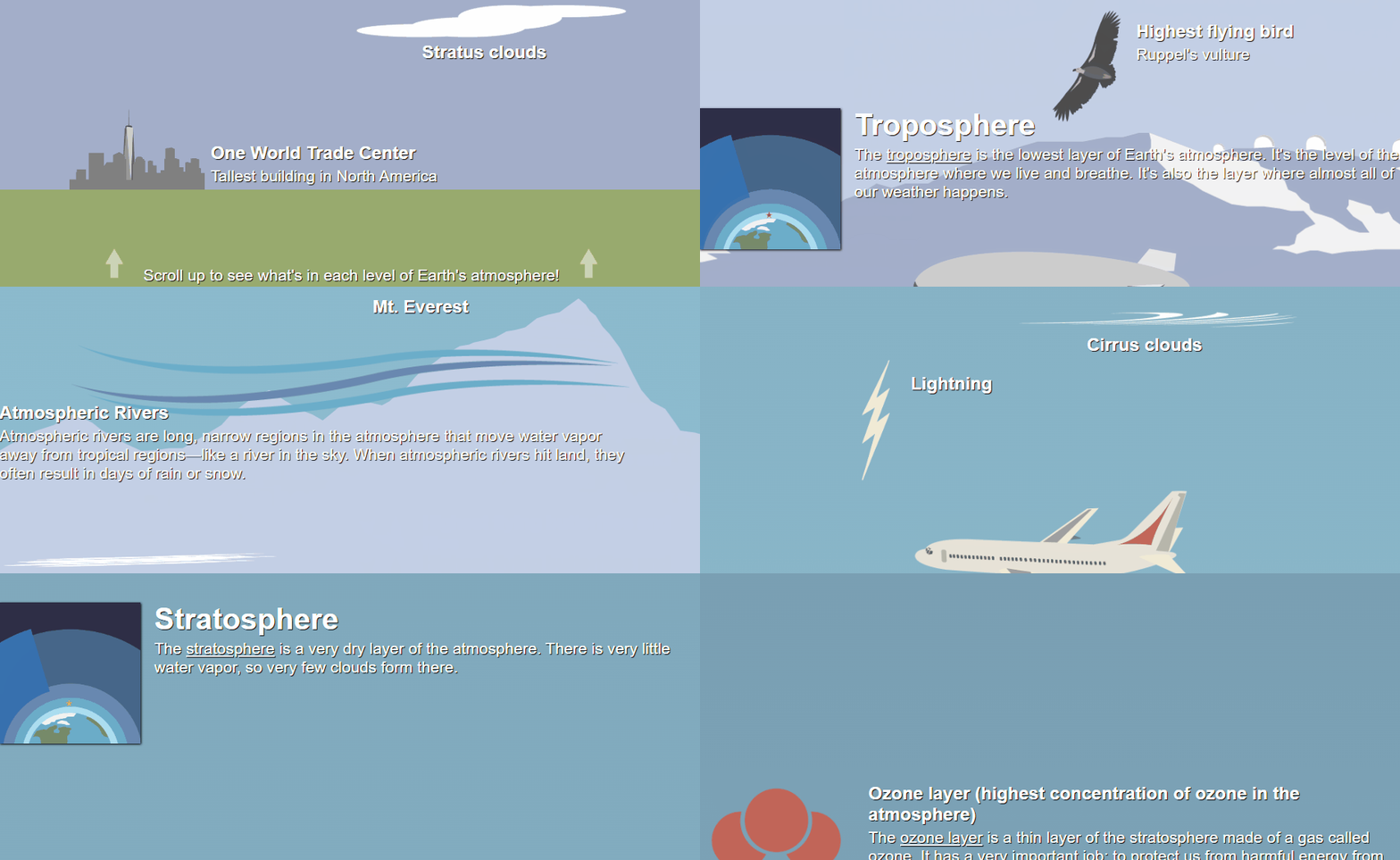
Earth's atmosphere is one of its five major systems, consisting of gases that envelop the planet from the ground to more than 10,000 kilometers (6,214 miles) above the surface. It serves as the arena where the sun's uneven heating is circulated across the planet by weather, while insulating against significant temperature changes between day and night. By trapping thermal energy via the greenhouse effect and protecting against most harmful debris and radiation from outer space, the atmosphere sustains suitable conditions for large segments of life on Earth.
The current atmosphere is not Earth's first. Planetary models suggest leftover hydrogen and helium from the formation of the solar system once surrounded the planet, but were lost to space due to insufficient gravity. Heavier molecules released by volcanic eruptions, such as water vapor, carbon dioxide, and ammonia, later formed a new atmosphere. Photosynthesis in ancient microorganisms and reactions involving solar radiation then turned these chemicals into the most abundant gases in the modern atmosphere: nitrogen (78%) and oxygen (21%).
Although the atmosphere stabilized into its five layers following the production of these gases, it continues to evolve through interactions with the sun and other Earth systems. This includes ozone depletion and increases in greenhouse gas concentrations caused by human activity.
1440 Findings
Hours of research by our editors, distilled into minutes of clarity.



Explore Science & Technology
Dive into the dynamic world of science and technology, where curiosity has brought about extraordinary understandings of the universe and creativity has led to the breakthroughs and innovations that have transformed our world. Explore a wide range of topics, from the natural and physical sciences to cutting-edge technologies and the people who shaped them, each of which is accompanied by carefully curated resources meant to inform, engage, and inspire those eager to uncover the nature of reality.
Featured Topics
- 3D Printing
- Algae
- Algorithms
- Asteroids
- Atoms
- Auroras
- Batteries
- Big Bang
- Bill Nye
- Biological Cells
- Bioluminescence
- Bioremediation
- Biosphere 2
- Black Holes
- Calculators
- Chaos Theory
- Climatology
- Comets
- Computer Viruses
- Coral Reefs
- Critical Minerals
- Crude Oil
- Cryptography
- Dark Energy
- Dark Matter
- Dark Web
- Data Centers
- David Attenborough
- Deep-Sea Mining
- Deepfakes
- Dinosaurs
- DNA
- Earth
- Earth's Atmosphere
- Earthquakes
- Eclipses
- El Niño-Southern Oscillation
- Electric Grids
- Electric Vehicles
- Electricity
- Environmental Protection Agency
- Extremophiles
- Fireworks
- Fracking
- General Relativity
- Generative AI
- Geothermal Power
- Grace Hopper
- Graphics Processing Unit
- Greenhouse Gases
- Helium
- Hubble Space Telescope
- Hurricanes
- International Space Station
- Internet
- Invasive Species
- James Webb Space Telescope
- Jupiter
- Keystone Species
- Large Hadron Collider
- Large Language Models
- Lasers
- Light
- Lightning
- LIGO
- Marie Curie
- Mars
- Memory
- Microchips
- Microplastics
- Mixed Reality
- Molecular Gastronomy
- Nancy Roman
- NASA
- National Science Foundation
- Neutron Stars
- Nikola Tesla
- Nobel Prize
- Nuclear Power
- Particle Accelerators
- Photosynthesis
- Plate Tectonics
- Pollinators
- Pontifical Academy of Sciences
- Quantum Computing
- Quantum Mechanics
- Radioactivity
- Rosalind Franklin
- Scientific Theory
- Self-Driving Cars
- Smart Cities
- Solar Power
- Sound
- Space Shuttle
- Space Tourism
- Space Trash
- Standard Model
- Stephen Hawking
- Sun
- Tardigrades
- Tesla
- Time
- Tornadoes
- Tsunamis
- Turbulence
- Viking Project
- Volcanoes
- Voyager Mission
- Water
- Wikipedia
- Wind Power