Explore the chemistry of undesired body odors
This graphic highlights some of the main compounds in different body odors, including halitosis (bad breath), flatulence, and foot odor.

Although human sweat is odorless, bacterial growth and the breakdown of sweat components—including organic acids and carbohydrates—give rise to what we know as body odor. A collection of bacteria contributes to such malodorous scents, but studies suggest Corynebacterium species, in particular, make adults smelly.
Humans have two types of sweat glands, the eccrine and apocrine. The latter, found primarily in our armpits and groin, opens up into hair follicles and contributes to body odor when bacteria naturally found on our skin mix with the sweat. Americans spent more money masking "BO" (an acronym coined by antiperspirant marketers in the early 1900s) than our counterparts in any other country in 2023—more than $6B.
Hormones, medications, food, body hair, and stage of life can all affect our scent. Sickness is also associated with different body odors, and mounting research has revealed that a variety of medical conditions have specific aromas. Some disorders may be detectable by their smell even before symptoms manifest, including Parkinson's disease.
Hours of research by our editors, distilled into minutes of clarity.
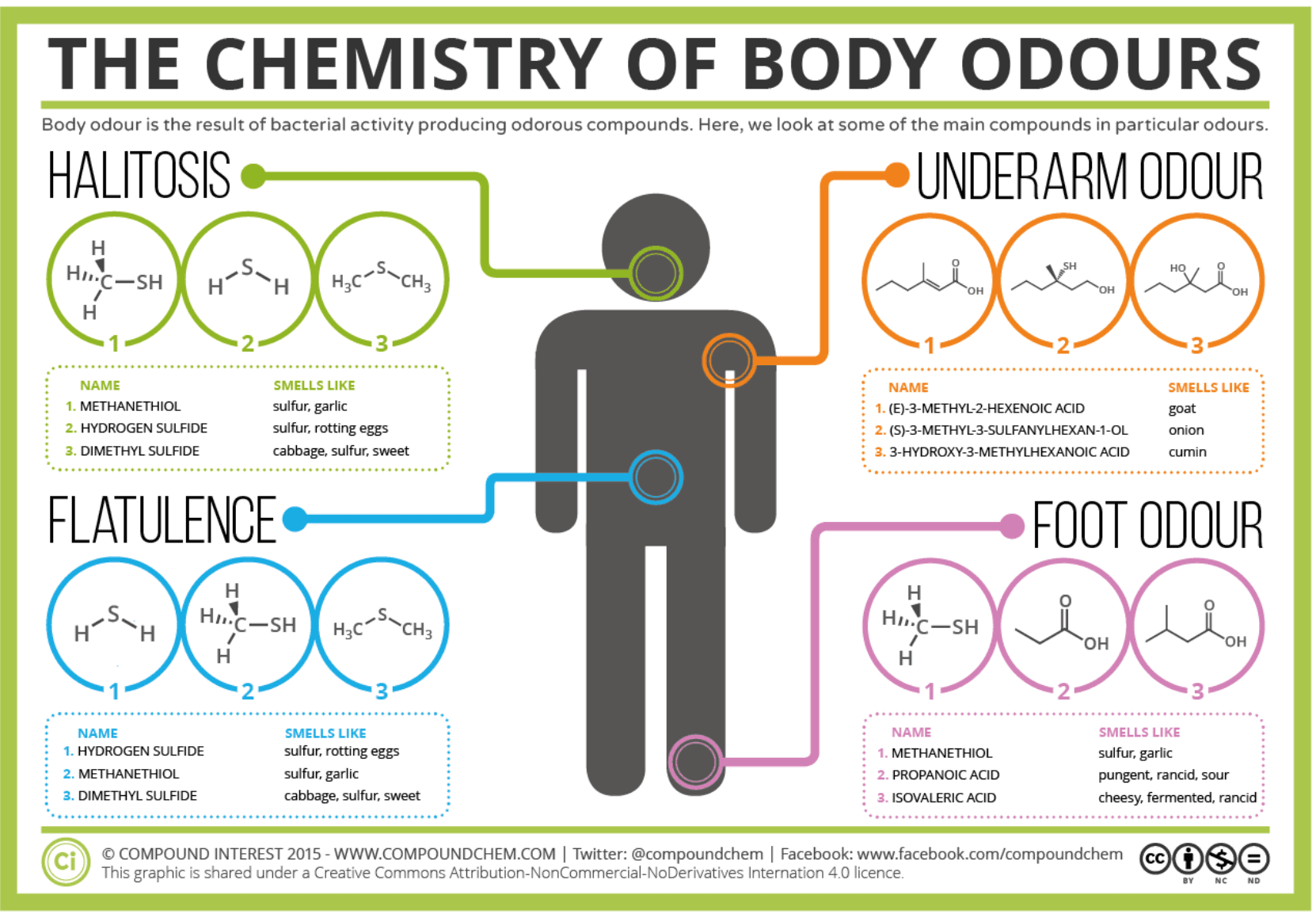
This graphic highlights some of the main compounds in different body odors, including halitosis (bad breath), flatulence, and foot odor.

Body odor is associated with sweat, but odor actually arises from the bacteria that multiply in moist environments on your skin. Hormones, medications, food, and body hair can all affect body odor.
For a small 2014 research study, a panel was tasked with sniffing the smelly t-shirts of people who had been injected with a compound known to activate the immune system and those of controls without the shot. It found that those who were acting as if unwell (due to the injection) generally smelled worse. Subsequent work found that those who sniffed unpleasant odors had a mild immune response of their own—perhaps to protect them from disease. (Some users may experience a paywall.)
She discovered she could smell diseases, including Parkinson's, tuberculosis, Alzheimer's, cancer, and diabetes. Working with an analytic chemist, she's learned she can smell subtle changes in odor—ones that smell consistent across individuals with the same disorder—even before symptoms manifest.
A gene variant found in 80%-95% of individuals with East Asian ancestry reduces armpit bacteria and related odors. People with this nonfunctioning ABCC11 gene variant lack a protein that transports molecules, including sweat, across cellular membranes, so their armpits are starved of sweat that bacteria may have metabolized to help them multiply.
Some sniffers with this rare trait may be more sensitive to pleasant smells, while others may be more attuned to unpleasant scents. Some research suggests that certain genetic mutations are associated with a heightened sense of smell.
In this small study published in 2015, two highly trained German Shepherd dogs sniffed hundreds of urine samples and were able to accurately detect prostate cancer—sniffing out certain volatile organic compounds—in almost every single case. One dog was correct 98% of the time and the other correctly identified patients 100% of the time. (Some users may encounter a paywall.)
Scientists compared the smells of babies and teenagers and identified some of the compounds that make teens smelly. Carboxylic acids present in teens, they wrote, seemed to give off an "earthy, musty, or cheesy" scent. This 2024 research could help inform future odor-control products.
The work identified the 25 most frequent words used to describe body odors across languages, ranked by frequency, and found that "sweaty" topped the list, followed by "sour" and "stinky."
Dermatologists recommend applying antiperspirant at night for the best results. When applied to clean, dry skin at night, the active ingredient in most antiperspirants (aluminum salt), combined with the skin's natural moisture, forms plugs that block sweat glands, limiting sweat and related odors.
Discover a broad spectrum of topics, from fundamental anatomy to the latest in medical research and treatments, all aimed at enhancing your understanding of health, wellness, and our bodies. Our resources are meticulously curated to offer precise and pertinent information to students, professionals, and anyone interested in learning more about the medical sciences. Dive in to stay informed, make well-informed health decisions, and explore the intriguing world of medicine.