Space

From roughly 60 miles above the Earth's surface to farther than light has traveled during the entire age of the universe, space has captured human imagination for millennia. Explore the final frontier with the best resources curated from across the internet.

1440 Findings

Hours of research by our editors, distilled into minutes of clarity.

  • NASA

    What does NASA do besides space?

    Although its splashiest accomplishments are the ones taking place in outer space, NASA actually does a lot more than space exploration. The federal administration also conducts intensive research on the interconnected systems of the Earth, from studies of the atmosphere and oceans to research into the composition of the planet's interior. See what NASA is discovering about our home planet here.
  • Solar System

    Zoom around our solar system

    This interactive model of our local neighborhood in the Orion arm of the Milky Way galaxy lets you sail and zoom around our Solar System. Learn about various different objects (include planets and manmade planet-exploring probes) and their proximity to Earth and other heavenly objects.

  • Black Holes

    What is a singularity?

    It's hard to imagine a singularity, which are described as an infinitely tiny point, created by gravity, until it has zero volume. The definition feels impossible, though perhaps not at the center of a black hole or at the beginning of the universe. Even then, singularities may be something else entirely. Singularities are a mathematical quandary that challenge us to better understand physics and the universe.

  • Mars

    Why haven’t humans reached Mars?

    Mars remains the most viable interplanetary destination due to its relatively habitable orbit. There are many challenges, however, including the huge distance to Mars, the need for advanced propulsion systems, uncertainty over the impacts of long-duration space travel on astronauts, and the need for safe landing techniques and equipment to handle Martian conditions. Human-manned missions to Mars are not likely to occur until the 2030s at the earliest.

  • Astrophysics

    Understanding how planets form

    Solar systems require millions of years to form. The process starts from gas and dust clusters circling a central, young star. Gravity leads to collisions between materials within the disk. Over time, dust particles merge and form pebbles, which eventually transform into rocks several miles in size. While these developing planets revolve around their star, they clear their path by removing materials, leaving behind mostly empty spaces. At the same time, the star absorbs nearby gas and pushes more distant material away. Watch a quick animation of the process here.

    Video

    Understanding how planets form

  • Black Holes

    Black holes 101

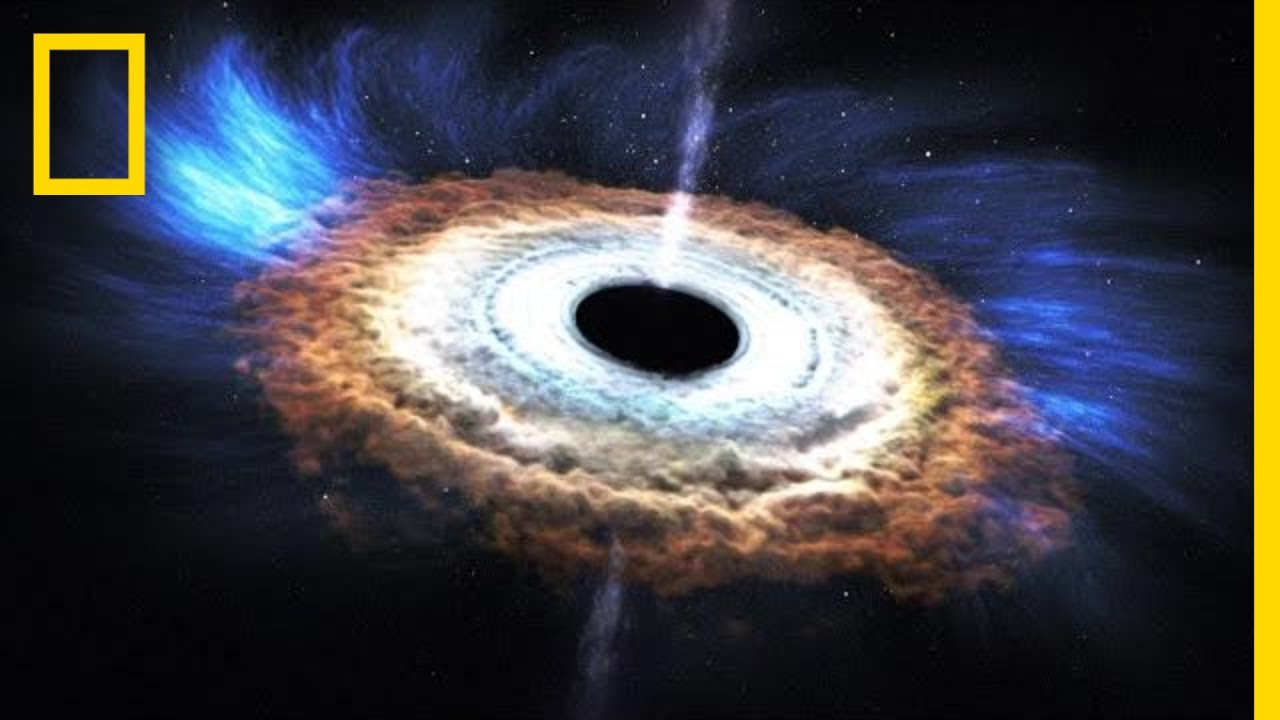
    At the center of our galaxy, a supermassive black hole churns. Learn about the types of black holes, how they form, and how scientists discovered these invisible, yet extraordinary objects in our universe. This three-minute video from National Geographic tutors the viewer on the basics regarding the universe's most mysterious residents.

    Video

    Black holes 101

  • Moon

    How did the moon form?

    That familiar orb in our night sky must have come from somewhere. The most widely accepted theory about the Moon's origin is the giant-impact theory, suggesting the Moon formed as a result of a massive collision between early Earth and another small planet named Theia. Analysis of samples brought back from the Apollo missions revealed chemical similarities between the Earth and Moon, supporting this theory. The Moon's formation stabilized Earth's orbit and reduced polar motion, contributing to our planet's relatively stable climate. In this piece, planetary scientists weigh in on the best theories explaining the origins of the moon.

Next page
Space | 1440