Astrophysics

Overview

Human exploration of the universe is progressing at an exciting pace, with regular advancements in the tools we use to study black holes, stars, quasars, and much more. Dive into some of the most mind-blowing observations and theories about physical reality with our curated resources on the physics of celestial objects.

1440 Findings

Hours of research by our editors, distilled into minutes of clarity.

  • The sound of two black holes colliding

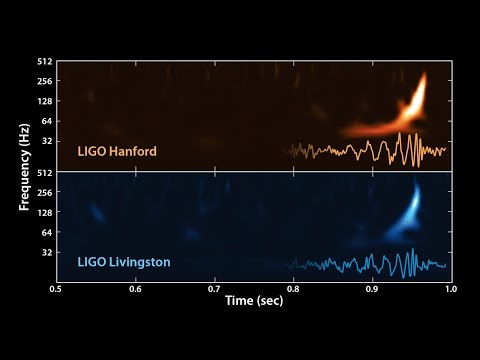
    Gravitational waves sent out from a pair of colliding black holes have been converted to sound waves, as heard in this brief but memorable animation. On Sept. 14, 2015, LIGO observed gravitational waves from the merger of two black holes, each about 30 times the mass of our sun. The incredibly powerful event, which released 50 times more energy than all the stars in the observable universe, lasted only fractions of a second.
    Video
    The sound of two black holes colliding

  • What is space-time?

    Space-time is a complex subject, but this Livescience article makes an effort to disentangle the topic. Somewhat akin to a sheet of rubber that can be warped and bent in parts, space-time is a bit more involved that that. However, the analogy makes this and other aspects of the concept simpler to grasp.

  • View a gallery of Einstein rings

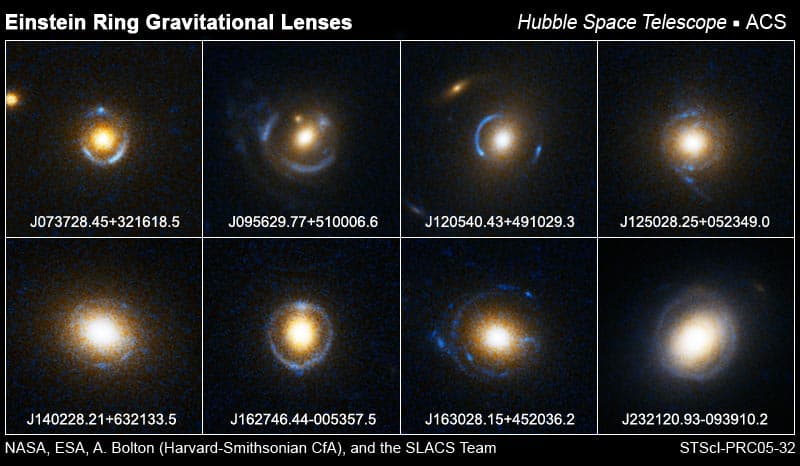
    As light from a distant galaxy spreads in all directions, rays that pass around a massive object, such as another galaxy, may be bent around it. If the massive object is positioned between the distant galaxy and our telescopes, we may observe this deflected light forming a ring around it.

  • The hypothetical particle that travels faster than light

    Astrophysicists inspired by science fiction developed the theory of the tachyon—a Greek word for "fast"—which is a field or particle hypothetically able to travel faster than light. Although no experiments have confirmed any part of it, it's a fun theory to consider.

    Video

    The hypothetical particle that travels faster than light

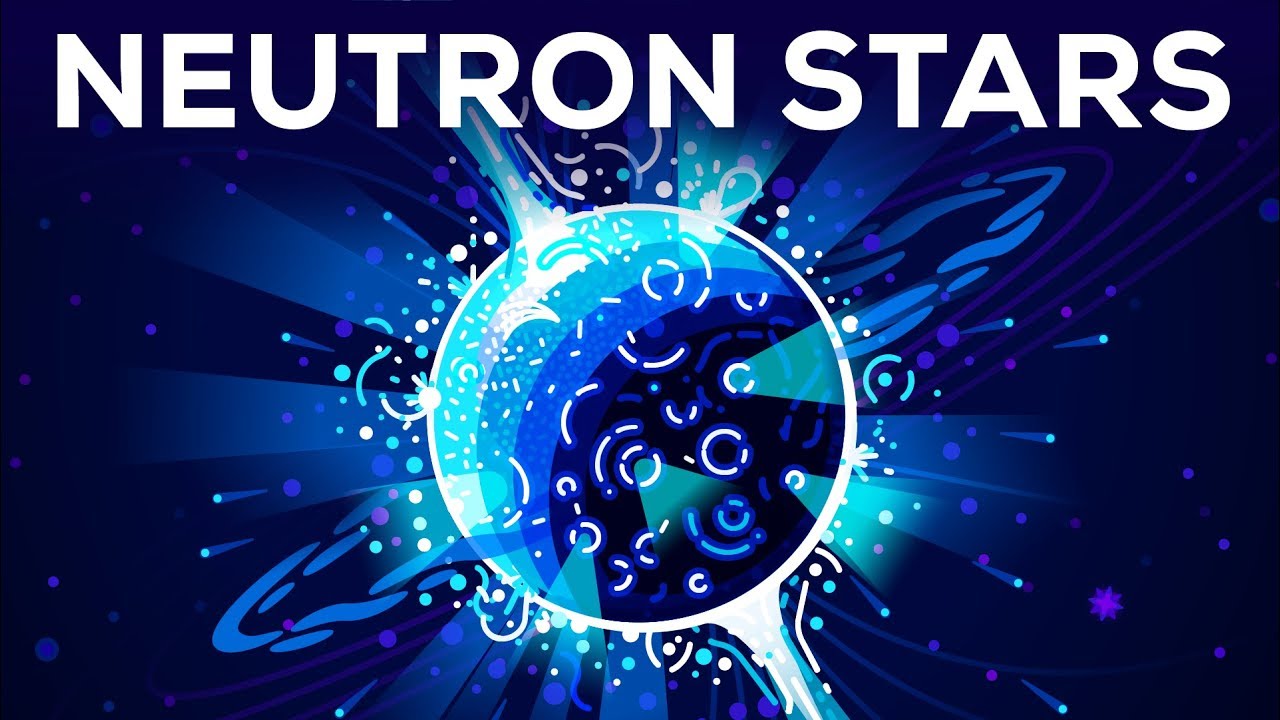
  • Neutron stars are ultra-dense remnants of massive stars

    When these stars exhaust their fuel, they undergo gravitational collapse, crushing their cores into neutron stars—objects with the mass of a star packed into a city-sized sphere. These dense remnants can spin rapidly, emit powerful radiation, and possess magnetic fields trillions of times stronger than Earth's.

    Video

    Neutron stars are ultra-dense remnants of massive stars

  • Neil deGrasse Tyson explains wormholes and black holes

    Much of the film Interstellar is centered on the existence of a wormhole and black hole, which happen to be two of the most perplexing things in the universe. Astrophysicist and StarTalk Radio host Neil deGrasse Tyson explains how wormholes and black holes work in real life in this two-minute video.

    Video

    Neil deGrasse Tyson explains wormholes and black holes

Next page

Explore Space

From roughly 60 miles above the Earth's surface to farther than light has traveled during the entire age of the universe, space has captured human imagination for millennia. Explore the final frontier with the best resources curated from across the internet.

View All Space