Private Credit
Overview
The private credit industry offers nonbank loans directly to businesses, particularly privately held midmarket companies. A variety of institutions house private credit funds, from private equity firms to insurance companies. As of early 2025, the global private credit market was estimated to be worth roughly $3T.
Private credit can be traced back to ancient Mesopotamia, where farmers borrowed seeds and repaid lenders after the harvest. The modern industry took off after the 2008 financial crisis, when banks scaled back from lending and nonbank lenders stepped in to fill the gap.
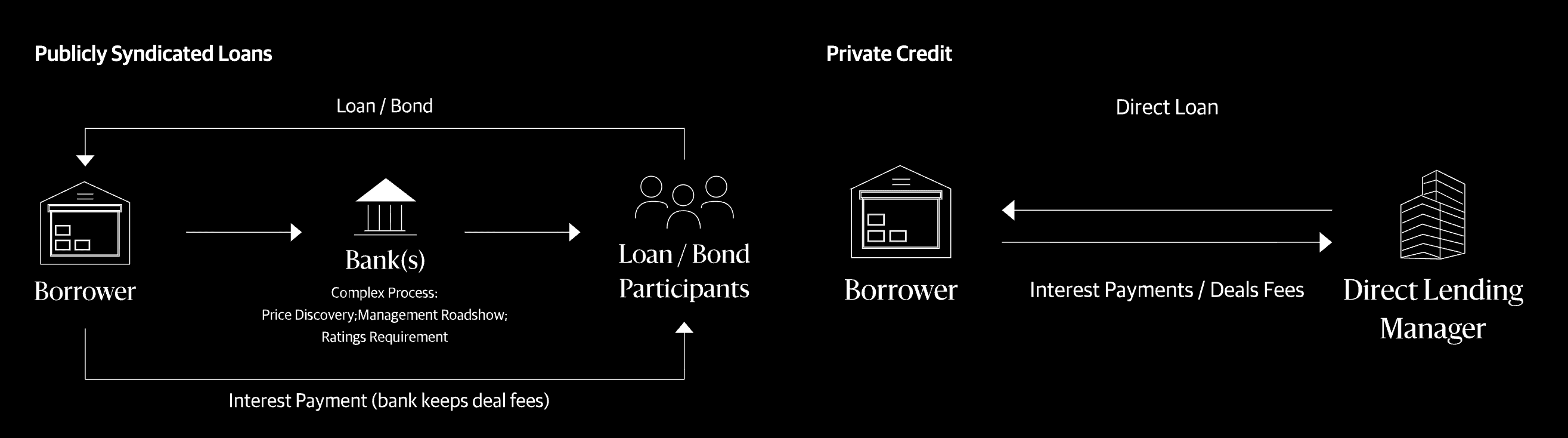
Traditional investment banks (think: Goldman Sachs, JPMorgan) use public markets to lend to large businesses. These institutions typically underwrite a loan, distribute it to investors as "term loans" or bonds, and collect fees along the way. With private credit, the loan goes directly to the borrower, with the lender generally holding it to maturity. Because they aren't traded on public markets, they're illiquid, which contributes to higher interest rates, alongside other factors.
1440 Findings
Hours of research by our editors, distilled into minutes of clarity.


Explore Business & Finance
The United States is home to more than 33 million businesses, the vast majority of which are small businesses, with millions being created (and others closing shop) every year. These businesses often rely on loans, provide the goods and services that keep the economy flowing, and sometimes even grow large enough to enter public markets or provide private investment opportunities. Explore key topics central to business and finance, from the role of the Federal Reserve to how initial public offerings work, how millions of American students finance higher education, and more.
Featured Topics
- 401(k)
- Amazon
- Bankruptcy
- Bitcoin
- Bonds
- Capital Gains
- College Tuition
- Consulting
- Creator Economy
- Credit Unions
- Federal Reserve
- Gig Economy
- Individual retirement accounts
- Inflation
- Initial Public Offerings
- Investment Banking
- Labor Unions
- Life Insurance
- Macy’s
- Minimum Wage
- Mutual Funds
- OpenAI
- Startups
- Stock Market
- Student Debt
- US Currency
- Venture Capital
- Wall Street
- Warren Buffett
- Y Combinator