Big Bang

1440 Findings

Hours of research by our editors, distilled into minutes of clarity.

  • Pinned

    A facility at CERN is dedicated to creating and analyzing anti-hydrogen

    Dubbed the "antimatter factory," the site was built to study the properties of dark matter and identify any inconsistencies with existing particle physics models. Antimatter particles have the same mass as normal matter, but opposite charge and other quantum properties.
  • The Big Bang theory describes how the universe began and continues to expand

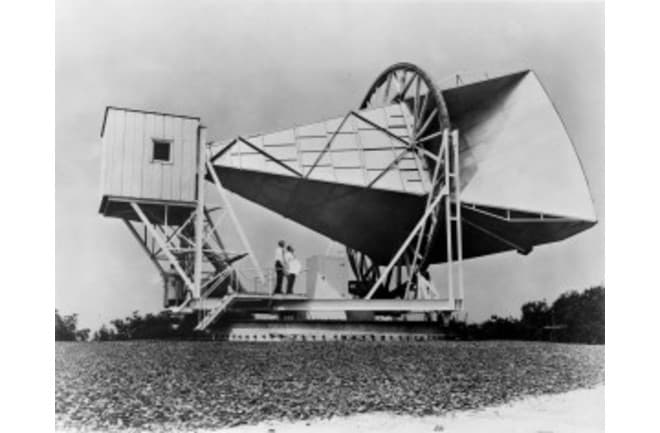
    Rooted in Lemaître’s 1927 idea of a growing universe and confirmed by Hubble’s redshift data, the theory is backed by evidence like cosmic microwave background radiation—remnants of the universe’s fiery birth detected in the 1960s. The radiation was first misidentified as interference from pigeon droppings inside a telescope antenna.

  • The cosmic microwave background is the faded light of when the universe glowed orange

    About 400,000 years after the Big Bang, the universe cooled enough for atoms to form, releasing a burst of orange-hued thermal radiation that has since redshifted into microwaves we now detect as the CMB. No matter where you point a detector in space, the CMB signal is always there.

  • After the Big Bang, the universe's current composition was built in stages

    The Big Bang theory describes the universe beginning 13.7 billion years ago as an ultra-dense point, followed by stages, like the radiation- and matter-dominated eras. Each era was responsible for a unique element, such as the cosmic microwave background and atomic nuclei.

  • Modern physics suggests that many universes with different physical laws could exist

    Physicists suggest that quantum fluctuations in the early universe could have given rise to these universes. Ancient Greek philosophers like Chrysippus proposed a version of the multiverse over 2,000 years ago—millennia before its adoption into various theoretical frameworks today.

  • The universe expands by stretching space itself, not into anything beyond it

    Thanks to Einstein’s relativity and Hubble’s observations, scientists understand that space stretches, like rising bread dough between raisins, with no "outside" to expand into. Some theories suggest our universe might be just one "bubble" in a vast multiverse, possibly floating on a higher-dimensional surface called a brane.

Explore Science & Technology

Since our ancient human relatives began using stone tools to perform tasks, humans have harnessed scientific knowledge and new technologies to expand the boundaries of our understanding of the natural world. From quantum computing and microplastics to artificial intelligence and memory, explore these topics and more with our concise yet informative overviews and expert-curated resources.

View All Science & Technology