Albert Camus

Overview

Albert Camus was an Algerian-born French writer known for his philosophical novels and essays. He was born into poverty in 1913 and, despite an ongoing struggle with tuberculosis, earned a degree and pursued a career in journalism. His novels—"The Stranger," "The Plague," and "The Fall"—were popular upon release and were cast as reactions to the horrors of World War II.

1440 Findings

Hours of research by our editors, distilled into minutes of clarity.

  • Camus was born in Algeria, but was considered French

    French Algeria was segregated between Arabs and "pieds-noirs," which was then a derogatory name for the million-plus Europeans living in the North African country. Camus was one of the latter, and throughout his life, he argued for political rights for Arabs while also believing the country should remain part of France. Pieds-noirs largely fled the country after it gained independence in 1962.

  • Camus grew up in poverty

    Albert Camus' father died when he was less than a year old, leaving his mother, a cleaning woman, and his grandmother to raise him in a poor neighborhood of Belcourt (now Belouizdad). It was an experience he'd reflect on in his unfinished autobiographical novel, "The First Man."

  • Camus credited a teacher with his success

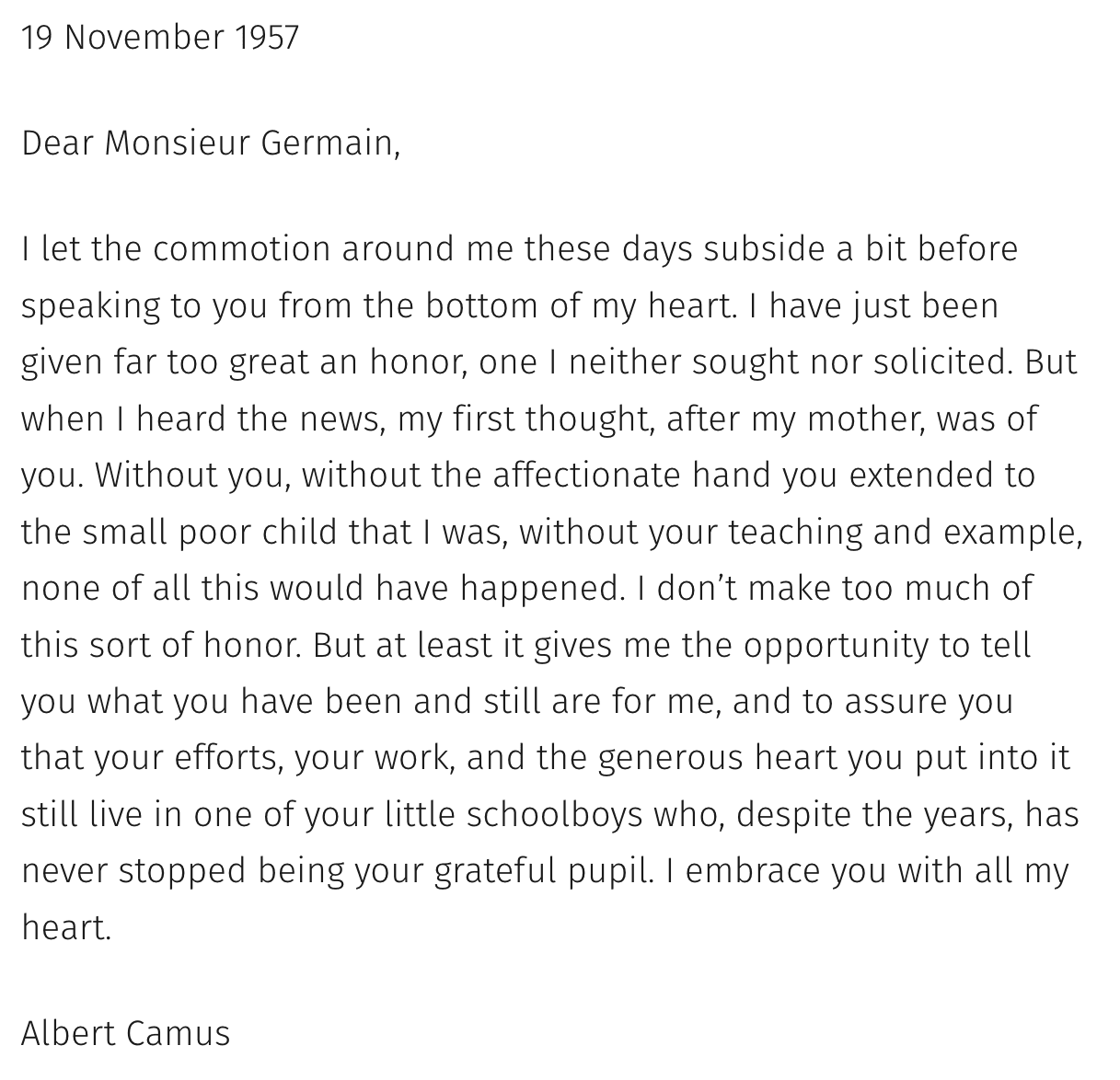
    After winning the Nobel Prize in literature in 1957, Camus wrote a letter to Louis Germain, his former teacher, thanking the man for "the affectionate hand" he extended to Camus as a student. In the short note, he'd go on to write, "without your teaching and example, none of all this would have happened."

  • Camus contracted tuberculosis as a teenager

    There was still little understanding of treatment for the disease at the time; for most people, a tuberculosis diagnosis was a death sentence. The 17-year-old Camus was quarantined in his uncle's house, where he grew into an avid reader. Scholars note that the experience would inform his later work, including his 1947 novel "The Plague."

  • Camus was a soccer goalie as a teenager

    The writer played for Algiers Racing University but had to quit after contracting tuberculosis. He remained a fan, though, once suggesting that the game taught him important lessons about morality. In the 1957 interview below, he briefly reflects on his time as a goalie and speaks about his recent Nobel Prize.

  • Camus edited an underground newspaper during World War II

    The paper, called "Combat," was aligned with the French Resistance fighting against the Nazi occupation. Like his fiction, his journalism was clear-eyed: When Hiroshima and Nagaski were bombed, he criticized the many writers impressed with the destruction, writing, "our technical civilization has just reached its greatest level of savagery."

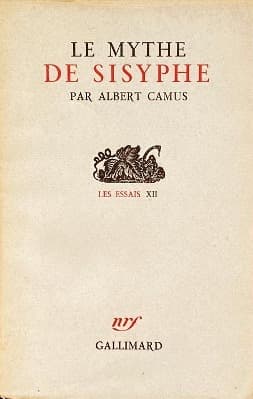
  • Read Albert Camus' 'Myth of Sisyphus and Other Essays'

    Camus' most famous work of nonfiction is this collection of philosophical essays. Perhaps the most resonant entry is the title essay, which reimagines the Greek myth of a man condemned to roll a boulder for all eternity. Rather than presenting the story as a cautionary tale about defying the gods, as the original myth intended, Camus considered Sisyphus an "absurd hero" for his actions and imagined him smiling as he endlessly toiled at his repetitive punishment.

  • Albert Camus believed existence was 'absurd'

    He didn't use "absurd" as we often do—meaning something silly—but instead to describe humans' desire to ascribe meaning and transcendence in a world that provided neither. Camus believed we needed to acknowledge and accept this absurdity rather than hopelessly believing we'd one day overcome it.

Explore Society & Culture

Art, music, sports, entertainment, movies, and many other subjects—these elements define who we are as a society and how we express ourselves as a culture. Take a deep dive into the topics shaping our shared norms, values, institutions, and more.

View All Society & Culture