The Airline Industry
Overview
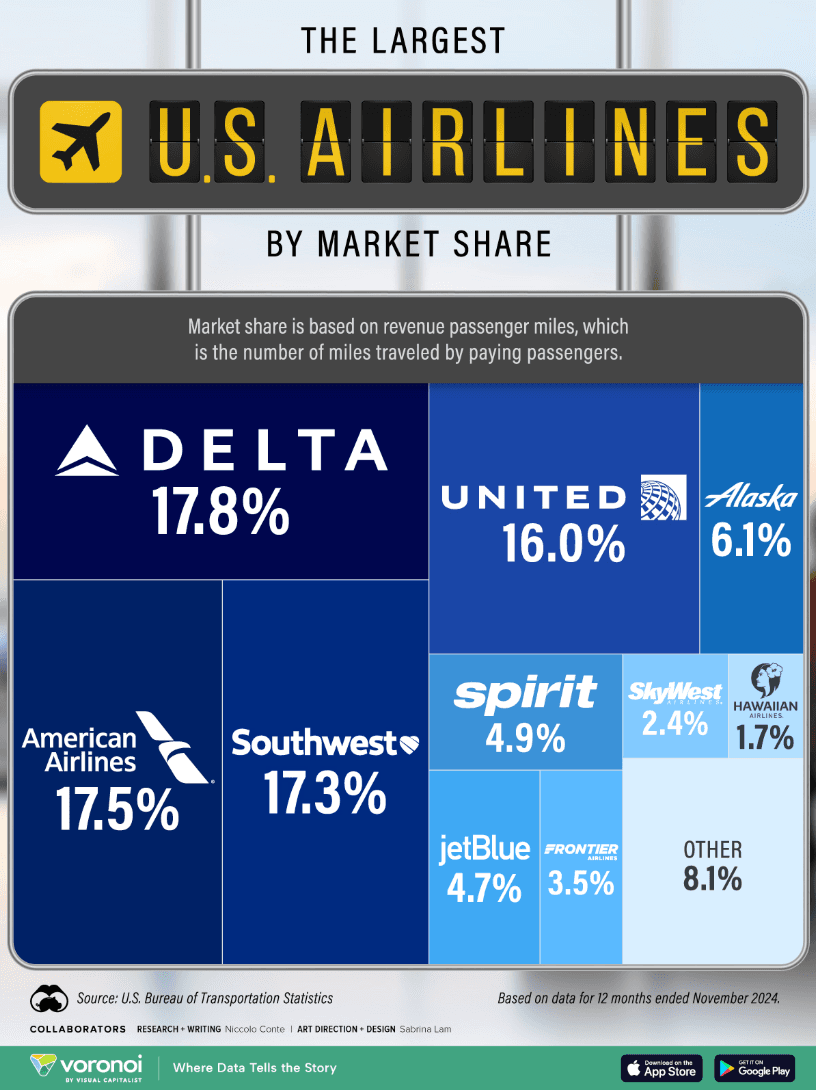
The commercial airline industry is a global network of airline companies that provide customers with seats on their flights in exchange for money, "miles," or "points." The global industry's publicly traded companies have a market cap of roughly $400B, with the top three US airlines by market cap being Delta (valued at roughly $47.9B), United (about $32.2B), and Southwest (about $20.1B) as of May 8, 2026.
Commercial airlines date back to the early 1900s, when the first commercial passenger airlines (like Florida's St. Petersburg–Tampa Airboat Line) were founded. In its early days, all fliers got the same level of service, as flying was a luxury that only the equivalent of today's first-class travelers could afford. But after WWII in the late 1940s, airlines began retrofitting cheaper military aircraft, packing in more seats, and introducing coach class to attract mass-market travelers.
As a result, differentiated pricing became the only viable business model. Today, most traditional airlines generate roughly two-thirds of passenger revenue from those in first, business, or premium economy classes combined. About 10% to 21% of their revenue stems from loyalty programs, and most earn no money on economy travelers, with the exception of budget airlines.
1440 Findings
Hours of research by our editors, distilled into minutes of clarity.







Explore Business & Finance
The United States is home to more than 33 million businesses, the vast majority of which are small businesses, with millions being created (and others closing shop) every year. These businesses often rely on loans, provide the goods and services that keep the economy flowing, and sometimes even grow large enough to enter public markets or provide private investment opportunities. Explore key topics central to business and finance, from the role of the Federal Reserve to how initial public offerings work, how millions of American students finance higher education, and more.
Featured Topics
- 401(k)
- Amazon
- Bankruptcy
- Bitcoin
- Bonds
- Capital Gains
- College Tuition
- Consulting
- Creator Economy
- Credit Unions
- Federal Reserve
- Gig Economy
- Individual retirement accounts
- Inflation
- Initial Public Offerings
- Investment Banking
- Labor Unions
- Life Insurance
- Macy’s
- Minimum Wage
- Mutual Funds
- OpenAI
- Startups
- Stock Market
- Student Debt
- US Currency
- Venture Capital
- Wall Street
- Warren Buffett
- Y Combinator