Posted by Dina Fine MaronAug 3The idea of a tongue map has been discredited, but taste sensitivity can vary across the tongue.Show 3 more findings ZoomThe tongue map and the spatial modulation of taste perceptionNational Institutes of Healthhttps://www.ncbi.nlm.nih.gov/pmc/articles/PMC8956797/
Posted by Teddy BurkhardtMay 7, 2025A timeline of the science of taste discoveriesThe tongue is made up of four types of papillae—elevated, nipple-like projections that give the organ its rough texture. In the early 1900s, initial research into the tongue's varying taste sensitivity led to a misleading map of the tongue and its taste regions. Over the decades, researchers fleshed out five distinct tastes (and more recently, a sixth). ZoomNaturehttps://www.nature.com/articles/486S2a/figures/1
Posted by Dina Fine MaronAug 3Humans have taste receptors throughout the body, including in the testes and lungs, but we don't taste what they detect because those areas lack taste buds.Show 2 more findings ZoomGut feelingsBig Thinkhttps://knowablemagazine.org/content/article/health-disease/2018/gut-feelings
Posted by Drew SteigerwaldJun 4, 2024Breaking down various tongue disorders, from infections to geneticsTaste is one of our fundamental senses, but can be impeded by a wide variety of conditions including glossitis, angioedema, and black hairy tongue. Most are characterized by their color, shape, and sometimes change in function. Causes range from vitamin or mineral deficiencies to fluid accumulation, fungal infection, or more. 6:42Understanding Tongue Disorders: Causes and Managementhttps://www.youtube.com/watch?v=C1NTTIf9Uxs
Posted by Dina Fine MaronFeb 19The research that led to sourScientists are trying to figure out if there are unique receptors that respond to the molecules that make up flavors we associate with calcium, blood, batteries, and other items that often escape dinner menus. Taste researcher Dr. Danielle Reed says the minimum evidence for a taste category typically involves identifying dedicated receptors and then removing them to show the taste vanishes.TASTE BUDDIES: The Controversial World Of Taste Science : Short WaveShort Wavehttps://open.spotify.com/episode/5CqDzNjqizUYfDYjjrZelf?si=4b07ca4b4000459f
Posted by Drew SteigerwaldSep 6, 2024Taste buds have evolved to fill a wide variety of functionsTaste buds do more than let you experience your favorite food. These peripheral organs can sense the chemical makeup, potential toxicity, and fleeting experience of flavor, giving the body a chance to respond to undesirable chemicals or tell the brain that you should reach for another scoop. 4:17Why Your Taste Buds Are More Important Than You Think1440 Originalshttps://www.youtube.com/watch?v=Q5HtJDKrt1o
Posted by Dina Fine MaronFeb 19Many parts of the body, including the testicles, have bitter, sweet, and umami receptorsTaste receptors—the tiny cells that report the chemical makeup of external stimuli to the brain—in the testicles don't "taste" in the same way as the gustatory ones you use to determine if there's enough sugar in your tea. Research suggests that these "teste" receptors can sense bitter, sweet, and umami compounds and use that chemical input to control physiological processes or (literally) change direction. (Some users may experience a paywall.) ZoomTaste perception: from the tongue to the testishttps://academic.oup.com/molehr/article/19/6/349/1061673
Posted by Dina Fine MaronJan 12, 2024How texture affects tasteTexture is the brain's interpretation of several sensations, including pressure, as registered by our teeth, tongue, and finger tips, and sound, as recorded by our ears. Texture also speaks to food particle sizes—smaller than 35 microns contributes to the sensation of creamy—and the balance between flavor and mouth time, such as the crunch of a crispy chip or the bounce of a chewy caramel. ZoomAll the Feels: How Texture Makes Taste - GastropodGastropodhttps://gastropod.com/all-the-feels-how-texture-makes-taste/
Posted by Dina Fine MaronMar 12Cats have a mutation that prevents them from tasting sweetness, and goldfish rank among the world's supertasters.Show 5 more findings ZoomEvolutionary biology: The lost appetites | NatureLimited AccessNaturehttps://www.nature.com/articles/486S16a
Posted by Dina Fine MaronJan 13, 2024These cells 'taste' danger, trigger immune responsesTaste receptor-coated tuft cells are found throughout the body, where they communicate with and take part in a growing list of biological processes. In the intestines, these taste receptor-studded cells can sense byproducts of parasite metabolisms. This causes the taste receptors to release chemicals that alert the immune system, order nearby goblet cells to produce mucus, and trigger muscle contractions in attempts to launch the parasites from the intestines. ZoomCells That ‘Taste’ Danger Set Off Immune ResponsesQuanta Magazinehttps://www.quantamagazine.org/tuft-cells-that-taste-danger-set-off-immune-responses-20191115/
Posted by Dina Fine MaronJan 11, 2024Each taste bud has 10 to 50 sensory cells that form a flower-like capsuleAt the top of the structure are thin filaments known as "taste hairs" that bind taste-producing substances to the surfaces of the cell, after which corresponding electrical signals are sent to the brain. Adults have 2,000 to 4,000 taste buds on their tongue. ZoomDistinct representations of basic taste qualities in human gustatory cortexNational Institutes of Healthhttps://www.ncbi.nlm.nih.gov/books/NBK279408/
Posted by Dina Fine MaronJan 9, 2024Octopuses have taste receptors along their tentaclesOctopus suction cups are filled with modified sensory receptors that can bind with a greater variety of materials and transport a wider array of information, such as flavor, from tactile stimuli. These structures allow the animal to search for food as it crawls the ocean floor. 8:17Mutated neuroreceptor lets octopuses taste with their armsNaturehttps://www.youtube.com/watch?v=Ng4sQvLDRPI
Posted by Teddy BurkhardtJan 11, 2024How our sense of taste evolves as we ageKids are hardwired to prefer sweets over greens, with sweetness a shorthand for calorie-rich and bitter flavor warning of potentially noxious plants. This holds true even in the womb, where fetuses have been seen via ultrasound scans grimacing as their hosts consume kale capsules. As they age into double digits and beyond, their taste cells and sense of smell diminish, leading to broader and less sensitive palates. ZoomWhy Does Our Sense of Taste Change As We Get Older?Discover Magazinehttps://www.discovermagazine.com/health/why-does-our-sense-of-taste-change-as-we-get-older
Posted by Dina Fine MaronJan 13, 2024The tongue evolved in animals roughly 350 million years agoCreatures like fish rely on suction to consume food, flexing their gills to create water currents that vacuum up their meals. The evolution of the tongue enabled vertebrates to completely cut ties with the sea, moving onto land where they could sample new foods and ways to eat them. ZoomHow the tongue shaped life on EarthSciencehttps://www.science.org/content/article/how-tongue-shaped-life-on-earth
Posted by Dina Fine MaronMar 24Our sense of smell affects what foods taste like and how we perceive itScent stimulates our olfactory sensor neurons high in the nasal cavity, and the brain attaches labels to those scents. But when we eat, chemicals from the foods travel from our mouths and throat to those neurons. We have roughly 400 odor receptors, and they can be used to decipher more than 10,000 different odors (or more than one trillion by some calculations), including the nuances of different foods. 2:55TED-Edhttps://www.youtube.com/watch?v=3NFTa9kTVRU
Posted by Dina Fine MaronJan 9, 2024How bitter taste receptors help guard against infectionReceptors for "bitter" tastes evolved to detect potentially harmful plant chemicals, such as nicotine. The receptors also trigger bacteria-fighting responses, including waving hairlike projections to bat away bacteria, ordering the release of bacteria-killing nitric oxide, and calling for antimicrobial protein reinforcements. ZoomHow Bitter Taste Receptors Defend the Body against Bacteriahttps://academic.oup.com/emph/article/9/1/431/6395358
Posted by Dina Fine MaronJan 27Neural replays in mice help explain food aversionsPrinceton University scientists published research in 2025 analyzing how mice learn to associate certain foods or flavors with feeling ill—even when there’s a time gap between eating something and feeling sick. The work, performed with grape Kool-Aid and injections of a substance that made mice sick, traced the literal “gut reaction” of how gut distress signals are linked to neural replays of what the mouse ate.Food & Winehttps://www.foodandwine.com/how-your-brain-remembers-food-poisoning-11714890
Posted by Dina Fine MaronFeb 19Ammonium may be the sixth basic tasteResearchers have proposed various candidates for the sixth official taste, including "fat." But research published in 2023 posits that ammonium should be considered the sixth taste since they found humans can apparently detect ammonium chloride, which the scientists describe as "bitter, salty, and a little sour." Detecting ammonia could be a survival mechanism to help detect when certain foods, including seafood, are no longer safe to eat. The work hinged on experiments with human cells exposed to ammonium chloride as well as rodent research. Healthlinehttps://www.healthline.com/health-news/new-sixth-basic-taste-ammonium#The-bottom-line
Posted by Dina Fine MaronApr 20Babies taste food in the womb via amniotic fluid, and it may influence future taste buds.Show 2 more findings ZoomWhat to Expecthttps://www.whattoexpect.com/pregnancy/fetal-development/fetal-taste/
Posted by Teddy BurkhardtJan 11, 2024How science came to understand umamiBefore Dr. Kikunae Ikeda sat down in 1907 and pondered the taste of dashi, scientists typically agreed upon four types of taste: sweet, salty, bitter, and sour. He boiled 90 pounds of kelp into a resin that he then stripped of different compounds until he was left with a single ounce of brown crystals. Testing later revealed these crystals were glutamate, an amino acid and one of the protein's building blocks. ZoomAccounting for TasteScience History Institutehttps://www.sciencehistory.org/stories/disappearing-pod/accounting-for-taste/
Posted by Dina Fine MaronFeb 19Fat is proposed as a candidate sixth basic tasteOleogustus is Latin for "a taste for fat," and researchers proposed in 2015 that it should be accepted as the sixth basic taste. This article teases apart exactly what it would take to officially be considered the sixth taste and why researchers think the fat taste may be a strong candidate. NPRhttps://www.npr.org/sections/thesalt/2015/08/02/428643391/oleogustus-is-the-newly-discovered-taste-and-boy-is-it-bad
Posted by Dina Fine MaronMar 24Humans can track smells on the ground quite well—our ability to crawl is a limiting factorAs part of a scientific bet, neurobiology researchers dragged a chocolate bar across the grass and sought to see if a human could track it—she could. This led to a more in-depth experiment on human olfactory capabilities and behavior when other senses were blocked.Huberman Labhttps://ai.hubermanlab.com/clip?sids=chunk_82310
Posted by Teddy BurkhardtAug 26, 2022Your DNA may determine whether you like coffee or teaWhether people prefer coffee or tea may boil down to a matter of taste genetics. People with a version of a gene that increases sensitivity to the bitter flavor of caffeine tend to be coffee drinkers, according to a report. Read on for more. ZoomCoffee or tea? Your preference may be written in your DNAScience Newshttps://www.sciencenews.org/article/coffee-tea-preference-dna-chemical-sensitivity-taste
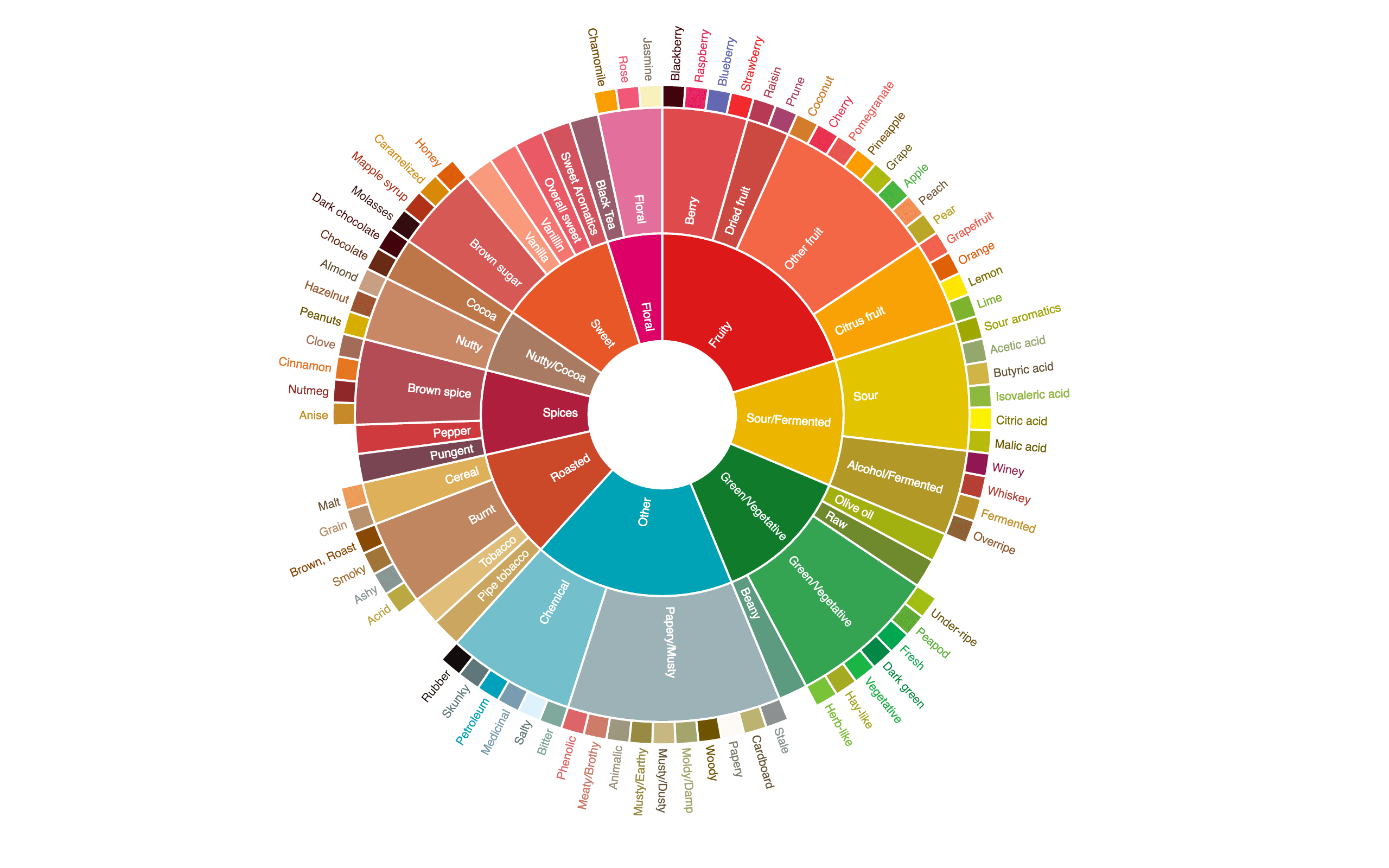
Posted by Teddy BurkhardtJun 8, 2023Cultivate your coffee taste with this interactive flavor wheelCoffee is one of the more complex things humans consume, and taste can vary drastically based on bean genetics, roasting technique, and more. Using this flavor wheel, you can more accurately describe your coffee's aroma by starting from the center and moving outward. ZoomInteractive Coffee Taster’s Flavor Wheelhttps://notbadcoffee.com/flavor-wheel-en/
Posted by Teddy BurkhardtMay 24, 2023Mapping the origins of the world's cropsFood has evolved alongside humanity, and through globalized trade, much of the world can enjoy foods once isolated to one region. Examine where your favorite foods originated from and see how diet differs across cultures with these interactive... ZoomOrigin of crops | CIAT Bloghttps://blog.ciat.cgiar.org/origin-of-crops/
Posted by Marco Daniel MachadoJul 30, 2025Individuals with synesthesia experience involuntarily overlapping sensations Tasting words or seeing colors in music results from the brain retaining extrasensory connections from infancy. While most lose these neural pathways during development, about 4% of people are synesthetes, maintaining them without realizing it's unusual. 13:10The Weird Reason Some People Can Taste ColorsBe Smarthttps://www.youtube.com/watch?v=pPIem63bC4w
Posted by Dina Fine MaronMar 24When humans perceive touch, the information is sent to the thalamus and then to the primary somatosensory cortex, the part of the brain that receives sensory input.Show 4 more findings 2:002-Minute Neuroscience: Primary Somatosensory Cortexhttps://www.youtube.com/watch?v=8hDoO0wcq8Q
Posted by Jeremy CronigMay 20Exposing fetuses to certain flavors in the womb could lead to children being less picky eatersA new study found that 3-year-olds were less averse to the smell of vegetables they had been repeatedly exposed to in utero, suggesting that what mothers eat in late pregnancy can leave a lasting imprint on their children's tastes.Want to Avoid Having a Picky Eater? Start Exposing Your Kids to Veggies Super Early—in the WombSmithsonian Magazinehttps://www.smithsonianmag.com/smart-news/want-to-avoid-having-a-picky-eater-start-exposing-your-kids-to-veggies-super-early-in-the-womb-180988750/
Posted by Marco Daniel MachadoMay 6The importance of volatile aroma compounds in the flavor quality of foodProcesses such as air movement and heating cause food to lose aroma molecules, which studies have shown play a major role in our sense of taste. While losing these molecules to the environment leaves fewer to be processed during consumption to intensify flavor, it can also produce previously nonexistent aroma compounds or release previously trapped ones, altering or enhancing the food's flavor. 6:42MinuteFoodhttps://www.youtube.com/watch?v=FBwbuojWwfo
Posted by Dina Fine MaronMar 24We can sense touch even through a toolResearch published in 2019 indicates that the same brain regions involved in sensing touch on the body also process it when humans use a tool to do the touching. Essentially, it's acting as a sensory extension of the body. (Some users may experience a paywall.)The Brain Senses Touch beyond the BodyScientific Americanhttps://www.scientificamerican.com/article/the-brain-senses-touch-beyond-the-body/
Posted by Teddy BurkhardtJan 9, 2025How do maps get their place names in multilingual areas?In countries with multiple local dialects, cartographers struggle to standardize place names enough to create maps of the region. This process inevitably leads to conflict. Case in point, Switzerland, where in the late 1800s many dialects called the same places by different names, leading one alienated community to demand the return of its local names. Read about this and several other examples of contentious place-naming on maps here. ZoomMaps and Switzerland’s linguistic destinyhttps://blog.nationalmuseum.ch/en/2025/01/maps-and-switzerlands-linguistic-destiny/
Posted by Marco Daniel MachadoNov 19, 2025Color originates from the brain processing light of varying wavelengthsVarious geometric models, including Newton's color circle of hue and saturation and the horseshoe-shaped XYZ space for mixing colors via vector mathematics, have been proposed to describe colors accurately. However, these models do not encapsulate the variety of psychological effects that cause perceived colors to differ from mathematical representations. 19:35The "Geometry" of Colourshttps://www.youtube.com/watch?v=7KYwi2F5Ce4
Posted by Dina Fine MaronAug 10Our love of chocolate may have more to do with how it ferments than previously realized—with specific microbes associated with more fruity or acetic tastes. Show 4 more findings ZoomHow scientists are perfecting chocolateKnowable Magazinehttps://knowablemagazine.org/content/article/food-environment/2026/how-scientists-are-perfecting-chocolate
Posted by Marco Daniel MachadoMay 6Why the Scoville scale for measuring a pepper's heat is outdated and inadequate for saucesDeveloped in 1912 by American pharmacist Wilbur Scoville, the scale is a subjective test in which testers determine the dilution at which capsaicinoids—the molecules that give peppers their heat—are no longer detectable. Modern chemical analyses can accurately quantify the amount of these molecules in peppers, which are diluted to varying degrees in sauces, thus affecting their net spiciness. 1:51First We Feasthttps://www.youtube.com/shorts/ssZJ5F9RF50
Posted by Dina Fine MaronMar 16How the five senses share information with each otherThe human body depends on information from the five sensory organs—the eyes, ears, nose, tongue, and skin—to react to the world around it. Each of these organs, in its own way, relies on complex circuitry to send signals back to the central nervous system. 3:11Visible Body | The 5 Senses - Sight, Sound, Smell, Touch, and Tastehttps://www.youtube.com/watch?v=QQFn3nosydw
Posted by Dina Fine MaronMar 24A stand-in 'nose' may help people with anosmia to smell certain odorsIn a 2025 paper, researchers reported they'd created a proof-of-concept device that bypasses typical olfactory pathways and instead exploits an alternative—the trigeminal nerve in the nose—to detect a few strong scents. The nerve typically helps detect the temperature of inhaled air or the presence of irritants. (Some users may experience a paywall.)Sciencehttps://www.science.org/content/article/artificial-nose-tells-people-when-certain-smells-are-present
Posted by Dina Fine MaronJun 23Paul Broca, a French brain researcher in the 19th century, hypothesized that humans evolved to trade in our "bestial sense" of smell for higher brain capacity.Show 4 more findings ZoomWhen the ability to smell goes awayKnowable Magazinehttps://knowablemagazine.org/content/article/health-disease/2026/what-happens-brain-lose-sense-of-smell
Posted by Teddy BurkhardtJul 5, 2024Tannins contribute to a wine's compositionTannins are compounds found in many different types of food, including grape skins. When consumed, they produce a noticeable drying effect in the mouth. Because of the difference in production methods, red wines typically have tannins while white wines do not. 4:00Mastering Wine: What are Tannins in Wine?https://www.youtube.com/watch?v=8i991dPH0sQ
Posted by Dina Fine MaronMar 24Humans likely cannot tickle themselves because there's no element of surpriseUnraveling the neural mechanisms of tickling—formally called gargalesis—is an area of active research, but a leading theory about why we can't tickle ourselves is that the brain's somatosensory cortex processes self-touch differently than it does external touch. The cerebellum already anticipated what was going to happen when you move your hand for self-touch, limiting the effectiveness of a self-tickle.Why Can’t We Tickle Ourselves?https://www.the-scientist.com/why-can-t-we-tickle-ourselves-73123
Posted by Teddy BurkhardtNov 22, 2022Common mistakes we make about the world mapMaps have long loosely approximated what the world actually looks like. Here's a few common errors that persist due to outdated conceptions of the world. ZoomMisconceptionsArcGIShttps://storymaps.arcgis.com/stories/1e7f582d478a4b99bd0c70fffeac4c8b