Trader Joe's breaks every rule of modern retail
The successful grocer doesn't do e-commerce, delivery, or coupons. And yet Americans are still obsessed with Trader Joe's.
The United States is home to more than 33 million businesses, the vast majority of which are small businesses, with millions being created (and others closing shop) every year. These businesses often rely on loans, provide the goods and services that keep the economy flowing, and sometimes even grow large enough to enter public markets or provide private investment opportunities. Explore key topics central to business and finance, from the role of the Federal Reserve to how initial public offerings work, how millions of American students finance higher education, and more.
Hours of research by our editors, distilled into minutes of clarity.
The successful grocer doesn't do e-commerce, delivery, or coupons. And yet Americans are still obsessed with Trader Joe's.
No institution wields more power in US finance than the Federal Reserve—but opinion polls indicate that most Americans don't know what it does. Curious about the country's central bank? 1440's got your breakdown of how the Federal Reserve works.
Americans owe more than $1T to credit card companies. And with rising interest rates that prevent cardholders from paying down debt (not to mention the rising cost of living), that number is likely to keep growing. A podcast episode explains how the US got here, and what policymakers and individuals can do about it.
The US has the largest national debt and one of the highest debt-to-GDP ratios. These vitals have long been considered a sign of poor fiscal health, but economists are beginning to shift their attention to interest rates to evaluate national debt.
1440's editor-in-chief chatted with an economist in this podcast episode to unravel how college tuition really works, who carries the biggest debt, and why the system feels expensive.
From a young age, John D. Rockefeller knew he was interested in business. He worked as a bookkeeper and sold candy prior to starting the business empire that would help cement the Rockefeller name in history: Standard Oil.
The 1920s in the US "roared" with rapid economic growth after the conclusion of World War I. But in October 1929, the bubbly stock markets crashed dramatically, plunging the nation into the decadelong Great Depression.
Since the middle of the 20th century, higher education has been viewed as a stepping stone to well-paying professional careers for millions of Americans. But, it can be costly. As of 2024, annual tuition currently ranges from around $10K for an in-state, four-year public university to almost $40K for private institutions.
This milestone requires plenty of preparation, starting with the SEC's S-1 registration, revealing key details about the company's finances and strategy. Investment bankers set valuations, secure long-term investors, and finalize share pricing before the public launch. IPOs provide companies with significant capital, but also demand transparency and invite public scrutiny.
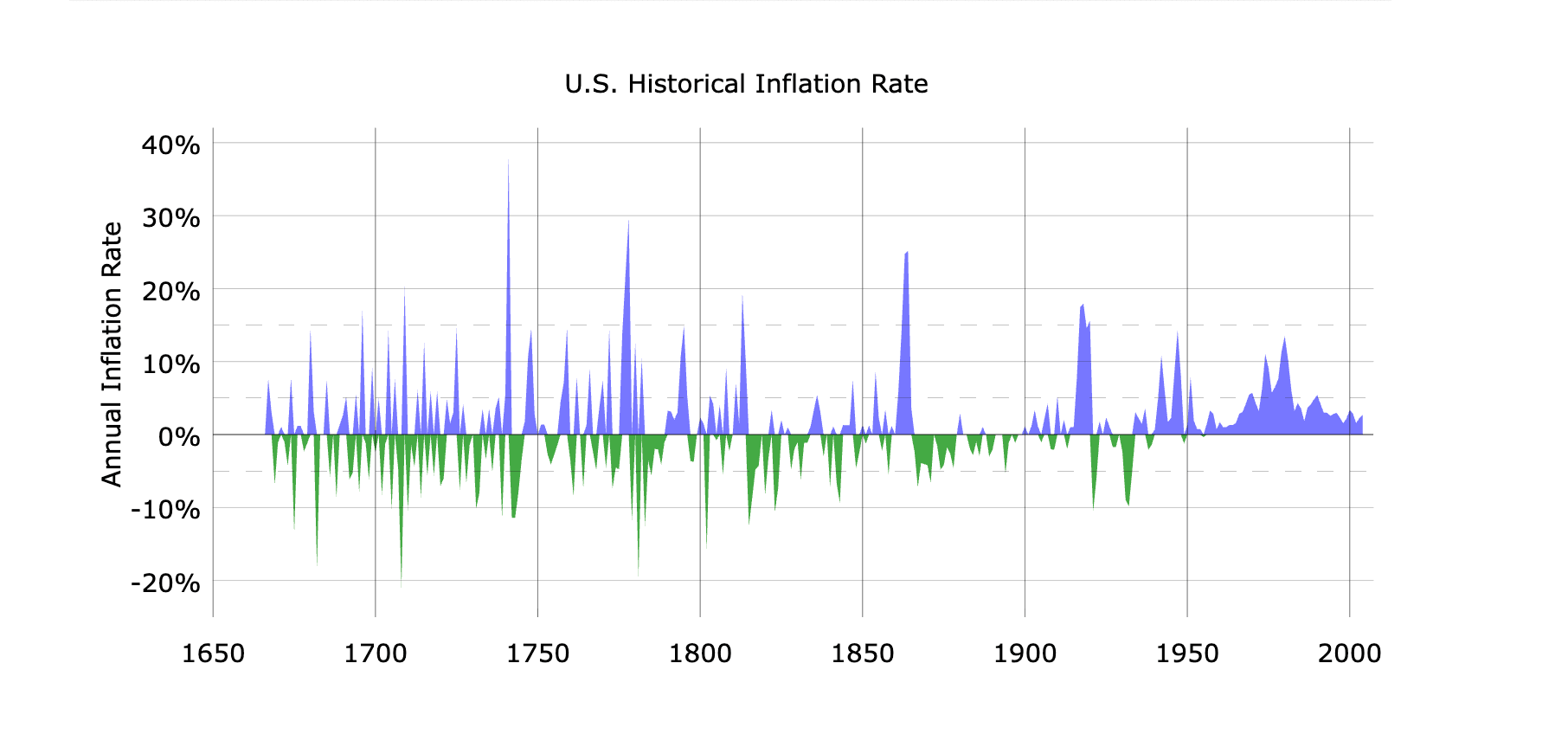
This was just after the Revolutionary War. Both World Wars also brought double-digit inflation. It's worth noting that exact inflation rates in early America are difficult to calculate precisely.
In New York City's Financial District, there's a bronze statue of a bull that attracts tourists from all over the world. But how did it get there, and what is it about the statue that makes people line up for photographs, day after day? Journalist PJ Vogt dives into the Charging Bull statue's origin story in a podcast episode (warning: some mature language).