The US federal government employs roughly 3 million people
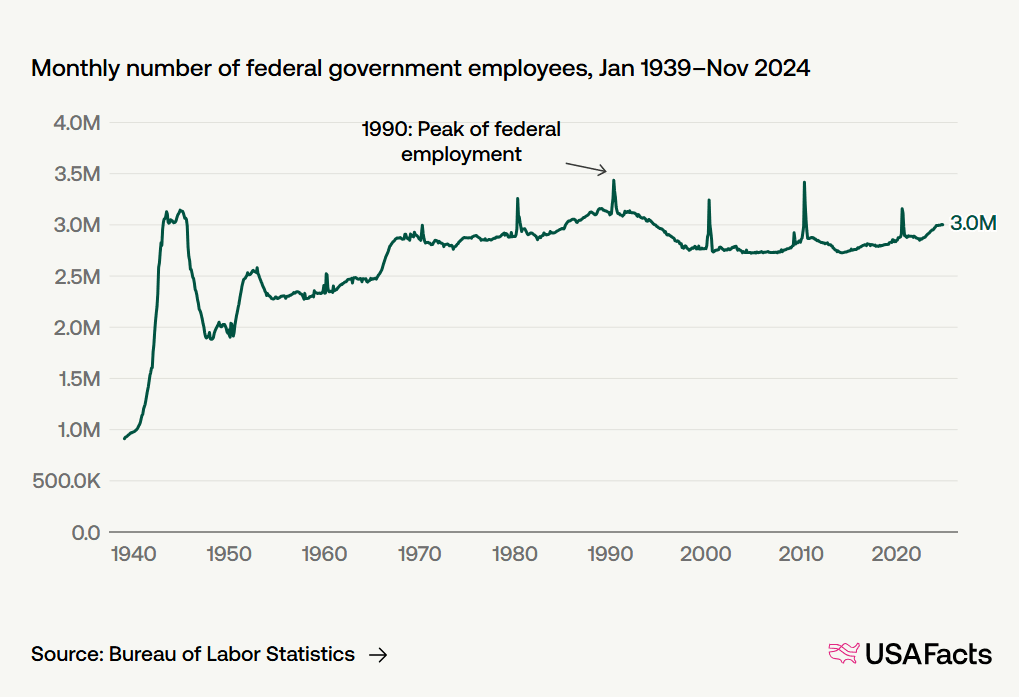
Tracking began in 1939, when the federal workforce consisted of about 1 million people. The total peaked in 1990 at 3.4 million, and hit a recent low in 2014 at 2.7 million.
Hours of research by our editors, distilled into minutes of clarity.
Tracking began in 1939, when the federal workforce consisted of about 1 million people. The total peaked in 1990 at 3.4 million, and hit a recent low in 2014 at 2.7 million.
This resource turns complex federal budget data into clear charts and summaries, letting users explore how much the government spends; where the money goes; and how revenue, deficits, and debt change over time.
Article I, Section 8's Spending Clause authorizes Congress to tax, pay debts, and promote the "common Defence and general Welfare," making it one of Congress's most powerful tools—and the constitutional foundation of federal budget control.
Before 1921, federal funding was fragmented and ad hoc. This article traces how inefficiency and postwar pressures led Congress to pass the Budget and Accounting Act, creating a standardized, centralized federal budgeting process.
Creating the federal budget starts months in advance. This resource explains each stage, showing how the president proposes priorities, Congress reshapes and approves funding, and federal agencies implement the final budget.
When lawmakers fail to pass a full budget, they rely on continuing resolutions to fund the government temporarily. This guide explains how CRs are enacted, how they function, and why they disrupt normal operations.
Federal spending is split between mandatory programs, funded automatically by law, and discretionary programs, funded through annual appropriations. This video breaks down which major programs fall into each category and why the distinction matters.
The US accounts for roughly 35% of global military spending, with defense taking up nearly half of discretionary funds. In this discussion, Michael E. O'Hanlon of the Brookings Institution explains why these levels are so high—and how they compare historically.
This interactive calculator challenges users to rebalance the federal budget by adjusting taxes and spending. Try your hand at weighing difficult trade-offs that shape long-term deficits, debt growth, and the sustainability of US public finances.
This US Treasury page explains what the national debt is, how it accumulates from annual deficits, and why rising debt can affect interest costs, fiscal flexibility, and long-term economic stability.
This US Treasury page explains how the federal deficit occurs when annual spending exceeds revenue, shows the current fiscal-year shortfall, and tracks how deficits rise and fall with economic conditions and policy choices.
The United States is home to more than 33 million businesses, the vast majority of which are small businesses, with millions being created (and others closing shop) every year. These businesses often rely on loans, provide the goods and services that keep the economy flowing, and sometimes even grow large enough to enter public markets or provide private investment opportunities. Explore key topics central to business and finance, from the role of the Federal Reserve to how initial public offerings work, how millions of American students finance higher education, and more.