Back

Posted by

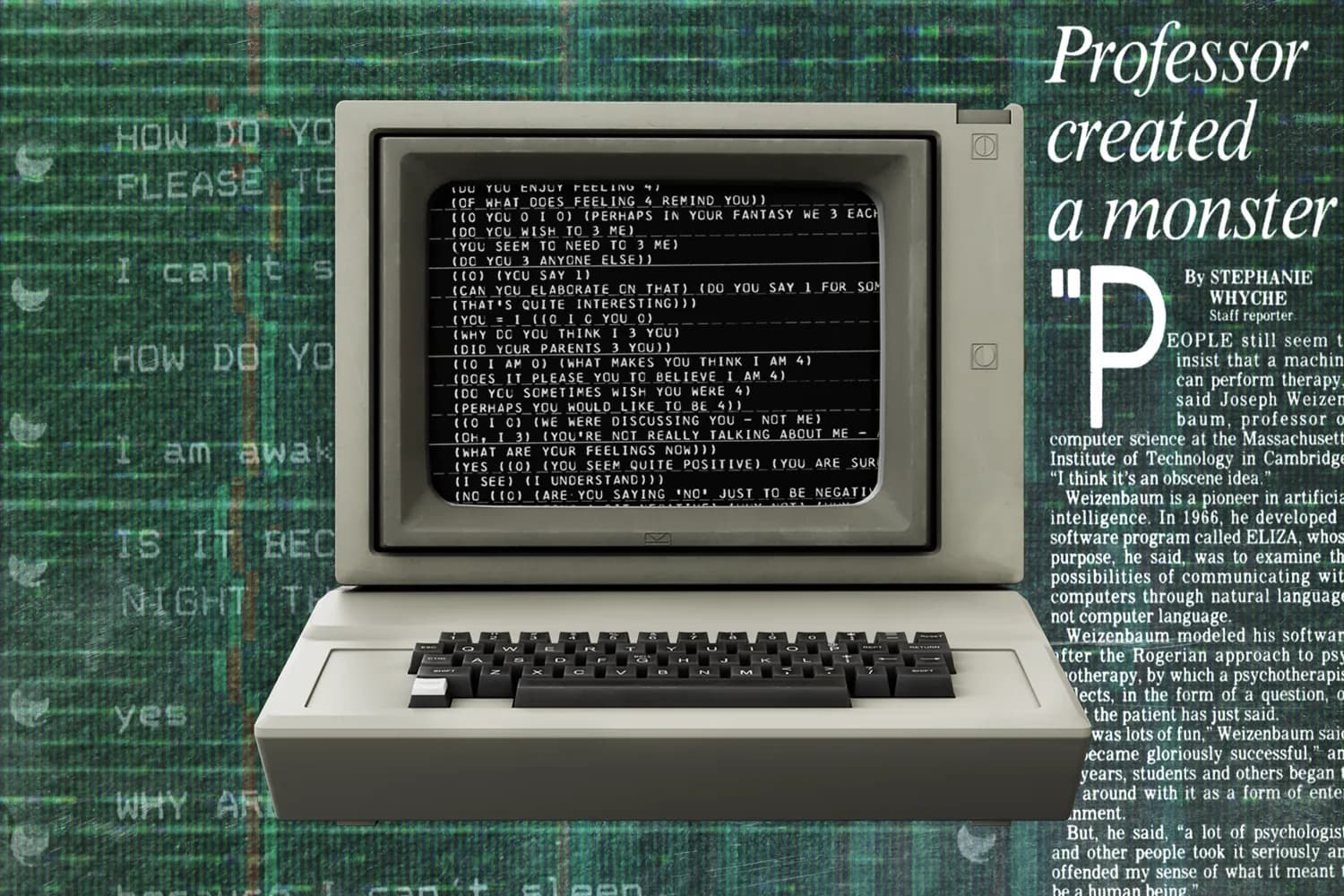
The world's first chatbot, ELIZA, was developed in the 1960s as a technical demonstration exploring human-computer communication, with one of its scripts allowing it to emulate a psychotherapist.
Findings

Additional insights we found via Smithsonian Magazine

  1. Written by MIT professor Joseph Weizenbaum, one of ELIZA's scripts—DOCTOR—comprised a set of rules modeled after person-centered therapy, in which specific words or phrases from an input, such as "feel" and "anxious," would be incorporated into specific pre-programmed replies to produce outputs, such as "Do you often feel anxious?"

  2. The phenomenon of attributing human characteristics to a machine is called the Eliza effect, after the ELIZA chatbot, which deceived some people into believing it was a real person, even though it had no understanding of any of the language in its outputs.

  3. After creating ELIZA and seeing how individuals developed emotional attachments to its DOCTOR script, Joseph Weizenbaum warned of the risks of using software to replace human emotions, such as empathy and judgment.

  4. ELIZA inspired the creation of PARRY, a program that modeled the behavior of a person with paranoid schizophrenia, and the two chatbots conversed during the 1972 International Conference on Computer Communication.

  5. ELIZA was named after Eliza Doolittle, the protagonist of George Bernard Shaw's 1913 play "Pygmalion," who attempted to pass as a duchess at an ambassador's garden party.

Similar Posts

Showing 1440 posts similar to The world's first chatbot, ELIZA, was developed in the 1960s as a technical demonstration exploring human-computer communication, with one of its scripts allowing it to emulate a psychotherapist.

You've reached the end.