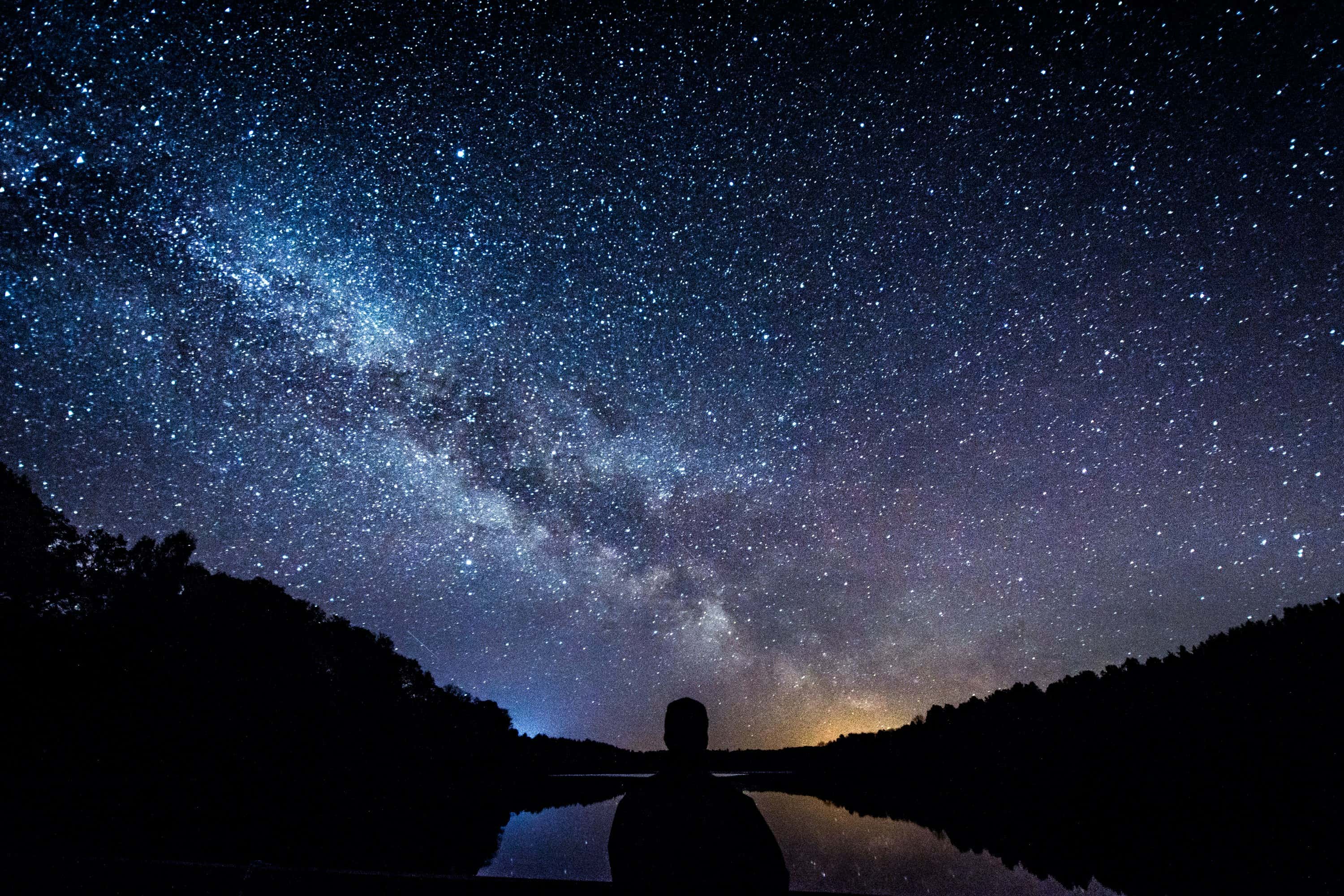
Person silhouetted against starry night sky above a calm lake surrounded by hills.

Science & Technology

Edited by Marco Daniel Machado

Dive into the dynamic world of science and technology, where curiosity has brought about extraordinary understandings of the universe and creativity has led to the breakthroughs and innovations that have transformed our world. Explore a wide range of topics, from the natural and physical sciences to cutting-edge technologies and the people who shaped them, each of which is accompanied by carefully curated resources meant to inform, engage, and inspire those eager to uncover the nature of reality.

Content on 1440 is curated and distilled by our team of human editors.
Read our use of AI for more details.

Posted by

Solid ground can behave like a liquid during earthquakes, causing objects to sink into or rise up from an otherwise rigid surface.

Posted by

Most people are exposed to radiation every day, but most of it is either harmless nonionizing radiation or negligibly small doses of ionizing radiation.

Posted by

Watch five AI models try to solve versions of the trolley problem and explain the ethics of how they choose one of two bad outcomes.

Posted by

Glow sticks shine brighter and burn out faster at warmer temperatures because the additional thermal energy increases the rate of the underlying chemical reaction.

Posted by

Water can hover and move against gravity when placed on a sufficiently hot surface—a phenomenon known as the Leidenfrost effect.

Posted by

Some octopuses change color while they sleep—a potential sign that they dream.

Posted by

Time zones were established in the 1880s because of railroads, which suffered from scheduling problems due to each town managing its own timekeeping.

Posted by

There may be up to 74,963 kinds of ice, each distinguished by differences in its density and the geometric arrangement of water molecules.

Posted by

Airplane mode isn't there to protect planes, but it does save your mobile device's battery life.

Posted by

Objects can be levitated by sound using an apparatus that causes these waves to interfere and combine, creating a 'pressure cage.'

Posted by

Earth's core is about as hot as the sun's surface due to leftover thermal energy from the planet's formation and heat from ongoing radioactive decay.

Posted by

If our universe had infinitely many stars, the night sky would still appear mostly dark—an apparent contradiction known as Olbers' paradox.

Posted by

Bolivia's Salar de Uyuni is considered the world's largest natural mirror, formed from a prehistoric lake that dried out about 40,000 years ago.

Posted by

'Lightsabers' can be created by holding fluorescent bulbs up to overhead power lines, causing the bulbs to light up without making contact.

Posted by

Replacing the sun with a black hole of identical mass would not change Earth's orbit, but life on Earth would collapse rapidly.

Posted by

The sun does not just get lower or higher in the sky throughout the year—it traces a figure-eight pattern called the analemma.

Posted by

Seaweed can collect critical minerals from ocean water, which can later be used in batteries, solar panels, and other clean-energy technologies.

Posted by

Gold can be dissolved by aqua regia—a combination of two acids that, on their own, cannot dissolve gold.

Posted by

Watch the birth of a neutron star, which takes less than one second, in this high-fidelity, 3D visualization.

Posted by

Hydras appear to be immortal, and each of the aquatic animal's individual cells can rebuild its entire body within days.

Posted by

It's always snowing in Earth's oceans, but marine snow is predominantly made of decaying organic material, not ice crystals.
Posted by

The Koch snowflake has an infinitely long border but can fit inside shapes with a finite area.