Black Holes

1440 Findings

Hours of research by our editors, distilled into minutes of clarity.

  • Pinned

    Falling into a black hole would stretch and shred your body beyond recognition

    As you approach a black hole, you initially feel weightless. Eventually, the difference in gravity between your feet and head would create a powerful stretching force that overcomes the molecular bonds in your body and pulls you apart.

  • The Event Horizon Telescope captured the first photo of a black hole in 2019

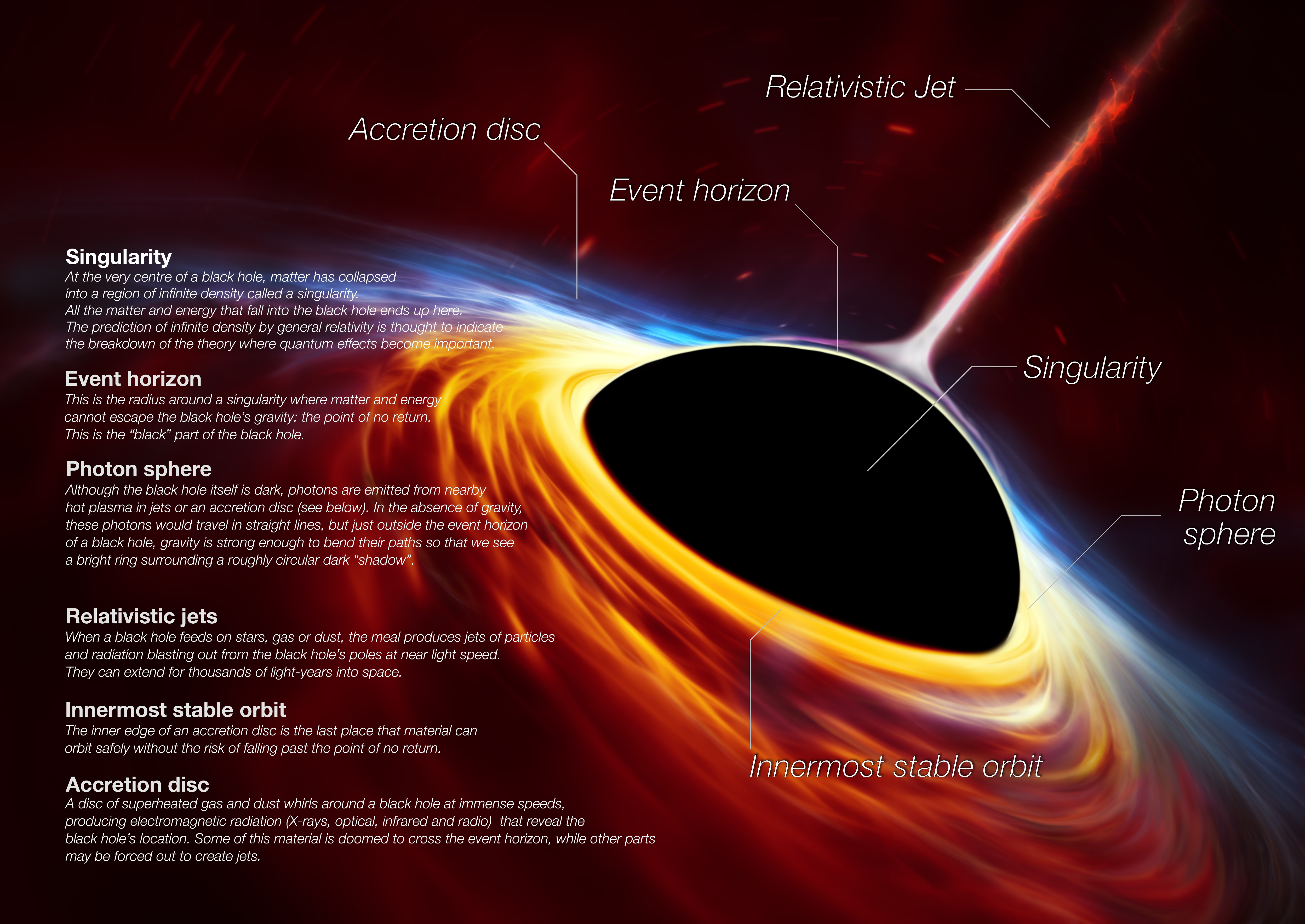
    Predicted by Einstein in 1916, these invisible objects can be indirectly seen through their accretion discs and X-ray bursts. Over 40 million trillion black holes may be scattered throughout the universe.

  • Black holes form from the collapse of massive stellar cores due to gravity

    Over time, less energy is released from the cores of massive stars as heavier elements are created through fusion. Once iron has been fused, energy is consumed rather than created, and runaway collapse creates a dense enough region where the stellar core existed to warp spacetime into a black hole.

  • General relativity redefined gravity as the curvature of spacetime

    The breakthrough came when Albert Einstein realized that freely falling is indistinguishable from weightlessness, leading him to the principle of equivalence between gravity and acceleration. His prediction that gravity bends light was confirmed in 1919 during a solar eclipse.

  • There may be as many as four types of black holes, categorized by their mass

    Three types are known to exist: stellar mass black holes, supermassive black holes, and intermediate black holes. A fourth type—micro black holes—is theoretical and would have the same mass as Mount Everest in a space the size of an atom.

Explore Science & Technology

Since our ancient human relatives began using stone tools to perform tasks, humans have harnessed scientific knowledge and new technologies to expand the boundaries of our understanding of the natural world. From quantum computing and microplastics to artificial intelligence and memory, explore these topics and more with our concise yet informative overviews and expert-curated resources.

View All Science & Technology