Stonehenge

1440 Findings

Hours of research by our editors, distilled into minutes of clarity.

  • Pinned

    Why was Stonehenge built?

    Located about 90 miles west of London, Stonehenge is one of the world’s most famous and mysterious prehistoric monuments. Built around the same time as Egypt’s Great Pyramid, this complex of giant stones, some weighing up to 30 tons, has captivated archaeologists and historians for over a thousand years. Want to learn more about this ancient marvel? Check out 1440's video explainer.

    Video 1440 Original

    Why was Stonehenge built?

  • Breaking down the big questions around Stonehenge

    What is a henge anyway? Where did the theory that aliens built it come from? How did some guy manage to buy Stonehenge as a gift for his wife for only £6,000? Host Greg Jenner breaks down the big questions about Stonehenge on this comedic history podcast from BBC Radio 4, with help from stand-up comedian Richard Herring and archaeologist Susan Greaney.

    The podcast title frame with animated two medieval knights
    Video

    BBC Radio 4 - You're Dead To Me Episode 13 Stonehenge巨石陣

  • A photo gallery of modern-day Druids

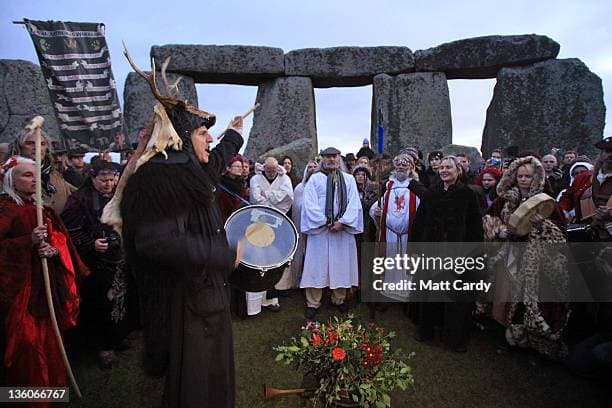
    The crowds that gather at Stonehenge for the solstice celebrations are a colorful bunch: Some wear the white robes of modern Druids, carry staffs and wear crowns made of antlers or wildflowers. Some blow through ox horn trumpets to mark midsummer; others just show up with a hula hoop. Getty photographers are on hand to capture all the sights.

  • The strange theories around Stonehenge's origins

    Stonehenge was built before the wheel was even invented, making its construction even more mysterious. In response, some wild theories have sprung up. One text from the 12th century depicts a giant from the Nephilim race helping the wizard Merlin erect the stones. A popular book from the 1960s suggested that Stonehenge (along with the Egyptian and Mayan pyramids) was actually built using alien technology.

  • A playful, bouncy model of the ancient Stonehenge

    Stonehenge is considered a sacred site by many modern-day druids and pagans. Then artist Jeremy Deller came along and recreated the monument as … a bouncy house? The inflatable artwork, measuring more than 100 feet across, invites the public to jump all over this symbol of British national identity. It has been displayed in Paris, in London during the 2012 Olympics and even at Stonehenge itself.

  • The battle of the beanfield at Stonehenge

    Back in the day, access to Stonehenge was free and open to all; families would picnic there, and there was even a Woodstock-inspired music festival that drew up to 100,000 attendees. Then, in 1985, Margaret Thatcher put the kibosh on the festival, blocking off road access and calling in 1,300 riot police to violently arrest festival goers. This documentary features footage from that day. People have been largely banned from the central part of the monument ever since, except on solstices and equinoxes.

    A still shot from the video of Operation Solstice.
    Video

    The battle of the beanfield at Stonehenge

  • Why was Stonehenge built?

    Located about 90 miles west of London, Stonehenge is one of the world’s most famous and mysterious prehistoric monuments. Built around the same time as Egypt’s Great Pyramid, this complex of giant stones, some weighing up to 30 tons, has captivated archaeologists and historians for over a thousand years. Want to learn more about this ancient marvel? Check out 1440's video explainer.

    Video 1440 Original

    Why was Stonehenge built?

  • What did Stonehenge sound like?

    At the University of Salford, acoustics researcher Trevor Cox has been doing sound experiments on a scale model of Stonehenge that he keeps inside a soundproof studio. He found that the monument had concert-hall acoustics, which might tell us something about why it was built. A BBC video crew visited Cox’s office for a demonstration of its special sound.

  • How science is uncovering the secrets of Stonehenge

    Scientific advances like radiocarbon dating and DNA analysis have upended what we know about the people who built Stonehenge. The Guardian explains how forensic geology and isotopic analysis of the teeth of a man who died 4,350 years ago reveal that those societies were likely much less violent and more cooperative than previously thought.

  • What Stonehenge sounded like

    Researchers built the first scale model of the world's best-known prehistoric stone circle, Stonehenge, to study its acoustic properties. Built approximately 5,000 years ago, the landmark in southern England has puzzled historians for centuries, but...

  • An introduction to Stonehenge

    Stonehenge may be the most famous monument of its kind, but it’s not the only one. In fact, building “henges” was kind of the “it” thing to do in prehistoric Europe. About 1,300 of them are still standing today. This introduction, written by a curator of the British Museum’s 2022 exhibition on Stonehenge, puts the monument in context.

Explore World History

Weave together the many narratives of world history with our highly curated and expanding selection of diverse, fascinating resources designed to showcase the breadth and richness of Earth's story, from the earliest traces of human civilization to the dramatic developments of contemporary cultures.

View All World History