Robber Barons
Overview
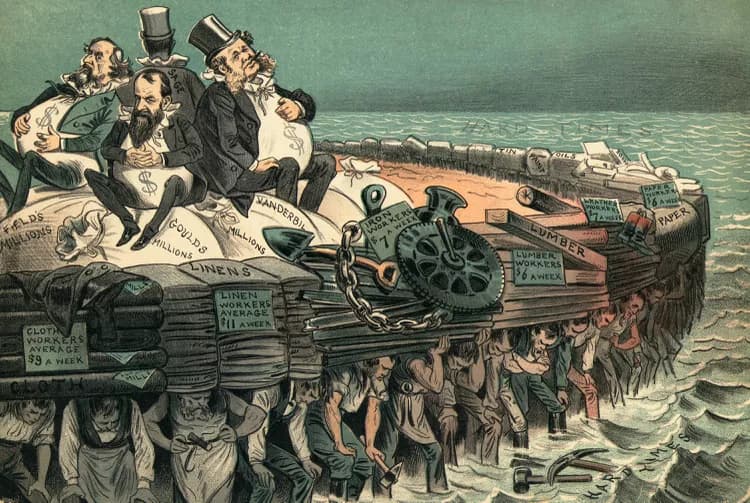
Often remembered for the controversial business practices that generated their massive wealth, the robber barons were a group of American industrialists who dominated the Gilded Age—the tumultuous years of rapid industrialization between the end of the Civil War and the beginning of the 20th century. Prominent names include John D. Rockefeller, Andrew Carnegie, JP Morgan, and Cornelius Vanderbilt. By the 1890s, the top 1% of American families held an estimated 40% to 50% of the nation's wealth—today's top 1% holds about 32%.
Originally a term for feudal lords who extracted illegal tolls or seized cargo from ships crossing their stretch of river in medieval Europe, "robber baron" was adopted in the mid-1800s to describe the exploitative practices of Gilded Age businessmen. These men amassed their wealth during a period of explosive growth in industrial monopolies and trusts, fueled in part by US railroad expansion. Their actions eventually spurred serious antitrust regulation—culminating in the Sherman Antitrust Act of 1890—that still defines how US monopolies are regulated today.
Some argue that today's US wealth inequality echoes the Gilded Age, casting the top 1% and massive technology companies as modern robber barons. Meanwhile, many of the original barons are remembered for their business prowess, which helped shape the modern American economy by building connecting infrastructure across the country, as well as their lasting philanthropic efforts.
1440 Findings
Hours of research by our editors, distilled into minutes of clarity.


Explore Business & Finance
The United States is home to more than 33 million businesses, the vast majority of which are small businesses, with millions being created (and others closing shop) every year. These businesses often rely on loans, provide the goods and services that keep the economy flowing, and sometimes even grow large enough to enter public markets or provide private investment opportunities. Explore key topics central to business and finance, from the role of the Federal Reserve to how initial public offerings work, how millions of American students finance higher education, and more.
Featured Topics
- 401(k)
- Amazon
- Bankruptcy
- Bitcoin
- Bonds
- Capital Gains
- College Tuition
- Consulting
- Creator Economy
- Credit Unions
- Federal Reserve
- Gig Economy
- Individual retirement accounts
- Inflation
- Initial Public Offerings
- Investment Banking
- Labor Unions
- Life Insurance
- Macy’s
- Minimum Wage
- Mutual Funds
- OpenAI
- Startups
- Stock Market
- Student Debt
- US Currency
- Venture Capital
- Wall Street
- Warren Buffett
- Y Combinator