Personal Checking
Overview
A personal checking account is the financial hub that many people use to receive income, pay bills, and make everyday purchases. More than 96% of US households have one, with a 2022 median balance of about $2.8K. These liquid accounts are designed for frequent use and immediate access, trading the higher interest earnings of savings accounts for convenience.
Technically, a checking account is a demand deposit: money held by a bank but available on request through checks, debit cards, transfers, and ATMs. Deposits have been insured by the Federal Deposit Insurance Corporation since the Great Depression (up to $250K per depositor today).
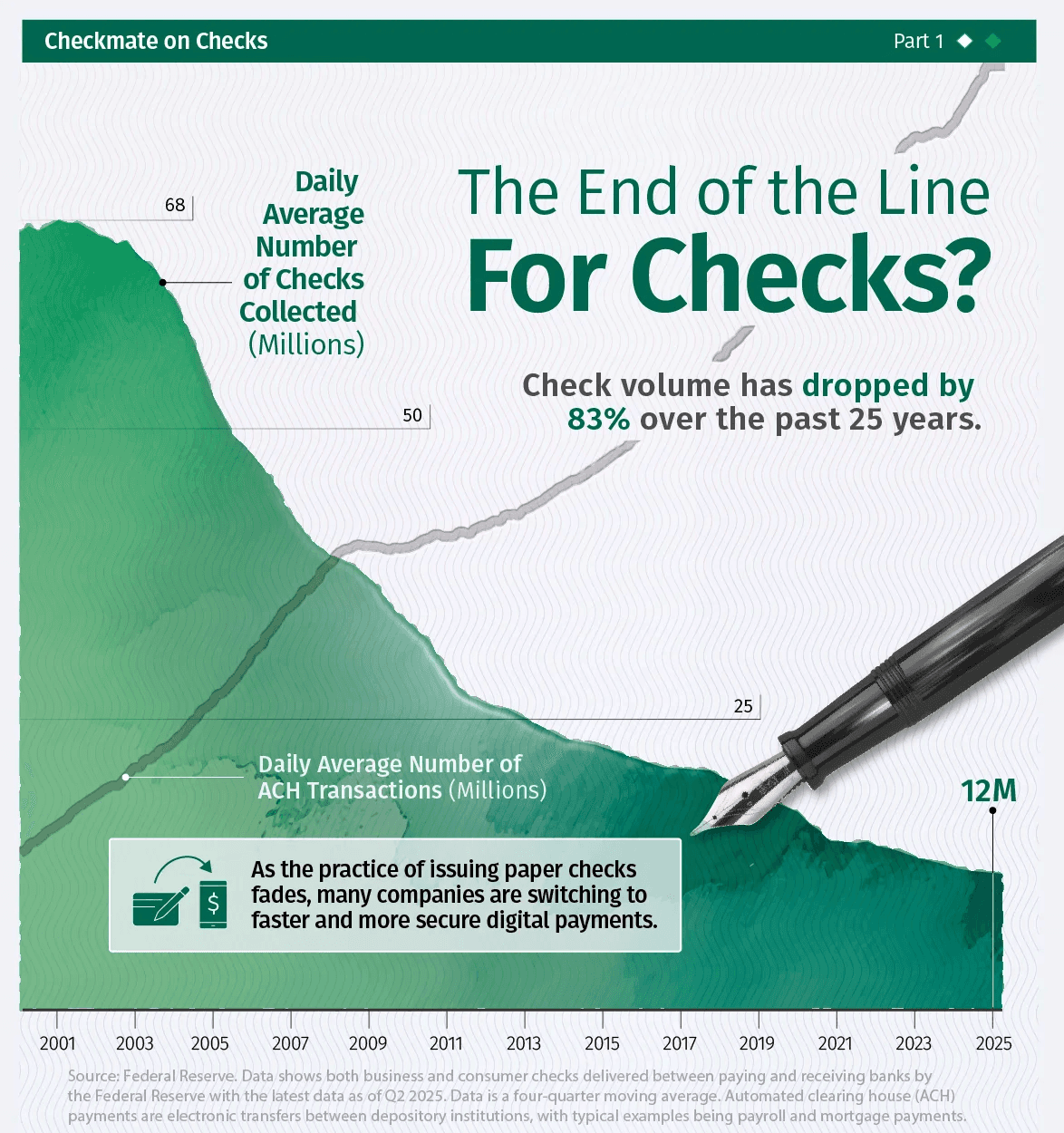
Checking accounts emerged in medieval and early modern Eurasia to transfer funds safely without transporting bulky coin or bullion. Handwritten IOUs evolved into bank-issued checks in the 18th century, and by the 1850s, clearinghouses arose to handle the surge in paper checks. Bank computerization and automated clearinghouses catalyzed the adoption of payroll direct deposit in the late 20th century, making checking accounts nearly universal. In the 2000s, digital imaging laws enabled mobile check deposit, accelerating the shift toward electronic payments.
Today, personal checking accounts connect customers to payment networks and form part of the roughly $17T in US bank deposits that support banks' balance sheets and lending activity.
1440 Findings
Hours of research by our editors, distilled into minutes of clarity.




Explore Business & Finance
The United States is home to more than 33 million businesses, the vast majority of which are small businesses, with millions being created (and others closing shop) every year. These businesses often rely on loans, provide the goods and services that keep the economy flowing, and sometimes even grow large enough to enter public markets or provide private investment opportunities. Explore key topics central to business and finance, from the role of the Federal Reserve to how initial public offerings work, how millions of American students finance higher education, and more.
Featured Topics
- 401(k)
- Amazon
- Bankruptcy
- Bitcoin
- Bonds
- Capital Gains
- College Tuition
- Consulting
- Creator Economy
- Credit Unions
- Federal Reserve
- Gig Economy
- Individual retirement accounts
- Inflation
- Initial Public Offerings
- Investment Banking
- Labor Unions
- Life Insurance
- Macy’s
- Minimum Wage
- Mutual Funds
- OpenAI
- Startups
- Stock Market
- Student Debt
- US Currency
- Venture Capital
- Wall Street
- Warren Buffett
- Y Combinator