Memes can influence politics and culture
Although internet memes are typically considered trivial and humorous, they're also powerfully persuasive political tools used to convey mainstream ideas.
In his 1976 book “The Selfish Gene,” biologist Richard Dawkins proposed that units of culture could be replicated, passed on, and evolve as they were transmitted, similar to human genes. He called this unit a "meme," to be pronounced like "cream."
Hours of research by our editors, distilled into minutes of clarity.
Although internet memes are typically considered trivial and humorous, they're also powerfully persuasive political tools used to convey mainstream ideas.
It's generally agreed upon that languages exhibit at least some of the following characteristics: compositionality, social transmission, arbitrariness of form and meaning, and accomplishment of linguistic functions like asking questions and expressing emotions, among other qualities. Memes fulfill these basic requirements, giving them linguistic legitimacy.
The evolution of the internet in the early 2000s supercharged the creation and spread of memetic content. Now, highly tuned algorithms on platforms like TikTok and YouTube influence the language, phrasing, and content of creators, which shapes how we use language in the real world.
Memes can hop offline, inspiring IRL events ranging from planking to shootings. By nature, memes contribute to the formation of in-groups, ones who are privy to meanings that escape content moderators who don't necessarily recognize what's hidden within layers of references.
Kids saying "67" and then erupting in laughter may have been popularized by social media, but childhood rhymes, songs, and jokes that confuse adults have always existed. Iona and Peter Opie studied the phenomena, publishing numerous books on the topic from the 1950s through the 1980s.
In 2018, #JobsNotMobs morphed from an internet meme into a conservative slogan. A video clip of angry protesters mixed with news anchors discouraging the use of the word "mob" posted on October 11, birthed the phrase. By October 19, it was adapted into a Republican party slogan.
Dogecoin is perhaps the most famous “memecoin.” While they tend to be more volatile than other types of crypto (after all, they’re often created due to ephemeral trends), that doesn’t mean they can’t be valuable: Dogecoin is currently one of the most valuable cryptocurrencies in the world.
"Meme stocks" is a phrase originating in the early 2020s, referring to companies with little underlying value who gain recognition through social media and whose stock price experiences rapid gains.
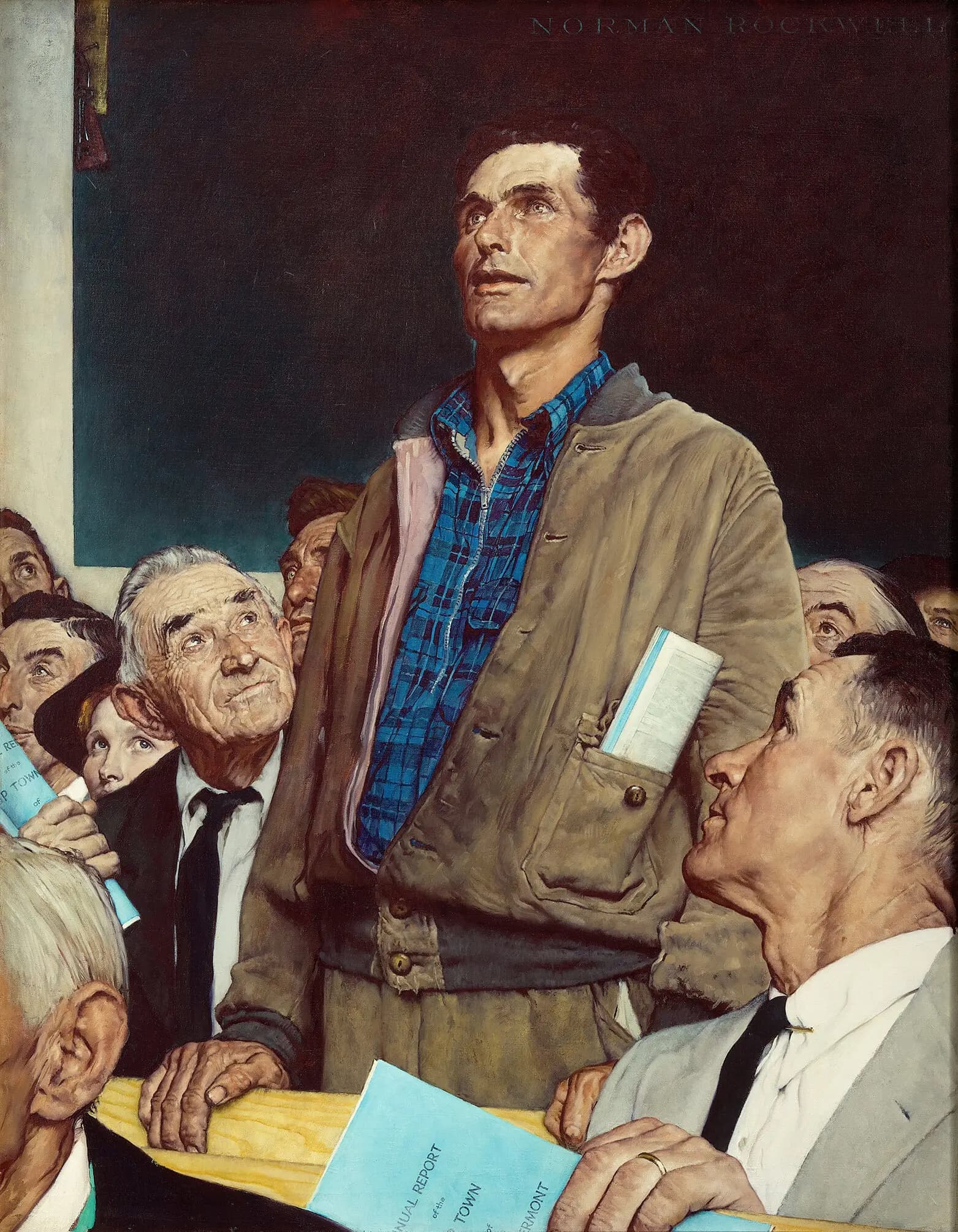
The famous painting, which portrays a man in work clothes speaking up in a crowd of men in suits, has become a companion image for internet users posting unpopular or controversial opinions.
The 2012 post titled "Just a book owners smile" shows 11-year-old Maggie Goldenberger—resplendent in her braces, pigtails, and treasure map-like vest—holding a trio of Goosebumps books and grinning wildly at the camera. Another user quickly captioned it, "GERSBERMS. MAH FRAVRIT BERKS."

Art, music, sports, entertainment, movies, and many other subjects—these elements define who we are as a society and how we express ourselves as a culture. Take a deep dive into the topics shaping our shared norms, values, institutions, and more.