Cold War

Overview

The Cold War was a global competition for power and influence between the United States, a capitalist democracy, and the Soviet Union, a state-controlled socialist system, from 1945 to 1991, sparked by tensions over how to shape the post-World War II order.

1440 Findings

Hours of research by our editors, distilled into minutes of clarity.
  • Cold War summary on a map

    The Cold War spanned much of the world, going far beyond the main territories of the principal players: the US and the Soviet Union. This video map shows where the action took place, from the wars in Southeast Asia to the Suez Canal in Egypt.

  • US–Soviet hostility began long before the Cold War

    US–Soviet tensions began decades before WWII. After the 1917 revolution, the US refused to recognize the Bolshevik regime and even sent troops to fight against it.

  • Wartime conferences exposed cracks in the US–Soviet alliance

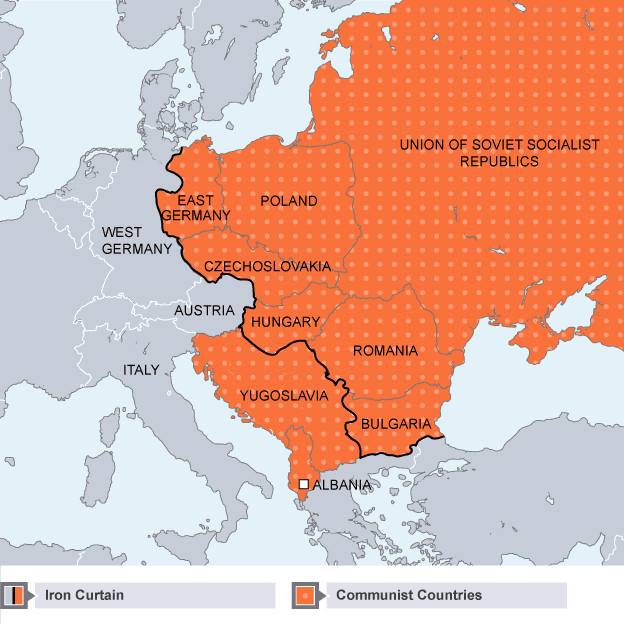
    At the Tehran, Yalta and Potsdam Conferences, Allied leaders coordinated WWII strategy—but deep disagreements over postwar Europe foreshadowed the Cold War. The USSR’s push for influence in Eastern Europe clashed with US and British calls for self-determination.

  • The Truman Doctrine marked the start of US containment strategy

    Introduced in 1947, the Truman Doctrine pledged US support for nations resisting communism—starting with Greece and Turkey—and launched the containment policy that defined early Cold War strategy.

  • The Marshall Plan aimed to rebuild Europe and limit Soviet influence

    Launched in 1948, the Marshall Plan provided over $12B (roughly $150B today) in US aid to help rebuild Western Europe. While framed as economic recovery, it also served as a Cold War tool—tying countries to the US and excluding the Soviet bloc.

  • The Berlin Airlift was the largest in history and a major Cold War victory for the US

    In 1948, the USSR blockaded West Berlin to pressure America and its allies. In response, the US and its partners launched the largest airlift in history—delivering supplies daily for nearly a year until Stalin backed down.

  • The 1969 moon landing was a defining Cold War victory for the US

    When Apollo 11 astronauts stepped onto the moon in July 1969, it marked a dramatic win in the US–Soviet space race. The televised landing—broadcast across the globe—showcased American technological supremacy.

Explore World History

Weave together the many narratives of world history with our highly curated and expanding selection of diverse, fascinating resources designed to showcase the breadth and richness of Earth's story, from the earliest traces of human civilization to the dramatic developments of contemporary cultures.

View All World History