Back

Posted by

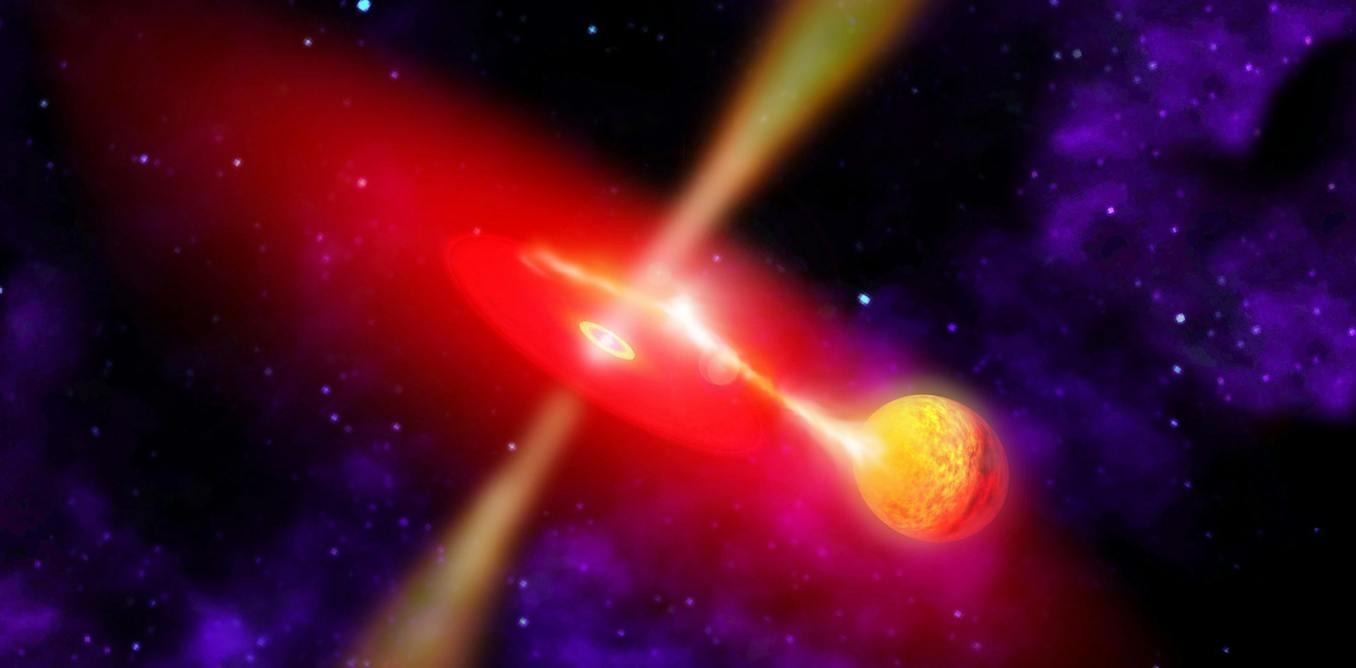
The deaths of massive stars and the mergers of neutron stars and black holes can produce gamma-ray bursts—jets of particles moving in opposite directions at near-light speed that comprise the universe's most powerful explosions.

Similar Posts

Here’s what we found related to above. Click through to dive even deeper.

  • Posted by

    Watch a simulation of black hole jets—beams of high-energy particles emitted from the poles of the stellar remnant at near the speed of light.

  • Posted by

    Fast radio bursts are millisecond-long flashes of radio waves caused by high-energy astronomical events.

  • Posted by

    Neutron stars, the remains of some massive stars after they explode in a supernova, are the densest directly observable objects in the universe.

  • Posted by

    Stars hold off gravitational collapse with the energy produced in nuclear reactions in their core, but when massive stars run out of fuel for these reactions, runaway collapse can produce a black hole.

  • Posted by

    Quasars are extremely luminous cores of distant galaxies, powered by supermassive black holes that consume as much as 100 Earth masses of material per minute.

  • Posted by

    Watch an artist's impression of two neutron stars merging in a kilonova explosion

    Such an event produces enough light to briefly outshine an entire galaxy and to produce characteristic gravitational wave and gamma-ray signals. On August 17, 2017, these signals were captured by the LIGO–Virgo and Fermi/INTEGRAL observatories, respectively, from a kilonova about 130 million light-years away.

  • Posted by

    Watch a 3D visualization of the formation of a black hole from the merging of two neutron stars.

  • Posted by

    Why starquakes may explain various phenomena associated with neutron stars

    Fast radio bursts—repeated millisecond-long pulses of enormous energy from neutron stars—are emitted with a timing that resembles the earthquakes and aftershocks seen on Earth when geological activity releases energy from within the planet. Although pulsars should gradually spin more slowly as they lose energy from emitting jets of radiation, sudden increases may result from interior matter moving during starquakes.

  • Posted by

    When they merge, black holes release multiple solar masses of energy

    The energy emanates outward in the form of gravitational waves, which can be detected at observatories like LIGO. After merging, it is impossible to determine the characteristics of the two black holes that merged to create it.

  • Posted by

    Antimatter can be created from dark lightning—high-energy light emitted by deflected electrons after they are accelerated to near the speed of light by thunderstorms.

  • Posted by

    More than 40 quintillion black holes are estimated to exist in the universe, including about 100 million in the Milky Way, each with masses up to hundreds of times that of the sun.

  • Posted by

    Watch the birth of a neutron star, which takes less than one second, in this high-fidelity, 3D visualization.

  • Posted by

    Stephen Hawking predicted that black holes evaporate by analyzing the interaction between quantum fields and spacetime curved by black holes.

  • Posted by

    Unlike black holes and neutron stars, white dwarfs are the only major stellar remnant not to form via a supernova.

  • Posted by

    What are pulsars?

    Pulsars are neutron stars created as part of stellar evolution and emit radiation beams visible from Earth. These beams pulse like a lighthouse's light due to the star's rotation, creating periodic high-energy emissions. Pulsars were first discovered as radio sources; it was also discovered they emit gamma rays. NASA uses its Fermi Gamma-ray Space Telescope to retrieve and analyze data from pulsars.

  • Posted by

    If the universe continues to expand forever, as current cosmological models suggest, it will eventually reach heat death, becoming a cold, dark, and empty void.

  • Posted by

    Black holes are formed from massive stars collapsing under their own gravity

    This creates a region where spacetime curves infinitely, known as a singularity. Black holes' intense mass and energy allow them to trap light, distort time and space, and present challenges with reconciling Einstein's theory with quantum mechanics.

  • Posted by

    While Type Ia supernovae obliterate a white dwarf from the inside, novae can temporarily increase the star's brightness up to 100,000 times without self-destruction.

  • Posted by

    Watch a simulation of a collapsing star becoming a black hole

    When a massive star can no longer release enough energy through fusion in its core to fight off gravitational collapse, the dense core collapses first, producing an event horizon that traps light within it, including some light produced within the star at the time of collapse. As more material falls into the growing event horizon, the star will appear to eclipse itself from the inside.

  • Posted by

    The formation of a neutron star through a core collapse lasts one-tenth of a second

    Massive stars keep fusing heavier and heavier elements in their cores to produce energy that pushes against the weight of the star itself. However, the fusion of silicon into iron consumes energy and initiates a feedback loop that rapidly compresses the stellar core, creating neutrons and neutrinos from the combination of electrons and protons.

  • Posted by

    No black dwarf stars exist, but most of the universe's stars will become one.

  • Posted by

    Attempts to 'fix' black hole physics have led scientists to theorize new types

    Along with their spin and charge, mass is used to categorize black holes as supermassive, intermediate, or stellar-mass. However, ongoing research suggests various additional types may exist, including primordials that formed one second into the universe's birth, fuzzballs—tangles of vibrating strings—and gravastars, which have a shell of dense matter around repulsive vacuum energy.

  • Posted by

    Watch a 3D simulation of a Type Ia supernova, in which carbon fusion completely destroys a white dwarf in seconds.

  • Posted by

    Trillions of neutrinos travel through your body every second without leaving a trace.

  • Posted by

    Cosmic rays are evidence of incredibly powerful astronomical events—solar cosmic rays provide information about eruptions and flares on the sun's surface, while galactic cosmic rays shed light on dying stars.

  • Posted by

    Scientists have determined the properties of cosmic rays by analyzing their trajectories in bubble chambers—containers filled with a vapor that clings to charged particles.

  • Posted by

    Black holes 101

    At the center of our galaxy, a supermassive black hole churns. Learn about the types of black holes, how they form, and how scientists discovered these invisible, yet extraordinary objects in our universe. This three-minute video from National Geographic tutors the viewer on the basics regarding the universe's most mysterious residents.

  • Posted by

    Particles moving faster than the speed of light give nuclear reactors an eerie blue glow.

  • Posted by

    How big is a supernova explosion?

    Supernovas are the biggest explosions in the universe, often obliterating the area surrounding them. So what would happen if one exploded near Earth? If the sun went supernova it'd be like getting hit by a nuclear explosion every second for weeks. Of course, that's not happening anytime soon. This animated video shows how distance is the key factor, and how you shouldn't be worried.

  • Posted by

    Observations of colliding neutron stars by the Laser Interferometer Gravitational-Wave Observatory in 2017 confirmed that gravity travels at the speed of light.

  • Posted by

    Despite fears of creating black holes, the Large Hadron Collider produces collisions with energies of 13.6 trillion electronvolts, about one million times smaller than the energy needed to create the lightest possible black holes.

  • Posted by

    A beam of neutrinos can be created by firing a beam of high-energy protons at a target to produce unstable particles that decay into neutrinos.

You've reached the end.