Posted by Dina Fine MaronMay 12The exercise sweet spot is shorter than you'd think—and longer workouts aren't generally better.Show 2 more findings ZoomNational Library of Medicinehttps://pubmed.ncbi.nlm.nih.gov/35599175/
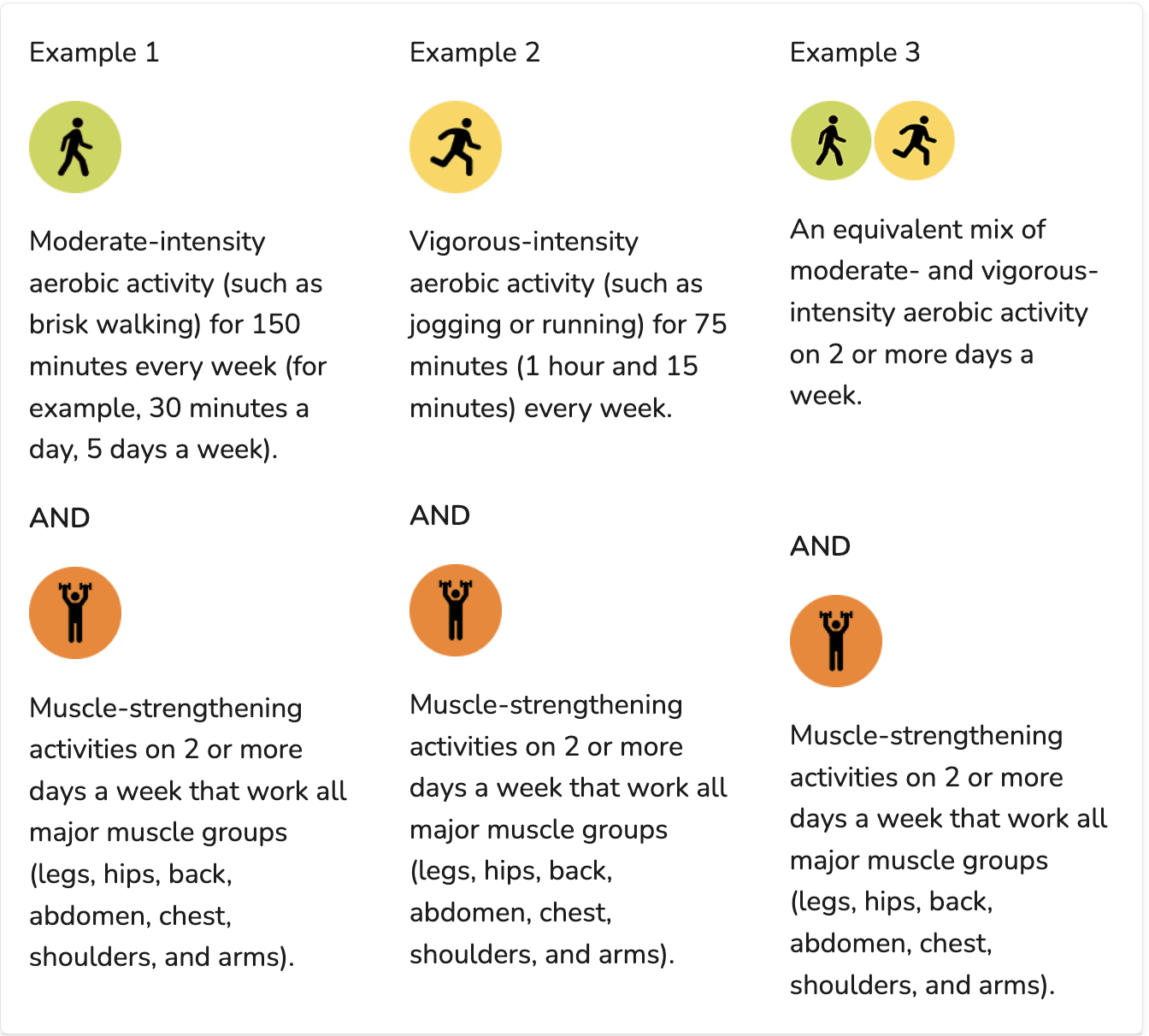
Posted by Drew SteigerwaldMar 3Health officials recommend at least 150 minutes of aerobic exercise per week and 2 sessions of resistance training, targeting each major muscle group.Show 2 more findings ZoomAdult Activity: An OverviewUS Centers for Disease Control and Preventionhttps://www.cdc.gov/physical-activity-basics/guidelines/adults.html
Posted by Dina Fine MaronMay 12Official recommendations state that healthy adults should perform progressive resistance training that increases weight and repetitions over time.Show 2 more findingsNational Library of Medicinehttps://pmc.ncbi.nlm.nih.gov/articles/PMC12965823/
Posted by Dina Fine MaronMay 12Adults need 2 days of muscle-strengthening activity weekly—yet most of us aren't doing that.Show 2 more findingsUS Department of Health and Human Services - Office of Disease Prevention and Health Promotionhttps://odphp.health.gov/our-work/nutrition-physical-activity/physical-activity-guidelines/current-guidelines
Posted by Dina Fine MaronMay 12Resistance training is linked to better memory and cognitive function in older adults.Show 2 more findings ZoomNational Library of Medicinehttps://pubmed.ncbi.nlm.nih.gov/38823487/
Posted by Drew SteigerwaldJun 30One minute of exercise correlates to five extra minutes of life (on average).Show 3 more findings“Exercise May Be the Single Most Potent Medical Intervention Ever Known”Plain English with Derek Thompsonhttps://open.spotify.com/episode/4llcv2QIXnxKeMzaqRZ1dS
Posted by Dina Fine MaronAug 27Recent global health estimates suggest that inactivity is a leading risk factor for death, contributing to 6% of deaths worldwide.Show 4 more findings ZoomPHYSICAL ACTIVITY FOR HEALTH - Global Recommendations on Physical Activity for Health - NCBI BookshelfTwitterFacebookLinkedInGitHubNCBI Insights BlogTwitterFacebookYoutubeNational Institutes of Healthhttps://www.ncbi.nlm.nih.gov/books/NBK305049/
Posted by Dina Fine MaronAug 27Discover how strength training may help your brain and what happens inside your cells when you work out with this original '1440 Explores' podcast.Show 4 more findingsWhy We Lose Muscle–And How to Keep It1440 Exploreshttps://open.spotify.com/episode/3KoruZqhiR4uSrjNtv8Xzy
Posted by Dina Fine MaronMay 12Strength training appears to make for a healthier, youthful-looking brain.Show 3 more findings ZoomNBC Newshttps://www.nbcnews.com/health/health-news/people-younger-brains-muscle-mass-less-visceral-fat-rcna245185
Posted by Teddy BurkhardtDec 27, 2024Moving your body every day is key to longevityIn an era of biohacking, where millionaires subject themselves to draconian routines and tests to de-age themselves, one study suggests a super simple key predictor of mortality: more than any other trait, how much subjects moved determined how long they'd live. Movement mattered even more than age in predicting overall life longevity. Researchers suggest this means we should all simply get outside a bit more. Read more about the study here. ZoomThis Simple Trait Is the Key to LongevityOutsidehttps://www.outsideonline.com/health/training-performance/movement-key-to-living-longer/
Posted by Meher QazilbashMar 13, 2025How endurance athletes can build resilienceLong-distance runners and other endurance athletes can improve their performances using tips explored in this article. Findings from two recent studies show that strength training, high-altitude training, and intense interval sessions are all potential methods for ameliorating long-term athletic capabilities. ZoomHow to Train Your Physiological ResilienceOutsidehttps://www.outsideonline.com/health/training-performance/fatigue-resistance/
Posted by Dina Fine MaronMay 12Resistance training can help fight osteoporosis, especially in menopausal women.Show 2 more findings 2:00:03 FoundMyFitnesshttps://www.youtube.com/watch?v=SUy6HwOhT3U
Posted by Teddy BurkhardtJul 31, 2023The eight habits that could add up to 24 years to your lifeA study presented at the American Society for Nutrition's annual meeting revealed that adopting eight healthy lifestyle habits in middle age can significantly increase life expectancy. The habits include being physically active, avoiding opioid... ZoomThese 8 habits could add up to 24 years to your life, study findsCBS Newshttps://www.cbsnews.com/news/8-habits-could-add-24-years-to-your-life-study/
Posted by Dina Fine MaronFeb 27Exercise can lead to muscle microtears, but the body's repair systems cause those fibers to grow back larger.Show 2 more findings 16:39How Your Muscles Change With ExerciseInstitute of Human Anatomyhttps://www.youtube.com/watch?v=2vXOq-aRtYY
Posted by Meher QazilbashMar 3Astronauts exercise on the International Space StationAstronauts maintain bone, muscle, and cardiovascular health with physical activity. It's crucial that they make time to exercise for approximately two hours per day. This resource offers a behind-the-scenes look at how high-intensity workouts help prevent muscle atrophy, bone density loss, and aerobic decline during monthslong space missions. 1:30Astronaut Exercise - NASANASA Johnsonhttps://www.youtube.com/watch?v=n-0A0zMvm4s
Posted by Drew SteigerwaldFeb 17Health span: The number of years one is active and disease-freeAs scientific advances continue to extend the average human lifespan, many are now turning their attention toward extending "health span." The ultimate goal would be to extend one's health span to match one's lifespan, which would necessitate a shift in focus toward the pursuit of healthy aging. (Some users may experience a paywall.)How you move defines how you live - Peter AttiaNational Geographichttps://www.nationalgeographic.com/premium/article/live-better-longer-healthspan
Posted by Teddy BurkhardtNov 7, 2023Can fasting help you live longer?Animal studies into the health benefits of calorie restrictions of 20%-40% suggest it extends life spans and reduces incidents of age-related diseases, including cancer. This article explores the research into fasting, calorie restriction, and longevity. ZoomCan fasting help you live longer? Here’s what the science says.National Geographichttps://www.nationalgeographic.co.uk/science-and-technology/2023/01/can-fasting-help-you-live-longer-heres-what-the-science-says
Posted by Dina Fine MaronMay 12Strength training doesn't require fancy equipment—cans, water bottles, and shopping bags work well.Show 2 more findingsUniversity of California Davis Healthhttps://health.ucdavis.edu/blog/cultivating-health/3-simple-exercises-to-start-resistance-training-at-home-or-in-the-gym-to-build-strength/2025/12
Posted by Drew SteigerwaldJul 3, 2024Doctors shift focus from extending lifespan to lengthening health spanAs scientific advances extend the average human lifespan, many are turning their attention toward extending "health span." Health span refers to the number of years one is active and disease-free. The ultimate goal is to extend one’s health span to match one’s lifespan. ZoomThe healthspan revolution: how to live a long, strong and happy lifeThe Guardianhttps://www.theguardian.com/lifeandstyle/2023/mar/28/healthspan-revolution-how-to-live-long-strong-happy-life
Posted by Dina Fine MaronMay 12Explore how to safely start 'strengthmaxxing' with body weight—not actual weights.Show 3 more findings ZoomLimited AccessThe Washington Posthttps://www.washingtonpost.com/wellness/2026/03/17/strength-training-tips/
Posted by Drew SteigerwaldMar 3Optimal human functioning requires movementThere is now ample evidence to back the centuries-old hypothesis that exercise is critical to human health. This review article explores the latest discoveries in exercise science, including how exercise is intrinsic to maintaining our organ systems throughout life. ZoomFrontiers | Optimal Human Functioning Requires Exercise Across the Lifespan: Mobility in a 1g Environment Is Intrinsic to the Integrity of Multiple Biological Systemshttps://www.frontiersin.org/journals/physiology/articles/10.3389/fphys.2020.00156/full
Posted by Dina Fine MaronApr 10Brain training game creates long-lasting changes in the brain that may help protect against dementia.Show 2 more findings ZoomBrain train game may help protect against dementia for up to 20 yearsNBC Newshttps://www.nbcnews.com/health/aging/brain-training-game-protect-dementia-research-decades-alzheimers-rcna257790?user_id=670e8b431a504235140b04ed
Posted by Meher QazilbashDec 16, 2024Overwork contributes to thousands of worker deathsCan work really kill you? The World Health Organization and the International Labor Organization have estimated that long work hours contribute to thousands of death from strokes and heart attacks each year. This BBC article argues that the culture of overwork and burnout is leading to a public health crisis in desperate need of solutions. ZoomLong working hours killing 745,000 people a year, study findsBBChttps://www.bbc.com/news/business-57139434
Posted by Dina Fine MaronFeb 27Exercise improves brain blood flow, stimulates neural growth, and more.Show 2 more findings 13:02The brain-changing benefits of exerciseTEDhttps://www.youtube.com/watch?v=BHY0FxzoKZE
Posted by Dina Fine MaronMay 12Adults may lose roughly 3% of their muscle mass each decade after 30.Show 2 more findingsUS Department of Health and Humans Services - Office on Women's Healthhttps://womenshealth.gov/sarcopenia
Posted by Drew SteigerwaldMay 28Exercise can change your genes without changing your DNA.Show 2 more findings ZoomThe Effect of Exercise on Your GenesScience Connected Magazinehttps://magazine.scienceconnected.org/2021/08/the-effect-of-exercise-on-your-genes/
Posted by Dina Fine MaronMay 12Watch this how-to video series on how to start strength training.Show 3 more findings ZoomMayo Clinichttps://www.mayoclinic.org/healthy-lifestyle/fitness/in-depth/strength-training/art-20046031
Posted by Dina Fine MaronMay 12Grip strength, how firmly and securely you can hold onto things, predicts death better than blood pressure Show 2 more findingsThe Lancethttps://www.thelancet.com/journals/lancet/article/PIIS0140-6736%2814%2962000-6/abstract
Posted by Dina Fine MaronDec 23, 2025Even brief physical activity can trigger the release of neurotransmitters that provide mental health boostsA couple of minutes of light walking or stretching can increase feelings of energy and reduce fatigue, not just through the release of endorphins. Exercise can also provide self-regulation and improve task engagement and focus in those with certain mental health disorders, like ADHD.Why Is Working Out Good For Your Mental Health? - Science Friday | Podcast on SpotifyScience Fridayhttps://open.spotify.com/episode/4hL1AxHLkCQs7ak5P8u5eD
Posted by Dina Fine MaronFeb 27Exercise causes diet-independent changes in the gut microbiome.Show 2 more findings ZoomExamining the Interaction between Exercise, Gut Microbiota, and Neurodegeneration: Future Research Directionshttps://www.mdpi.com/2227-9059/11/8/2267
Posted by Dina Fine MaronApr 7Just a 10-minute mental health break can yield benefitsThe US CDC offers recommendations for alleviating stress in daily life. Short 10-minute breaks can significantly improve mental health, especially when used for activities like deep breathing, dancing, or writing down things you are grateful for. Building meaningful relationships, termed "social connectedness," can also alleviate stress and promote resilience. ZoomHow to Reduce Stress in 10 MinutesUS Centers for Disease Control and Preventionhttps://www.cdc.gov/howrightnow/wellbeing/index.html
Posted by Dina Fine MaronMay 19Heat-related complications are of greater concern for distance runners than cardiac threatsAnalysis of more than 130,000 runners in Tel Aviv events during a seven-year period indicated that the runners were 10 times more likely to experience heatstroke than serious cardiac problems. Scientists suggest that runners should take 10 to 14 days to acclimate to a hot climate before tackling a serious run. 2:31Risk of Heat Stroke in Distance RunnersThe Weather Channelhttps://www.youtube.com/watch?v=TAi19PalvQg
Posted by Dina Fine MaronApr 6Doctors are prescribing social activities—and seeing good resultsPhysicians, especially in the UK, are asking patients what they enjoy and then prescribing a consistent regimen of doing that type of activity to improve fitness and overall health, including community exercise classes, volunteering, and spending time in nature. This approach may provide better incentives to stick with an activity.NPRhttps://www.npr.org/2025/07/14/nx-s1-5434386/social-prescription-arts-exercise-loneliness
Posted by Dina Fine MaronMar 29, 2024World records are often broken later in the day—and scientists wonder if muscle clocks explain the difference.Show 2 more findings ZoomYour muscles keep time too. How circadian rhythms affect your workout and your healthNPRhttps://www.npr.org/sections/health-shots/2024/03/29/1241424775/exercise-timing-circadian-rhythm-morning-evening
Posted by Drew SteigerwaldJul 3, 2024Extending the worldwide lifespan by one healthy year is worth $38TThis econometric study attempts to estimate the economic value of increasing the global healthy lifespan by one year—and to answer the question of whether it is better to extend lifespans or slow the rate of healthy aging. ZoomThe economic value of targeting aging - Nature AgingNaturehttps://www.nature.com/articles/s43587-021-00080-0
Posted by Dina Fine MaronJan 16Staying on standard time permanently would slightly reduce obesity and stroke riskA 2025 study that examined time changes found that permanently changing to standard time would slightly reduce obesity and stroke risk more than switching to permanent daylight saving time. 2:17https://www.youtube.com/watch?v=bmIfb-bGumM