Posted by

Explore how global teams coordinated by the UN's International Search and Rescue Advisory Group find and rescue survivors of large-scale earthquakes, from preliminary surveys to recovering bodies.
Findings

Additional insights we found via Reuters

  1. Before any rescue takes place and international teams arrive, local emergency personnel conduct broad, rapid surveys of the affected areas by air and land to identify search-and-rescue priorities, spot potential hazards such as damaged infrastructure, and create sectors to assign to search teams.

  2. Sectors are then assessed to identify rescue sites that command centers may allocate specific rescue teams to, the integrity of the infrastructure, the existence of void spaces, such as stairwells, where people may be trapped, and environmental dangers, including downed power lines, gas leaks, and flooding.

  3. Search and rescue, often aided by trained search dogs, is then deployed to the identified sites for fast-paced rescues near the surface of the debris, lasting no more than a few hours.

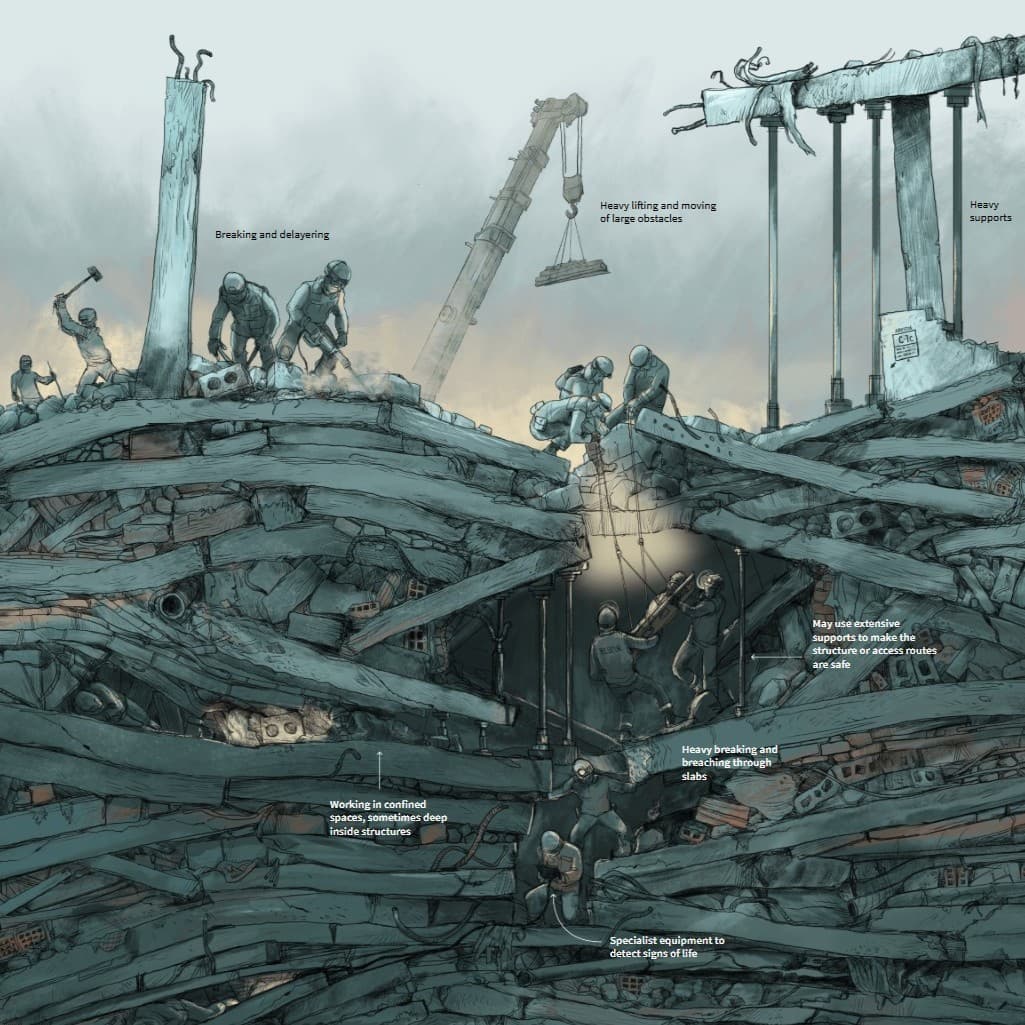
  4. Finally, the full search and rescue penetrates most or all of the survivable voids within collapsed structures over several days, with support from life-detection sensors, hydraulic equipment, power tools, and larger machines, such as cranes.

  5. Search and rescue attempts are usually halted after a week if no one has been found alive in the previous two days, leaving local teams to use demolition equipment and heavy machinery to remove large piles of rubble and recover any human remains.

Similar Posts

Showing 1440 posts similar to Explore how global teams coordinated by the UN's International Search and Rescue Advisory Group find and rescue survivors of large-scale earthquakes, from preliminary surveys to recovering bodies.

You've reached the end.