Posted by

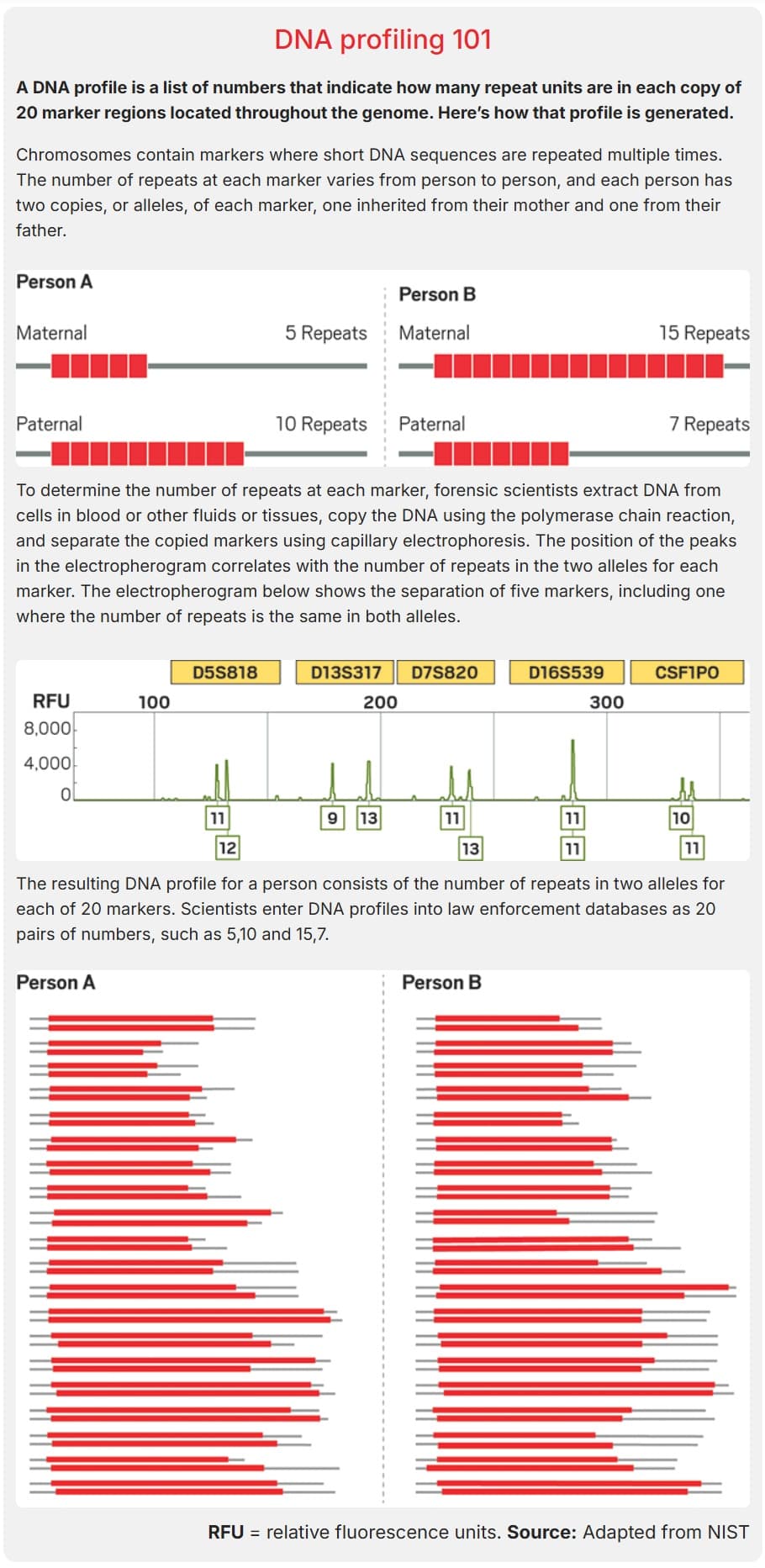
Like counting how often a word is repeated in a sentence, forensic scientists can identify people by tallying how often short segments of genetic information repeat in specific parts of a person's DNA—a set of numbers that varies from person to person. (Paywall may apply.)
Findings

Additional insights we found via Chemical & Engineering News

  1. Through DNA profiling, the numbers of short tandem repeats—segments of DNA three to five bases long—within specific chromosomal regions are used to construct an individual's genetic profile, which can be compared with existing profiles to make an identification.

  2. DNA profiling via short tandem repeats relies on capillary electrophoresis, which identifies the number of repeating segments of DNA by measuring how quickly the genetic material moves through an electric field—shorter pieces containing fewer repeats moving faster.

  3. Before the 1990s, when forensic scientists transitioned to using short tandem repeats, some DNA profiling techniques involved larger DNA segments called minisatellites, which were counted via film sensitive to the radioactive phosphorus used to label the DNA—a method that took weeks rather than hours.

  4. The first criminal conviction through the use of DNA evidence was in 1988, when the perpetrator of a 1986 murder in Leicestershire, England, was identified via an analysis of minisatellites.

  5. Forensic scientists can construct DNA profiles of individuals using only a few cells through the polymerase chain reaction, which amplifies genetic signals, and, in mixed samples, can improve the rate of matches with individuals in profile databases using algorithms that incorporate statistical methods.

  6. DNA paternity tests compare genetic markers, like short tandem repeats, from the cells of children and their alleged fathers, often collected via cheek swabs.

Similar Posts

Showing 1440 posts similar to Like counting how often a word is repeated in a sentence, forensic scientists can identify people by tallying how often short segments of genetic information repeat in specific parts of a person's DNA—a set of numbers that varies from person to person. (Paywall may apply.)

You've reached the end.