Term Limits
Overview
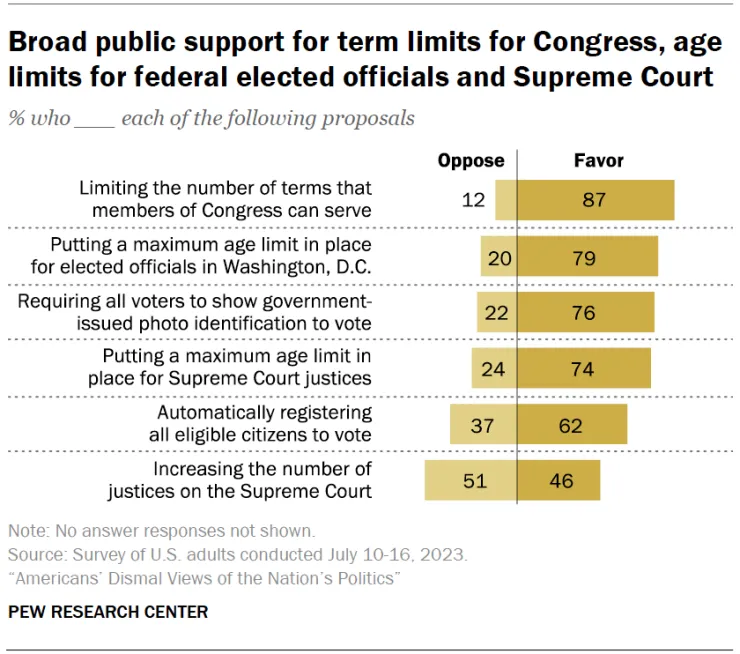
Term limits are rules that restrict how long an elected official may serve. At the federal level in the United States, only the presidency is capped at two terms, while members of Congress may serve indefinitely if reelected, and Supreme Court justices hold lifetime appointments.
The debate over federal term limits is as old as the United States—centered on balancing democratic accountability with institutional expertise and political continuity. Early Americans were deeply wary of concentrated power after centuries of distant British rule. Under the Articles of Confederation, congressional delegates faced strict rotation limits, but the Constitution ultimately rejected mandatory term limits. Instead, informal norms prevailed: Many early lawmakers served briefly before returning home. As being a politician became a more lifelong profession in the 19th century, those norms faded, and long-term congressional careers became common.
George Washington's voluntary retirement after two terms as president set an enduring standard, followed by every president until Franklin D. Roosevelt, who won four elections during the Great Depression and World War II. His unprecedented tenure led to the 22nd Amendment in 1951, formally limiting presidents to two terms. While many states impose limits on governors and legislators, federal term limits beyond the presidency remain politically popular but have not been adopted by Congress.
1440 Findings
Hours of research by our editors, distilled into minutes of clarity.





Explore Civics
An informed citizenry is the backbone and bulwark of a vibrant democracy. From the principles behind the founding of the country to the forces that shaped our modern institutions, explore the most illuminating and insightful Civics resources from across the internet.