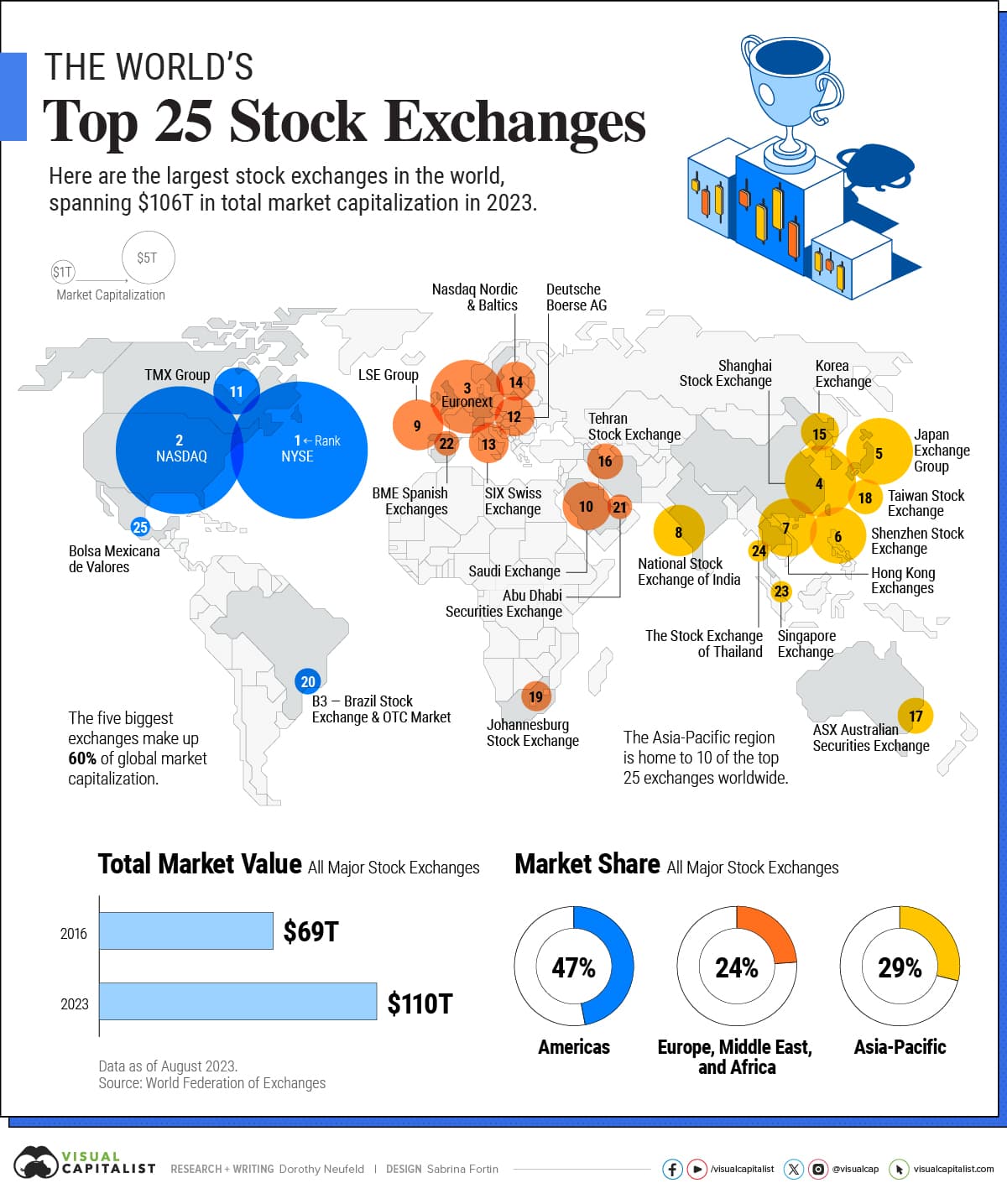
Posted by Phoebe BainMay 4Visualize the differences between the New York Stock Exchange and the Nasdaq.Show 3 more findings ZoomVisual Capitalisthttps://www.visualcapitalist.com/difference-nyse-nasdaq/
Posted by Phoebe BainMay 4The Nasdaq is typically the world's second-largest stock exchange when measured by the total market value of the companies listed on the exchange.Show 3 more findings 4:26NerdWallethttps://www.youtube.com/watch?v=BXO-UpmrFQo&t=145s
Posted by Phoebe BainMay 4Find out how companies decide which stock exchange to list onTech companies often prefer to list on the tech-focused Nasdaq, whereas more traditional organizations opt for the New York Stock Exchange. Sometimes the choice is made partly based on the services an exchange offers a company.Marketplacehttps://www.marketplace.org/story/2016/03/16/stock-exchanges
Posted by Phoebe BainMay 4The fees for keeping a company listed on the NYSE are typically higher than the Nasdaq's.Show 3 more findingsBass, Berry & Simshttps://www.bassberrysecuritieslawexchange.com/new-york-stock-exchange-vs-nasdaq-stock-market/
Posted by Phoebe BainJun 26'The stock market' can be loosely defined as a set of exchanges and other places where shares of public companies are bought and sold. Show 3 more findings 3:10Stock Market Explained in 3 Minutes1440 Originalshttps://youtu.be/jXLGDe5Y1j4
Posted by Phoebe BainAug 14, 2024What’s up with the new Texas Stock Exchange?The two biggest stock exchanges in the U.S. are both based in New York—the New York Stock Exchange and the Nasdaq. But a potential new “Texas Stock Exchange”—which would be based in, you guessed it, Texas—could change that. To find out more about the project, backed by enormous companies such as BlackRock and Citadel, watch this video. 9:28Why BlackRock is Building a New Stock Market... In Texashttps://www.youtube.com/watch?v=e3jjy3EanGc

Posted by Phoebe BainMay 4The Nasdaq Composite index includes all of the companies traded on the exchangeThis 3,000+ company index stands in contrast to the Nasdaq 100, which only includes 100 of the most influential non-financial companies traded on the exchange. These are the two most commonly used indices for Nasdaq investments.MarketBeathttps://www.marketbeat.com/learn/nasdaq-100-vs-nasdaq-composite/
Posted by Teddy BurkhardtMay 4The stock market, explained in 3 minutesThe stock market consists of a set of exchanges and other venues where shares of public companies are bought and sold. The Nasdaq and the New York Stock Exchange are two of the most well-known exchanges in the US, while major exchanges also operate around the world, including in Tokyo, Shanghai, London, and São Paulo. 3:10Stock Market Explained in 3 Minutes1440 Originalshttps://www.youtube.com/watch?v=jXLGDe5Y1j4
Posted by Phoebe BainMay 4Companies sometimes change which stock exchange they're listed on.Show 3 more findingsInvestopediahttps://www.investopedia.com/financial-edge/0712/why-companies-change-exchanges.aspx
Posted by Phoebe BainJul 28The NYSE is one of the few remaining stock exchanges where much active trading still happens in person on the trading floor.Show 3 more findings ZoomHow To Experience the New York Stock Exchange | The Wall Street ExperienceThe Wall Street Experiencehttps://www.thewallstreetexperience.com/blog/experience-the-nyse/
Posted by Teddy BurkhardtMay 4The Nasdaq was founded in 1971, marking the debut of electronic tradingThe Nasdaq stock exchange arguably invented electronic trading, making it a key part of fintech history. It's often used as a benchmark for how the tech industry is performing. 1:56Understanding the Nasdaq and how it differs from the NYSEYahoo Financehttps://www.youtube.com/watch?v=i6MQxJz3t2Y
Posted by Phoebe BainMay 4What is after-hours trading?While both the New York Stock Exchange and the Nasdaq open at 9:30 am ET and close at 4 pm ET, some trading is allowed after that. After-hours trading was once only open to institutional investors and people with particularly high net worths. Now, with the advent of computers, anyone can trade stocks anywhere online, and those regulations have broadened.After-Hours Trading: How It Works, Pros & Cons, Example | The Motley Foolhttps://www.fool.com/terms/a/after-hours-trading/
Posted by Phoebe BainMay 4Read about when Nasdaq partnered with the London Stock Exchange in 1992, and other key moments in Nasdaq historyThe partnership became the first intercontinental linkage between capital markets, setting the stage for worldwide trading amid increasing globalization. Nasdaq separated from its parent company in 2006, becoming a fully independent licensed national securities exchange. A year later, it added the Scandinavian-based Exchange, OMX.Robinhoodhttps://robinhood.com/us/en/learn/articles/1GXPrecRfkSNp0aBblBSsL/what-is-the-nasdaq/#Whats_the_history_of_Nasdaq
Posted by Phoebe BainMay 4The Nasdaq 100 index tracks the exchange's 100 largest non-financial companiesThis index was created in 1985, over a decade after the Nasdaq first launched. The companies on the index must meet certain criteria, including having a minimum average daily trading value of $5M.Investopediahttps://www.investopedia.com/terms/n/nasdaq100.asp
Posted by Drew SteigerwaldJun 30A history of stock exchanges, from Venitain merchants to modern dayWhile the idea of stock exchanges—markets where securities can be bought and sold—is mostly synonymous with Wall Street, the New York Stock Exchange, and other modern markets, places to buy and sell financial instruments have a long history.... 5:31Warren Buffett Explains the 2008 Financial CrisisThe Wall Street Journalhttps://www.youtube.com/watch?v=k2VSSNECLTQ
Posted by Phoebe BainNov 14, 2024The first US stock exchange dates back to the 1790s in PhiladelphiaOnly two years after that stock exchange in Philadelphia started, the largest stock exchange in the US to date was created: the New York Stock Exchange. ZoomResearch Guides: Wall Street and the Stock Exchanges: Historical Resources: Stock ExchangesLibrary of Congresshttps://guides.loc.gov/wall-street-history/exchanges#:~:text=In%20the%20beginning%20there%20were,the%20Bank%20of%20New%20York.
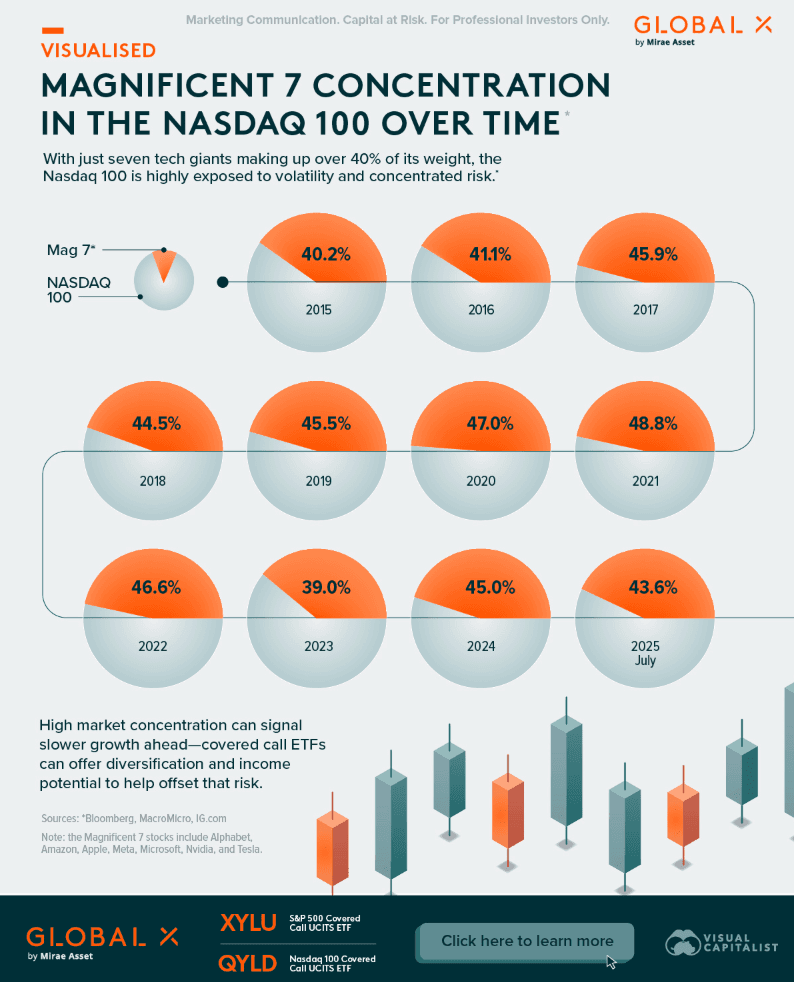
Posted by Phoebe BainSep 9, 2025The Nasdaq's 'Magnificent 7' have an outsized impact on the Nasdaq 100's performanceThese seven companies are Alphabet, Amazon, Apple, Meta, Microsoft, Nvidia, and Tesla. They're often responsible for over 40% of the Nasdaq 100 index's gains, but the exact percentage varies from year to year.Show 3 more findings ZoomVisualised: Magnificent 7 Concentration in the Nasdaq 100 Over TimeVisual Capitalisthttps://www.visualcapitalist.com/sp/visualised-magnificent-7-concentration-in-the-nasdaq-100-over-time-gxeu01/
Posted by Teddy BurkhardtApr 3A stock index is a group of companies clustered together, often providing a condensed snapshot of a market segment.Show 3 more findings 7:47What Are Stock Market Indicies? (S&P 500, Dow Jones, & NASDAQ Explained)Whyzehttps://www.youtube.com/watch?v=y-RGEos-lus
Posted by Phoebe BainMay 4When the New York Stock Exchange was started in 1792, traders would meet both outside on the street and in coffee shops to do business.Show 3 more findingsThe History of NYSENYSEhttps://www.nyse.com/history-of-nyse
Posted by Phoebe BainMar 26See a real-time list of the most shorted stocks in the USEvery two weeks, the Nasdaq and New York Stock Exchange release the stocks with the most short positions. Some of the companies with the highest short positions as of early 2026 were Hims & Hers and Groupon.Yahoo Financehttps://finance.yahoo.com/research-hub/screener/most_shorted_stocks/
Posted by Phoebe BainAug 14, 2024Why does the stock market matter?Open any newspaper, turn on your local TV news station, or listen to a daily business radio segment, and you’re bound to hear about how the stock market is performing. Netflix created a 17-minute (free) explainer that dives deep into the nitty-gritty of how we got here. 17:34Explained | The Stock Market | FULL EPISODE | Netflixhttps://youtu.be/ZCFkWDdmXG8?feature=shared
Posted by Teddy BurkhardtJun 24, 2024The origin and history of stock exchangesWhen were stocks first sold? Though debt was first sold in Venice in the 14th century, stocks proper began in the Netherlands. To fund its spice trade across the world in 1602, the Dutch East India Company sold stocks to individual investors, a novel approach to raising funds. It was the Dutch West India Company that founded New York—the site of some of the world’s greatest stock exchanges. Listen to a concise historical overview here. ZoomThe History of Stocks and Stock Exchangeshttps://everything-everywhere.com/the-history-of-stocks-and-stock-exchanges/
Posted by Phoebe BainApr 3Investors rely on the S&P 500 as a benchmark for the state of the economySince the index represents a broad range of diverse industries, it's become a proxy for the market itself and a common benchmark for investors to compare returns and performance patterns against. Generally speaking, when someone says a stock is under- or out-performing the market, that actually means under- or out-performing the S&P 500. The S&P 500 is exchange-agnostic, and includes companies listed on both the NYSE and Nasdaq.Investopediahttps://www.investopedia.com/ask/answers/041315/what-are-pros-and-cons-using-sp-500-benchmark.asp
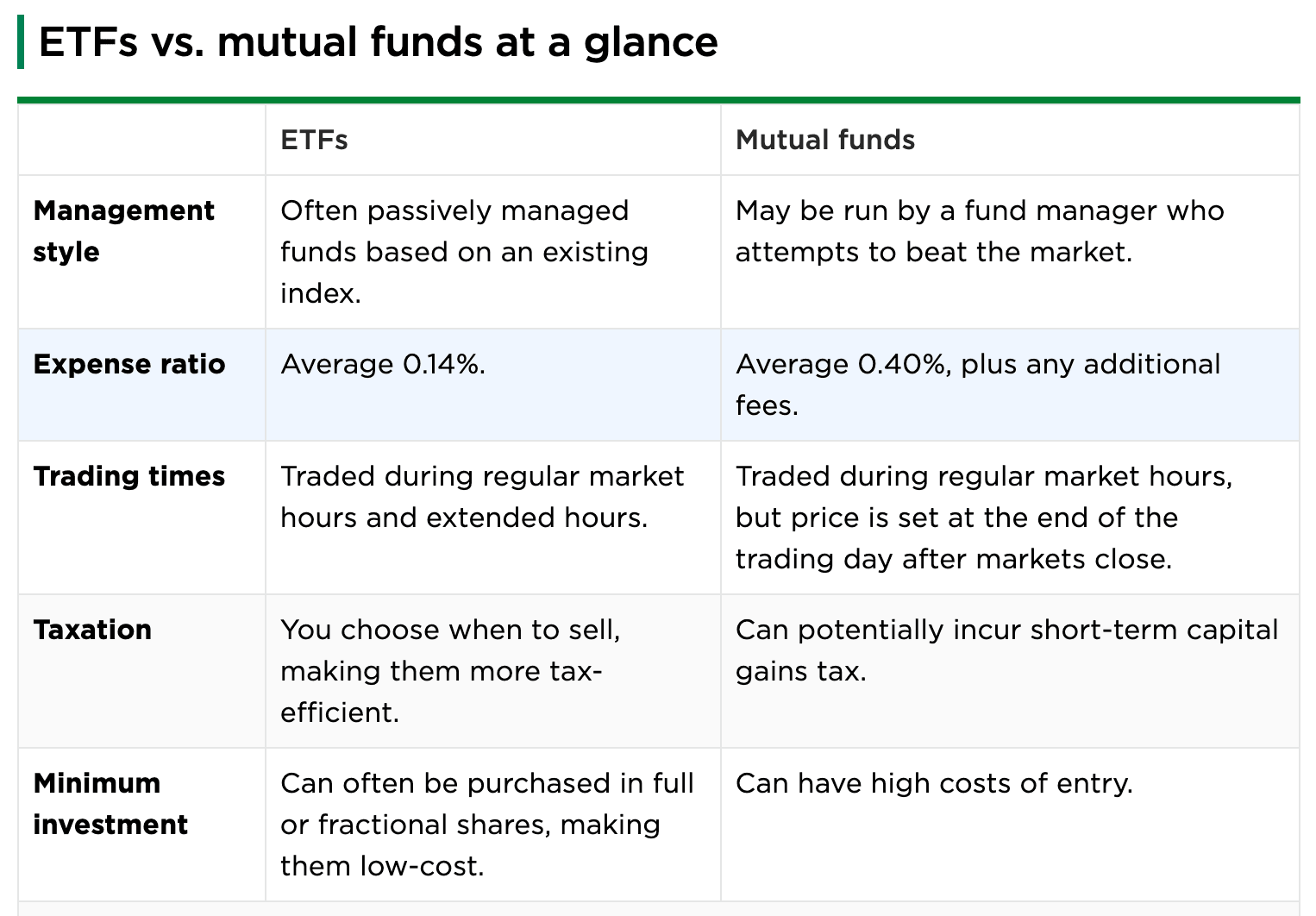
Posted by Phoebe BainAug 27ETFs and mutual funds both pool money into a basket of investments—but the key difference between them is that mutual funds trade just once per day after the market closes, while ETFs trade like stocks throughout the day at fluctuating prices.Show 4 more findings ZoomETF Vs. Mutual Fund: Which Is Right For You? | BankrateNerdWallethttps://www.nerdwallet.com/investing/learn/etfs-vs-mutual-funds
Posted by Phoebe BainApr 3The Dow Jones Industrial Average vs. the S&P 500: Which one is a better representation of the economy?The Dow and S&P 500 are both indexes meant to provide a broad representation of the economy. The Dow has 30 companies and is weighted by share price, while the S&P 500 has 500 different companies weighted by market capitalization. Since the indexes are so different, investors don't always agree on which index is a better representation of the economy—though the two move in the same direction more than 90% of the time.https://www.thestreet.com/investing/dow-jones-vs-sp-500-which-index-actually-represents-the-market
Posted by Phoebe BainAug 13, 2024See the world’s largest stock markets in 1900 versus 2023The US is now home to the world's largest stock market, but that wasn't always the case. This data visualization shows where the largest stock markets in the world were in 1900, then compares that map to the current geographical distribution of stock markets today, based on each country’s percentage share of global market capitalization. See what it looks like by clicking here. ZoomMapsMapped: The World’s Largest Stock Markets (1900 vs. 2023)Visual Capitalisthttps://www.visualcapitalist.com/mapped-the-worlds-largest-stock-markets-1900-vs-2023/
Posted by Teddy BurkhardtFeb 27The dot-com bubble burst in 2000 when the Nasdaq dropped more than 76% in roughly 2 yearsBetween 1995 and 2000, the Nasdaq Composite index jumped from roughly 1,000 to 5,000 amid excitement over new internet companies. As venture capitalists dumped money into startups, those same companies struggled to turn a profit, leading to a bubble. The Nasdaq wouldn't reach its former high until 2015.Understanding the Dotcom Bubble: Causes, Impact, and LessonsInvestopediahttps://www.investopedia.com/terms/d/dotcom-bubble.asp
Posted by August MoonJun 11The number of publicly traded companies has decreased in recent years.In 1996, more than 7,300 companies traded publicly on US stock markets, but that number has recently dropped to 4,300. Economists point to two reasons: First, going public requires full disclosure of operations, exposing it to scrutiny from investors, competitors, and analysts. Second, the IPO process is expensive and time-consuming. 1:09Why Has the Number of Publicly Traded Companies Shrunk?1440 Originalshttps://youtube.com/shorts/nCm_NbjBYtA
Posted by Phoebe BainFeb 27More than 650 companies went public in the US in 1996As the dot-com bubble reached its peak, most dot-com companies went public with little proof of being profitable and were often overvalued. In 1999, the Nasdaq's price-to-earnings ratio (a tool used to determine a stock's value that divides its price by earnings) hit 90.2, signaling that many companies were operating at a net loss. Startups promised investors that more time and money would help scale their businesses and become profitable.https://internationalbanker.com/history-of-financial-crises/the-dotcom-bubble-burst-2000/
Posted by Phoebe BainMay 4What's the difference between a stock and a share?While the words "stock" and "share" are often used interchangeably in casual conversation, they have different meanings. For instance, "stock" is more general, whereas "share" is more precise.Shares vs Stocks: What’s the Difference?https://www.sofi.com/learn/content/shares-vs-stocks/
Posted by Phoebe BainAug 20, 2024The difference between stocks and bondsWhile more people invest in stocks than bonds, experts say owning both can make for a healthier portfolio. Stocks are considered a riskier investment than bonds, but tend to have higher returns. While bonds might be the safer option, they won’t grow your wealth as quickly. ZoomThe Wall Street Journalhttps://www.wsj.com/buyside/personal-finance/investing/bonds-vs-stocks
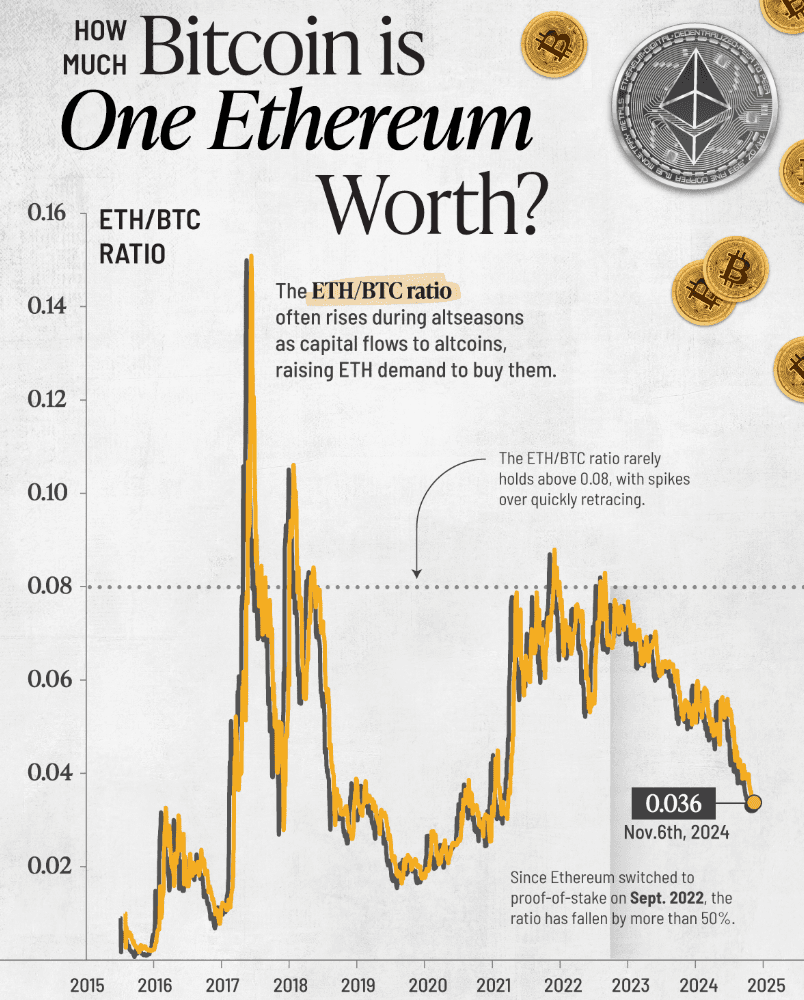
Posted by Meher QazilbashMar 10, 2025The similarities and differences between bitcoin and ethereumEthereum is the second-largest cryptocurrency by market cap behind Bitcoin. Usually, that comparison just scratches the surface of the overall market cap. Instead, a visual pits the tokens up against each other on a per-token basis and shows how and why the Ethereum/bitcoin ratio has fluctuated over time. ZoomVisual Capitalisthttps://www.visualcapitalist.com/ethereum-to-bitcoin-ratio-over-time/
Posted by Meher QazilbashMar 28, 2025Retail investors are average joes, while institutional investors often move billions of dollars a dayRetail investors often trade 100 shares at a time, while institutional investors trade 10,000 or more. The biggest difference is that, unlike retail investors, institutional investors are professionals who are trading someone else’s money. ZoomInstitutional Investors vs. Retail Investors: What’s the Difference?Investopediahttps://www.investopedia.com/ask/answers/06/institutionalinvestor.asp
Posted by Meher QazilbashAug 4, 2025See the top 100 ETFs by trading volumeThis list grabs the top 100 by trading volume, or the average number of shares that have traded hands over a 3-month period. Top of the list is a semiconductor-focused fund from Direxion, followed by other tech-centric offerings. ZoomMost Popular ETFs: Top 100 ETFs By Trading Volumehttps://etfdb.com/compare/volume/
Posted by Phoebe BainAug 14, 2024A stock market timelineThe stock market has come a long way since the 1600s, when the first version of a stock exchange was created in Amsterdam. Mile markers along the way include everything from the Dow Jones Industrial Average's creation in 1896 to the stock market woes during the COVID-19 pandemic in 2020. ZoomA Brief History of the Stock Markethttps://www.sofi.com/learn/content/history-of-the-stock-market/
Posted by Phoebe BainJul 7Millions of Americans will be invested in SpaceX because of the fast-tracked process to list SpaceX on the Nasdaq 100, and, subsequently, the index funds that track it.Show 4 more findings 9:29Why the SpaceX IPO Is Unlike Any OtherBloomberghttps://www.youtube.com/watch?v=F5OFTtX0x04
Posted by Phoebe BainApr 28As technology evolved, so did Wall StreetBefore the telephone was invented in the mid 1800s, people had to trade stocks in person. But once office telephones and computers became commonplace, banks and other financial institutions didn't necessarily need to have their headquarters near exchanges like Wall Street's New York Stock Exchange. ZoomWhy The Finance Industry Is Leaving Wall Streethttps://www.thecity.nyc/2022/10/25/finance-employers-leave-wall-street-tax-breaks-lower-costs-dallas-elsewhere-securities-industry/
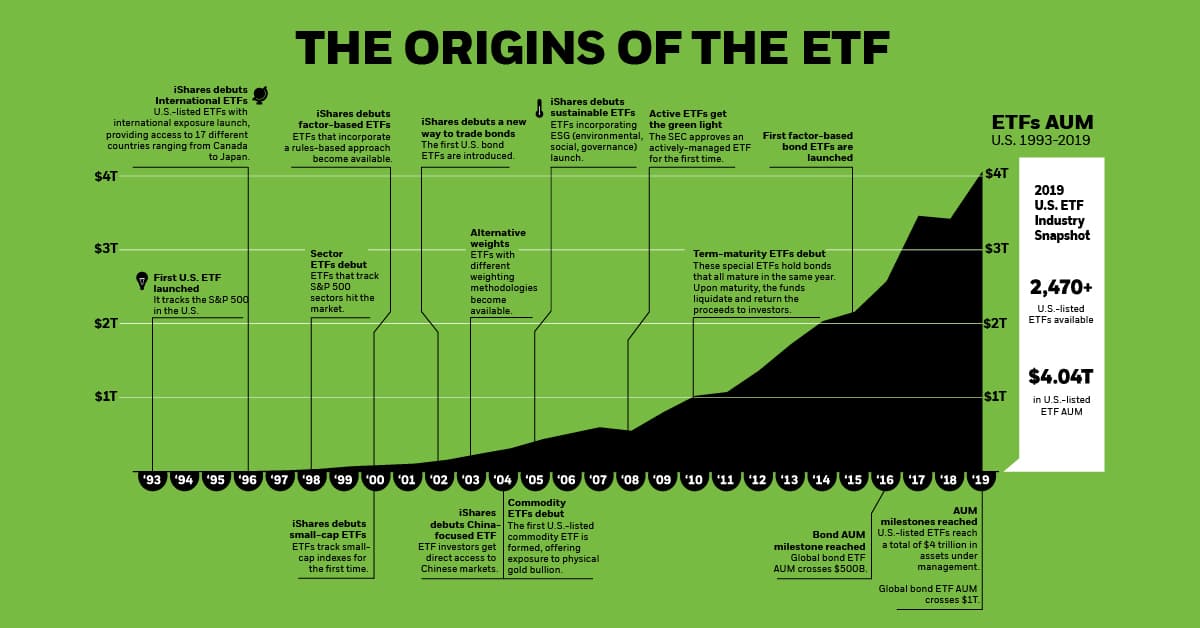
Posted by Meher QazilbashJan 21, 2020ETFs were first created as an alternative to mutual funds, combining the diversification benefits of a mutual fund with the ability to trade throughout the day on a stock exchange. Show 4 more findings ZoomThe 26-Year History of ETFs, in One InfographicVisual Capitalisthttps://www.visualcapitalist.com/sp/the-26-year-history-of-etfs-in-one-infographic/
Posted by Phoebe BainAug 27Open-end and closed-end mutual funds differ in how they create and distribute shares.Show 3 more findings 11:53Open-End and Closed-End Mutual FundsKhan Academyhttps://www.youtube.com/watch?v=_ZJary7yZyU
Posted by Teddy BurkhardtOct 16, 2025The S&P 500, managed by the same company, is another major stock indexAlso run by S&P Dow Jones Indices, the S&P 500 tracks 500 large US firms using market-value weighting. Many analysts view it as a more accurate gauge of the American economy.Icons: The S&P 500® and The Dow® | S&P Dow Jones Indiceshttps://www.spglobal.com/spdji/en/research-insights/index-literacy/the-sp-500-and-the-dow/