Good morning. It's Thursday, July 9, and welcome to this week's Business & Finance newsletter. First time reading? Sign up here or forward to share with friends.
This week, post-Fourth of July celebrations, we're exploring US Currency. We're also exploring CEO pay, Trump accounts, and more.
PS—Reader feedback is a gift! Whether it's feedback on our new email format, suggestions for us to cover, or anything else, we're happy to hear from readers. Simply reply to this email or reach out at [email protected].
—Phoebe Bain, 1440 Business & Finance Section Editor
Editor's Note: Last week, we mistakenly wrote that inflation rose more than 4% in May rather than writing that inflation rose to an annual rate of more than 4% in May. Thank you to the reader who wrote in pointing this out! |
|
|
|
The US dollar is the official currency of the US. It’s not only the most widely circulated currency in the world but also considered one of the most stable. Also referred to as the Federal Reserve note and abbreviated as USD, it can be issued as paper money or coins. There were almost 55 billion banknotes (another term for bills, often called “notes”) totaling about $2.3T in circulation by the end of 2023.
> How the US dollar became the world's primary reserve currency. (More)
> See how much US currency is circulated around the world each year. (More)
The US used to print higher denominations than the seven types of bills in print today—$1, $2, $5, $10, $20, $50, and $100—but the Bureau of Engraving and Printing stopped printing bills over $100 in 1969 (like the $5K and $10K bills) due to lack of use. Paper money is made up of 75% cotton and 25% linen.
> The US once had a $100K bill, created for transactions between Federal Reserve banks. (More)
> Contrary to popular belief, the $2 bill is still in circulation today. (More)
> Inside the "Where's George?" project that tracked a trail of $1 bills across the country. (More)
There are four coin denominations currently in circulation. Pennies are mainly composed of zinc. Nickels, dimes, and quarters are all partly made of nickel.
> Some coin denominations have ridges on their sides in part to prevent counterfeiting. (More)
> Why more than $60M in coins ends up in America's landfills each year. (More)
Discover more:
> The $1 bill hasn't been redesigned in more than 60 years. (More)
> What gives a dollar bill its value? (More)
> A live bald eagle named Peter once lived at the Philadelphia Mint. (More) |
|
|
|
|
🫶 Humankind: Warren Buffett is among the world's most generous philanthropists, having given away more than $68B in his lifetime. |
|
|
|
|
In partnership with Alumni Ventures |
|
Invest Alongside Firms Like a16z & Bessemer |
|
Please support our sponsors! |
|
|
|
|
1440 brings you the knowledge and context behind the week's stories:
The "21st Century Housing Act" that recently moved through Congress is meant to address the nation's housing shortage—but no one seems to know how many homes the bill would actually create. (More, free w/email)
> Construction of small, affordable starter homes has decreased 75% since the 1970s.
> See how much it costs to build a new home in each US state.
Chanel announced its acquisition of Charvet, the world's oldest shirtmaker, last week as the fashion house continues its expansion into menswear. (More)
> The most expensive ad of all time was for Chanel No. 5 perfume.
> What the phrase "shirtsleeves to shirtsleeves in three generations" actually means.
As new caps on graduate school loans take effect, economists are considering how much the changes will actually affect tuition prices. (More)
> Graduate school borrowers account for half of all outstanding student debt.
> See the most common master's degrees in 43 different countries.
A growing number of companies are matching contributions to "Trump accounts," the tax-advantaged investment savings accounts for eligible US children that rolled out July 4. (More)
> Billionaire investor Ray Dalio has donated to support Trump accounts.
> Connecticut recently became the first state to launch a baby bond program. |
|
|
|
|
One Story We're Taking Stock In |
|
Unlike the controversial idea of universal basic income, a new economic concept is quickly gaining bipartisan support: universal basic capital. Under a UBC system, every American would have a small ownership stake in top US companies—such as the AI firms whose combined stock gains have created trillions of dollars in shareholder value over the past few years. Rather than receiving a monthly check, Americans would each be given an account containing a chunk of equity invested in a broad portfolio.
The idea of universal basic capital has been endorsed by leaders with a wide swath of political ideologies, from Bernie Sanders to Donald Trump to Sam Altman. The article below—one of the most fascinating pieces we read this week—explains how the system would work and why it's so much less divisive than many modern forms of economic policy. |
|
> Why everyone is suddenly talking about "universal basic capital." (Read) |
|
|
|
|
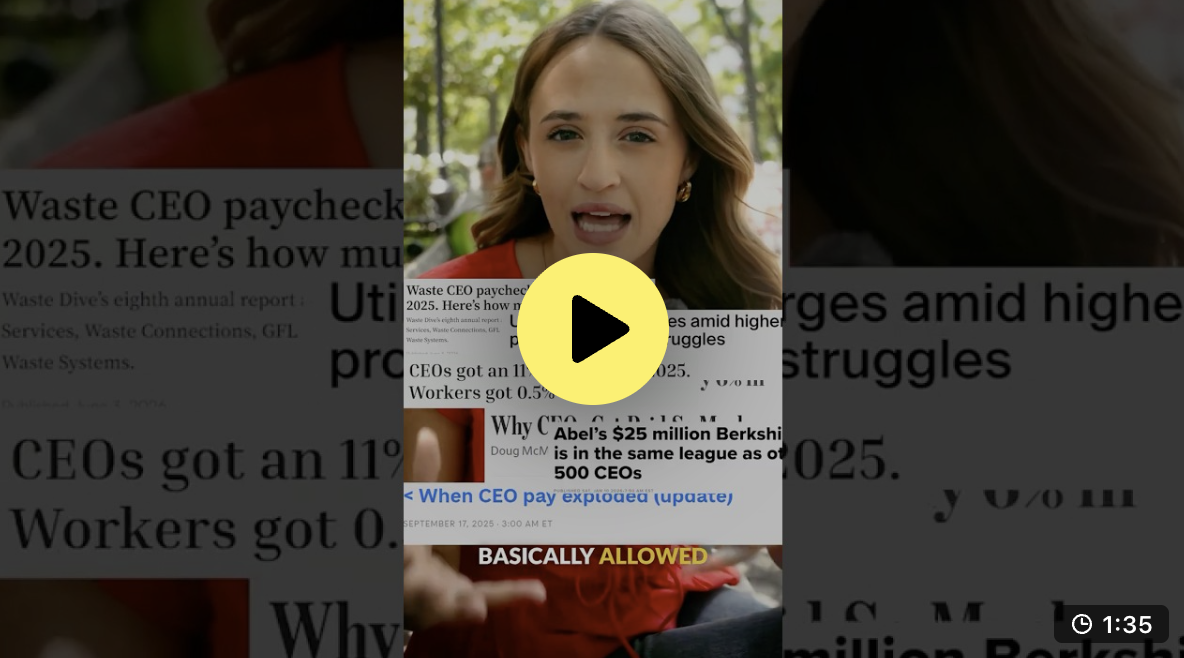
The median household income in the US is just over $83K per year, but CEOs tend to make about 281 times the typical worker's annual compensation. As it turns out, one law that tried to close the growing gap between CEO and worker pay in the early 1990s instead created a trillion-dollar loophole that led to today's chasm.
1440 dug into how one tax loophole changed executive compensation as we know it: |
|
|
|
In partnership with Alumni Ventures |
|
Co-Invest With Top VC Firms Like A16z |
|
Please support our sponsors! |
|
|
|
|
*Please support our sponsors. |
|
|
|
|
"Nothing will work unless you do." |
|
|
Behind the Name. Why 1440? The printing press was invented around the year 1440, spreading knowledge to the masses and changing the course of history. More facts: In every day, there are 1,440 minutes. We’re here to make each one count.
Want to connect with 4.7 million insatiably curious minds? Become a 1440 partner here. |
|
*Disclosure: Co-investors are shown for illustrative purposes only and do not represent all co-investors with which AV has invested. There can be no guarantee of who may be co-investors in the future. The identity of any co-investor is not a guarantee of investment quality or performance. Venture capital investing involves substantial risk, including the risk of loss of all capital invested. Past performance does not guarantee future results. |
|
1440 Media 222 W Merchandise Mart Plaza, Suite 1212 Chicago, IL 60654
Copyright © 2026, 1440 Media, All rights reserved. |
|
|
|
|
|
|
|