Posted by Dina Fine MaronFeb 17Most people with East Asian ancestry are genetically predisposed to be less smelly.Show 2 more findings 26:29Why do armpits smell? - CrowdScience podcast, BBC World ServiceBBC World Servicehttps://www.youtube.com/watch?v=lsr1TvXltwo
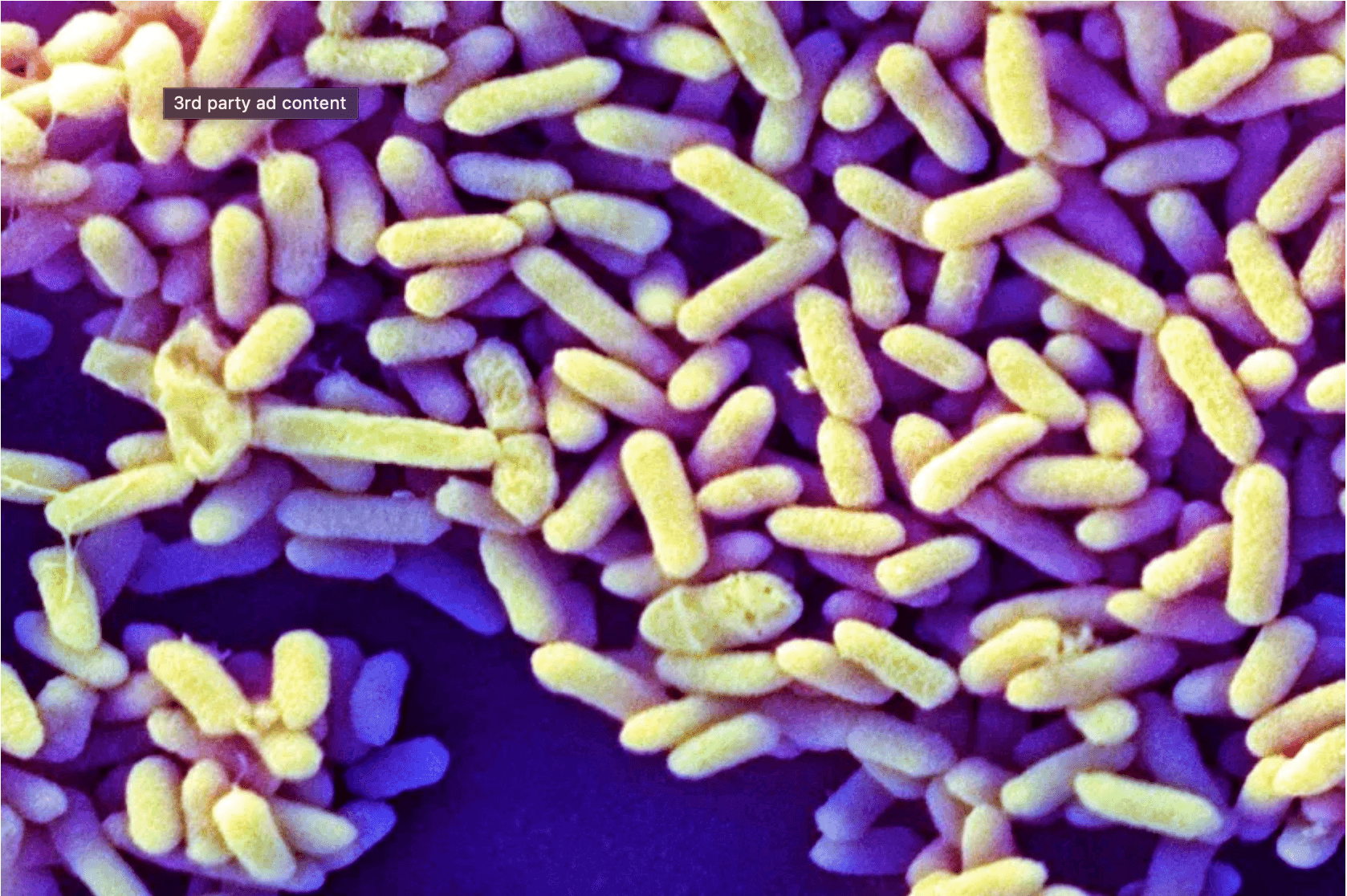
Posted by Dina Fine MaronFeb 17Corynebacterium species are particularly responsible for our funky smellMyriad bacteria contribute to our body odor, but research suggests that Corynebacterium species are strongly associated with the bad smells emanating from adults. Staphylococcus and Cutibacterium genera may also play leading roles.National Library of Medicinehttps://pmc.ncbi.nlm.nih.gov/articles/PMC6267001/
Posted by Dina Fine MaronFeb 17Sweat doesn't smell, but bacteria multiply in moist environments—and cause an odorBody odor is associated with sweat, but odor actually arises from the bacteria that multiply in moist environments on your skin. Hormones, medications, food, and body hair can all affect body odor.Cleveland Clinichttps://my.clevelandclinic.org/health/symptoms/17865-body-odor
Posted by Dina Fine MaronFeb 17Carboxylic acids are one reason teens are smellyScientists compared the smells of babies and teenagers and identified some of the compounds that make teens smelly. Carboxylic acids present in teens, they wrote, seemed to give off an "earthy, musty, or cheesy" scent. This 2024 research could help inform future odor-control products.Phys.orghttps://phys.org/news/2024-03-dissimilar-babies-teenagers.html
Posted by Dina Fine MaronFeb 17Hereditary hyperosmia is the official term for being a super-smellerSome sniffers with this rare trait may be more sensitive to pleasant smells, while others may be more attuned to unpleasant scents. Some research suggests that certain genetic mutations are associated with a heightened sense of smell.The Conversationhttps://theconversation.com/four-reasons-why-some-people-become-super-smellers-from-pregnancy-to-genetic-differences-141404
Posted by Dina Fine MaronApr 28Learn how your earwax may be determined by genetics—and geographyResearchers have discovered that wet and dry earwax are associated with specific gene variations. Wet earwax is particularly associated with warmer areas of Europe, Asia, and the Americas, suggesting that dry earwax may have been evolutionarily advantageous in cooler climates.University of Delawarehttps://udel.edu/~mcdonald/mythearwax.html
Posted by Dina Fine MaronFeb 17'Old people' smell is real—it's a chemical buildup when fatty acids on the skin oxidizeThe chemical composition of body odor seems to change with age. Later in life, we harbor higher concentrations of a chemical compound called 2-nonenal that forms when omega-7 fatty acids on the skin oxidize, and the skin's natural antioxidant defenses weaken. Commonly called "nonenal", it's the smell widely associated with aging, and it's often described as a grassy or greasy odor.https://assistinghands.com/112/florida/thevillages/blog/how-to-prevent-body-odor-in-seniors
Posted by Dina Fine MaronFeb 17Americans only became intolerant of body odor in the last centuryDaily bathing only became a societal norm in the last century. Today, Americans routinely bathe and buy more deodorant than any other country, spending roughly $6 billion annually on odor-reducing products. The rise of industrialized soaps, deodorants, and antiperspirants—and extensive marketing around them—stimulated this demand.https://www.saturdayeveningpost.com/2023/07/no-offense-how-americans-became-intolerant-of-body-odor/
Posted by Dina Fine MaronFeb 17Read a study documenting how 'old people' smell increases with ageAnalysis of body odors from individuals aged 26 to 75 confirmed that 2-nonenal, an unsaturated aldehyde with an unpleasant, greasy, and grassy odor, was detected only in subjects aged 40 and older.https://www.sciencedirect.com/science/article/pii/S0022202X15411984
Posted by Dina Fine MaronFeb 17A 2025 study explored the common words to describe body odor across 17 countriesThe work identified the 25 most frequent words used to describe body odors across languages, ranked by frequency, and found that "sweaty" topped the list, followed by "sour" and "stinky."Naturehttps://www.nature.com/articles/s41597-025-04630-8
Posted by Dina Fine MaronFeb 17Americans spent $6.6 billion on body odor products in 2023This high figure from Euromonitor, a research firm, suggests Americans spent more on deodorant than in any other country. Beyond deodorant, there's also growing interest in "whole body" deodorant designed to mask smells from various parts of the body beyond the armpit.Forbeshttps://www.forbes.com/sites/joshuacohen/2024/06/04/suddenly-whole-body-deodorants-are-trending-in-the-us/
Posted by Dina Fine MaronFeb 17On average, people smell worse if they're sickFor a small 2014 research study, a panel was tasked with sniffing the smelly t-shirts of people who had been injected with a compound known to activate the immune system and those of controls without the shot. It found that those who were acting as if unwell (due to the injection) generally smelled worse. Subsequent work found that those who sniffed unpleasant odors had a mild immune response of their own—perhaps to protect them from disease. (Some users may experience a paywall.)CNNhttps://www.cnn.com/2016/01/20/health/the-smell-of-disease
Posted by Dina Fine MaronMar 24Roughly 15 of every 1,000 people in the US have smell disordersAnosmia is a lack of a sense of smell. It can be present at birth, related to diseases including Parkinson's, Alzheimer's, and COVID-19, or have unknown causes.https://jamanetwork.com/journals/jama/fullarticle/2767634
Posted by Dina Fine MaronFeb 17'Sweat dating' is a dating approach in which partners select each other based on body odor.Show 2 more findingsSpecial Episode: Sarah Everts & The Joy of SweatThis Podcast Will Kill Youhttps://open.spotify.com/episode/1najUM8JmUudmI8YkC7vkR
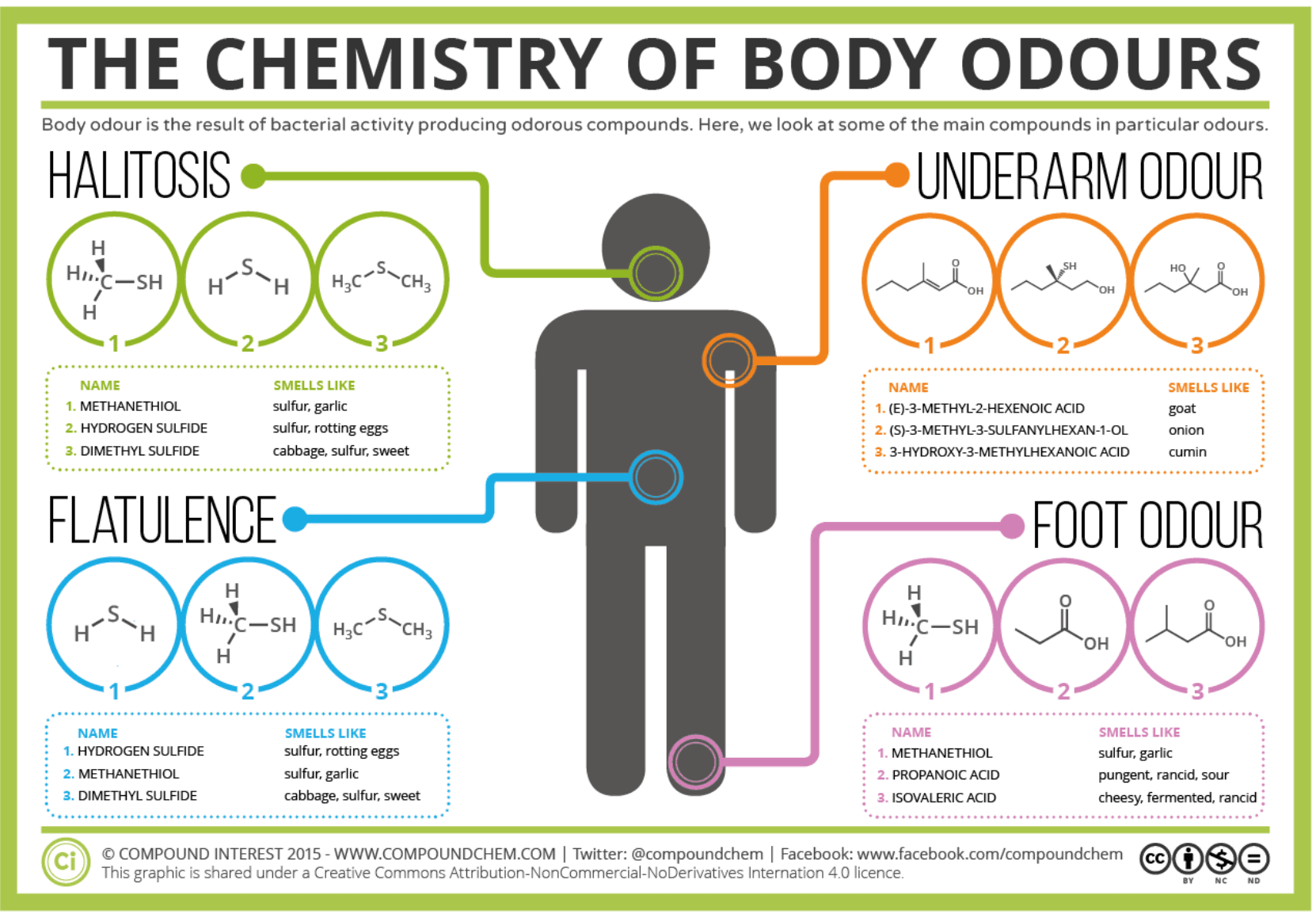
Posted by Dina Fine MaronFeb 17Explore the chemistry of undesired body odorsThis graphic highlights some of the main compounds in different body odors, including halitosis (bad breath), flatulence, and foot odor. Zoomhttps://www.compoundchem.com/2014/04/07/the-chemistry-of-body-odours-sweat-halitosis-flatulence-cheesy-feet/
Posted by Marco Daniel MachadoJul 16A dog's nose can be up to 100,000 times more sensitive than a human's, and each possesses a secondary organ for smelling, which helps learn about other dogs when they sniff each other's butts.Show 3 more findings 2:28But Why Do Dogs Smell Each Other's Butts?Reactionshttps://www.youtube.com/watch?v=PZlJ8XfwiNg
Posted by Dina Fine MaronMay 15Even if you have some ASD-linked gene variations you may not develop ASDIndividual environment and life experiences affect how genes perform in the body, potentially adding methyl groups to DNA that affect their function and turning genes on and off—which may heighten or reduce disease risk. ZoomThe Transmitterhttps://www.thetransmitter.org/spectrum/dna-methylation-in-autism-explained/
Posted by Dina Fine MaronMar 241 in 15 adults over age 40 experience phantom odorsThis phenomenon was measured in a 2018 study that examined the prevalence and risk factors for phantom odor perception. Older adults were less likely to experience these phantom odors as they age, just as their overall sense of smell declines. Women are more likely than men to perceive phantom odors.National Institute on Deafness and Other Communication Disordershttps://www.nidcd.nih.gov/news/2018/1-american-in-15-smells-odors-that-are-not-there
Posted by Dina Fine MaronJan 12Amish kids have far fewer allergies than the general populationOnly about 7% of Amish children in a northern Indiana community have tested positive for common allergens in routine skin prick tests, whereas half of the general US population tests positive for them. Asthma is also extremely uncommon among the Amish, even when compared with other farming communities. Researchers are interested in exploring if approaches like exposing kids across the general population to Amish farm dust might stave off some allergies. 1:20The Washington Posthttps://www.youtube.com/watch?v=sAGRa8nlKqU
Posted by Dina Fine MaronMar 16Multiple genes are associated with Alzheimer's risk, but one particularly well-known disease-associated gene is apolipoprotein E (APOE), which typically encodes a protein that helps carry cholesterol and other fats in the bloodstream. Show 1 more findingHow One Gene Affects Alzheimer’s RiskScience Fridayhttps://www.sciencefriday.com/segments/alzheimers-gene/?utm_source=join1440&utm_medium=email&utm_placement=newsletter&user_id=66c4bde45d78644b3a9e49ec
Posted by Dina Fine MaronJan 12Embracing poor hygiene in early life won't stave off allergiesThe hygiene hypothesis, first proposed in 1989 by British immunologist David Strachan, suggests that early life exposure to microbes—like those from farm dust or pets—properly trains our immune systems to respond to threats. But sometimes the idea is misinterpreted: It doesn’t mean that poor hygiene—like failing to wash hands–will help ward off allergies; that type of behavior leads to infections and won’t help with allergy prevention.National Institutes of Healthhttps://pmc.ncbi.nlm.nih.gov/articles/PMC8007786/
Posted by Dina Fine MaronMay 20Genetics may account for nearly 67% of mosquito attractiveness.Show 2 more findings ZoomGenes Make Some People More Attractive to MosquitoesSmithsonian Magazinehttps://www.smithsonianmag.com/science-nature/genes-make-some-people-more-attractive-mosquitoes-180955075/
Posted by Meher QazilbashApr 29, 2025Why there’s barely any cheese in traditional East Asian foodEast Asian cuisine has historically been cheese-free, but why? Several unique circumstances combined to limit—or eliminate—the dairy product in dishes from Japan, Korea, China, and other nearby countries: Livestock were seen as working animals rather than nutritional sources, and most people were lactose intolerant. As Western cuisine becomes more popular globally, though, cheese is making its way into more East Asian diets. ZoomWhy There's No Cheese in Chinese Food and Other East Asian Cuisine - ThrillistThrillisthttps://www.thrillist.com/eat/nation/no-cheese-chinese-food-east-asian-japanese-korean
Posted by Marco Daniel MachadoMay 30, 2025Alkaptonuria was the first identified genetic disorderIn 1902, a rare recessive mutation was determined to cause alkaptonuria—a disease that induces dark pigmentation of connective tissue. The responsible gene was not isolated until the 1990s.1902: Orderly Inheritance of Disease ObservedNational Institutes of Healthhttps://www.genome.gov/25520240/online-education-kit-1902-orderly-inheritance-of-disease-observed
Posted by Teddy BurkhardtAug 26, 2022Your DNA may determine whether you like coffee or teaWhether people prefer coffee or tea may boil down to a matter of taste genetics. People with a version of a gene that increases sensitivity to the bitter flavor of caffeine tend to be coffee drinkers, according to a report. Read on for more. ZoomCoffee or tea? Your preference may be written in your DNAScience Newshttps://www.sciencenews.org/article/coffee-tea-preference-dna-chemical-sensitivity-taste
Posted by Dina Fine MaronFeb 17Typhoid smells like freshly baked brown breadCertain ailments are associated with documented scents, including diabetes, Parkinson's disease, and typhoid. The skin of people with yellow fever, for example, can smell like a "butcher shop." 2:05https://www.youtube.com/watch?v=_HWTyd2S_-M
Posted by Teddy BurkhardtFeb 19Western babies often lack a gut microbe common elsewhere.Show 2 more findings ZoomHow baby microbiomes in the West differ from those everywhere elseNew Scientisthttps://www.newscientist.com/article/2516131-how-baby-microbiomes-in-the-west-differ-from-those-everywhere-else/
Posted by August MoonFeb 18, 2025Why some people have allergiesWhy do some people have allergies while others don’t? One theory suggests allergies are a relic of our evolutionary past. Our immune system, once primed to fight parasites, now mistakes harmless substances for threats. 1:25Why Some People Have Allergies1440 Originalshttps://www.youtube.com/shorts/tP-n9-dg8GM
Posted by Marco Daniel MachadoJan 27Ancestry testing matches DNA to known genetic variants found in specific ancestriesAfter a lab receives a person's sample, the DNA is separated into single strands, which are chemically cut into smaller fragments. The fragments are then fed into an array of variants of known origins, and technicians observe if a person's fragments bind to specific variants.NISThttps://www.nist.gov/how-do-you-measure-it/how-do-companies-measure-dna-discover-your-ancestry
Posted by Dina Fine MaronJan 9, 2024How bitter taste receptors help guard against infectionReceptors for "bitter" tastes evolved to detect potentially harmful plant chemicals, such as nicotine. The receptors also trigger bacteria-fighting responses, including waving hairlike projections to bat away bacteria, ordering the release of bacteria-killing nitric oxide, and calling for antimicrobial protein reinforcements. ZoomHow Bitter Taste Receptors Defend the Body against Bacteriahttps://academic.oup.com/emph/article/9/1/431/6395358
Posted by Dina Fine MaronJan 12Modern conveniences may be contributing to allergy increasesA combination of genetics and how the environment changes our genes are likely contributing to the rise in allergies. But daily conveniences, such as dishwashers and packaged baby food, also change the level of bacterial exposures in early life, with potential implications for allergy development, experts from Mount Sinai Health System state in this video discussion. 51:40https://www.youtube.com/watch?v=9OFjKY9RiMY
Posted by Dina Fine MaronJun 23Paul Broca, a French brain researcher in the 19th century, hypothesized that humans evolved to trade in our "bestial sense" of smell for higher brain capacity.Show 4 more findings ZoomWhen the ability to smell goes awayKnowable Magazinehttps://knowablemagazine.org/content/article/health-disease/2026/what-happens-brain-lose-sense-of-smell
Posted by Marco Daniel MachadoMay 30, 2025The lack of diversity in DNA databases limits their applicationsEuropean ancestry dominates genetic research, hindering the usage of genetic databases for precision medicine for other groups, including African Americans, who face higher health risks due to genetic variants. Many Indigenous communities have also resisted genetic research due to past exploitation. (Some readers may experience a paywall.)DNA databases are too white, so genetics doesn’t help everyone. How do we fix that?Science Newshttps://www.sciencenews.org/article/genetics-race-dna-databases-reference-genome-too-white
Posted by Marco Daniel MachadoJun 30Odor blockers use nonpolar oils to trap smelly polar moleculesIn the case of feces, gut bacteria produce compounds such as skatole and hydrogen sulfide, which the brain registers as unpleasant. Because oils do not dissolve in water, they can be used to create a layer on the surface that prevents smelly compounds underwater from escaping into the air.How does Poo-Pourri prevent unpleasant smells? • Chemistry For Your Lifehttps://open.spotify.com/episode/1gJZ9V6E8tmLcPsPq4eiwQ
Posted by Dina Fine MaronFeb 17Fear has a specific 'smell'—at least to machinesThis excerpt from a Mythbusters episode takes on the smell-of-fear question, comparing the sweat composition of individuals exposed to snakes, rats, and scorpions with that of people exercising. Molecularly, the sweats are different to a gas chromatography machine, but to most noses would be indistinguishable. 9:03https://www.youtube.com/watch?v=V2beO53uu1A
Posted by Dina Fine MaronFeb 17Antiperspirants work better if they are applied at nightDermatologists recommend applying antiperspirant at night for the best results. When applied to clean, dry skin at night, the active ingredient in most antiperspirants (aluminum salt), combined with the skin's natural moisture, forms plugs that block sweat glands, limiting sweat and related odors. 2:06https://youtu.be/df42rAiquus?si=XQx93D1kK8xpf1tW
Posted by Dina Fine MaronMar 24Read the academic article explaining how ancient smells can be dissected and recreatedThis paper explores how biomolecular data on past scents can be teased out and then transformed into olfactory museum experiences, adding another component to our understanding of archaeology.https://www.frontiersin.org/journals/environmental-archaeology/articles/10.3389/fearc.2025.1736875/full
Posted by Dina Fine MaronMar 31Carrier screening enables individuals without symptoms to see if they carry a gene for diseaseSome conditions are autosomal recessive—meaning a person may carry a gene for that condition, but not have symptoms. Cystic fibrosis, sickle cell disease, and Tay-Sachs disease are examples of autosomal recessive diseases in which a person must inherit two copies of a nonfunctioning gene—one from each parent—to develop disease.Autosomal Recessive DisorderNational Institutes of Healthhttps://www.genome.gov/genetics-glossary/Autosomal-Recessive-Disorder#:~:text=Autosomal
Posted by Dina Fine MaronFeb 17A super-sniffer smelled her husband's Parkinson's disease years ahead of symptoms.Show 2 more findingsInvisibiliahttps://open.spotify.com/episode/0FKP6xr4mwZRCHtOApVA9U